
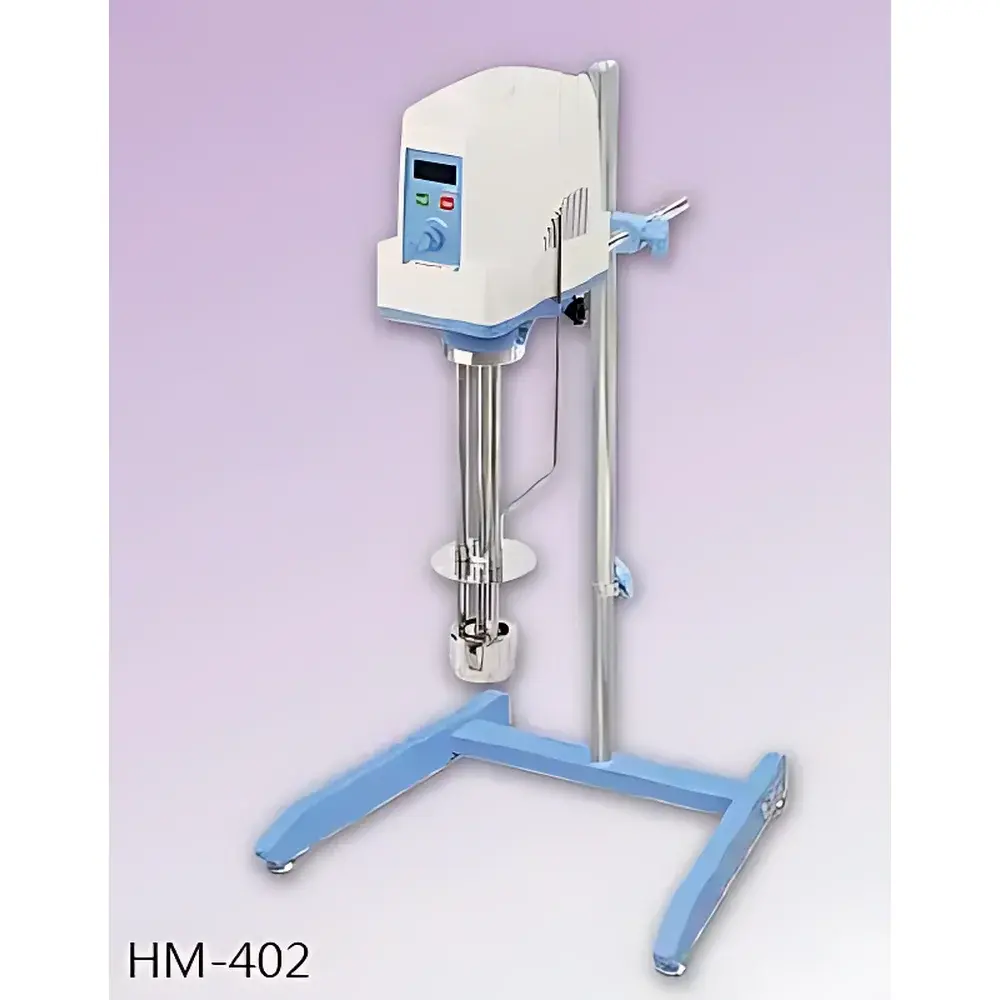
HsiangTai HM-402 Pneumatic-Lift High-Capacity Laboratory Homogenizer
| Brand | HsiangTai |
|---|---|
| Origin | Taiwan |
| Model | HM-402 |
| Instrument Type | Benchtop Homogenizer |
| Sample Processing Volume | 2 L |
| Output Power | 350 W DC Motor |
| Speed Range | 200–7,000 rpm |
| Max. Torque | 5.4 kgf·cm / 0.53 N·m |
| Dimensions (W × L × H) | 530 × 450 × 950 mm |
| Drive Type | Digital-Controlled Brushless DC Motor |
| Lift Mechanism | Pneumatic-Assisted Vertical Adjustment |
| Safety Features | Thermal Overload Protection, Integrated Fuse, Vibration-Damped Base |
Overview
The HsiangTai HM-402 is a benchtop high-torque laboratory homogenizer engineered for reproducible high-shear mixing, dispersion, and emulsification of viscous and heterogeneous samples in R&D and quality control laboratories. It operates on the principle of rotor-stator mechanical homogenization: a precision-machined rotating shaft (rotor) rotates at controlled speeds within a fixed concentric sleeve (stator), generating intense hydrodynamic shear, cavitation, and turbulent flow to reduce particle size, break aggregates, and achieve uniform phase distribution. Designed for continuous operation under load, the HM-402 delivers stable rotational performance across its full speed range (200–7,000 rpm), with real-time digital speed feedback and active torque compensation to maintain consistent shear energy input—even during viscosity transitions or sample thickening events. Its robust cast-aluminum frame, low-vibration motor mount, and balanced drive train ensure operational stability during extended processing cycles, minimizing mechanical drift and operator fatigue.
Key Features
- Digital speed display with ±10 rpm accuracy and stepless electronic speed control via rotary encoder
- High-efficiency 350 W brushless DC motor delivering up to 0.53 N·m maximum torque—optimized for high-viscosity formulations including polymer solutions, pigment pastes, and suspension concentrates
- Pneumatic-assisted vertical lift mechanism enabling rapid, tool-free height adjustment (±150 mm travel) with ergonomic one-hand operation and position-locking capability
- Integrated thermal overload protection and certified Class II fuse system compliant with IEC 61010-1 safety standards for laboratory electrical equipment
- Vibration-dampened base assembly with non-slip rubber feet; acoustic enclosure design reduces operational noise to ≤68 dB(A) at 1 m distance
- Stainless steel rotor-stator probe (standard 20 mm diameter, optional 10/30 mm variants) with precision-ground clearance (0.2–0.3 mm) for repeatable shear intensity
Sample Compatibility & Compliance
The HM-402 accommodates sample volumes from 50 mL to 2 L in standard cylindrical glass or stainless-steel vessels (diameter 60–120 mm). It is routinely employed for processing pharmaceutical suspensions (e.g., topical gels per USP ), cosmetic emulsions (oil-in-water, water-in-oil), pigment dispersions in architectural coatings (ASTM D1210 fineness-of-grind testing), textile auxiliaries, and reactive adhesive formulations. All wetted parts comply with FDA 21 CFR Part 177 requirements for indirect food contact, and surface finish meets ISO 13485-grade passivation specifications. The instrument supports GLP/GMP-aligned workflows through traceable speed logging and manual parameter recording—though it does not include built-in audit trail or 21 CFR Part 11 electronic signature functionality.
Software & Data Management
The HM-402 operates as a standalone analog-digital hybrid system with no embedded microprocessor or network interface. Speed setpoint and real-time RPM are displayed on a dual-digit LED panel; no data export, USB connectivity, or PC synchronization is provided. Users record operational parameters manually in lab notebooks or LIMS-integrated spreadsheets. For automated documentation, third-party external tachometers or torque sensors (e.g., OMEGA PX409 series) may be deployed in parallel with calibrated validation protocols. Firmware updates are not applicable; calibration verification is performed annually using NIST-traceable tachometric standards per ISO/IEC 17025 guidelines.
Applications
- Pharmaceutical: Homogenization of nanoemulsion preconcentrates, active ingredient dispersion in semi-solid dosage forms, and granule wet massing studies
- Coatings & Inks: Deagglomeration of TiO₂, carbon black, and iron oxide pigments in acrylic and epoxy resin matrices
- Personal Care: Stabilization of silicone-based emulsions, surfactant micelle formation, and fragrance oil dispersion in aqueous bases
- Chemical R&D: Catalyst slurry preparation, polymer latex blending, and surfactant-assisted nanomaterial exfoliation (e.g., graphene oxide in DMF)
- Academic Research: Shear-rate-dependent rheological preconditioning prior to capillary rheometry or small-angle X-ray scattering (SAXS) analysis
FAQ
What is the recommended maintenance schedule for the HM-402?
Routine inspection every 200 operating hours includes checking rotor-stator clearance, verifying pneumatic lift seal integrity, cleaning probe threads with isopropyl alcohol, and confirming fuse continuity. Annual recalibration of speed indication against a handheld optical tachometer is advised.
Can the HM-402 be used with corrosive solvents such as chlorinated hydrocarbons or strong acids?
Only with optional chemically resistant rotor-stator probes (Hastelloy C-276 or PTFE-coated stainless steel); standard 316SS probes are rated for pH 2–12 and non-oxidizing organics. Always consult the chemical compatibility chart before exposure.
Is the pneumatic lift system compatible with vacuum or pressure-rated vessels?
No—the lift mechanism is designed for ambient-pressure open or loosely capped containers only. Use with sealed reactors requires custom mounting brackets and external actuation interfaces.
Does the HM-402 meet CE or UL certification requirements?
Yes—it carries CE marking per Machinery Directive 2006/42/EC and EMC Directive 2014/30/EU, and complies with UL 61010-1 third edition for laboratory electrical safety.
What rotor-stator geometries are available for the HM-402?
Standard configuration includes a 20 mm conical rotor with fixed-gap stator; optional configurations include 10 mm fine-dispersion (for sub-5 µm particle targeting) and 30 mm heavy-duty (for >1.5 Pa·s viscosity processing). Probe interchangeability requires recalibration of torque compensation thresholds.



