
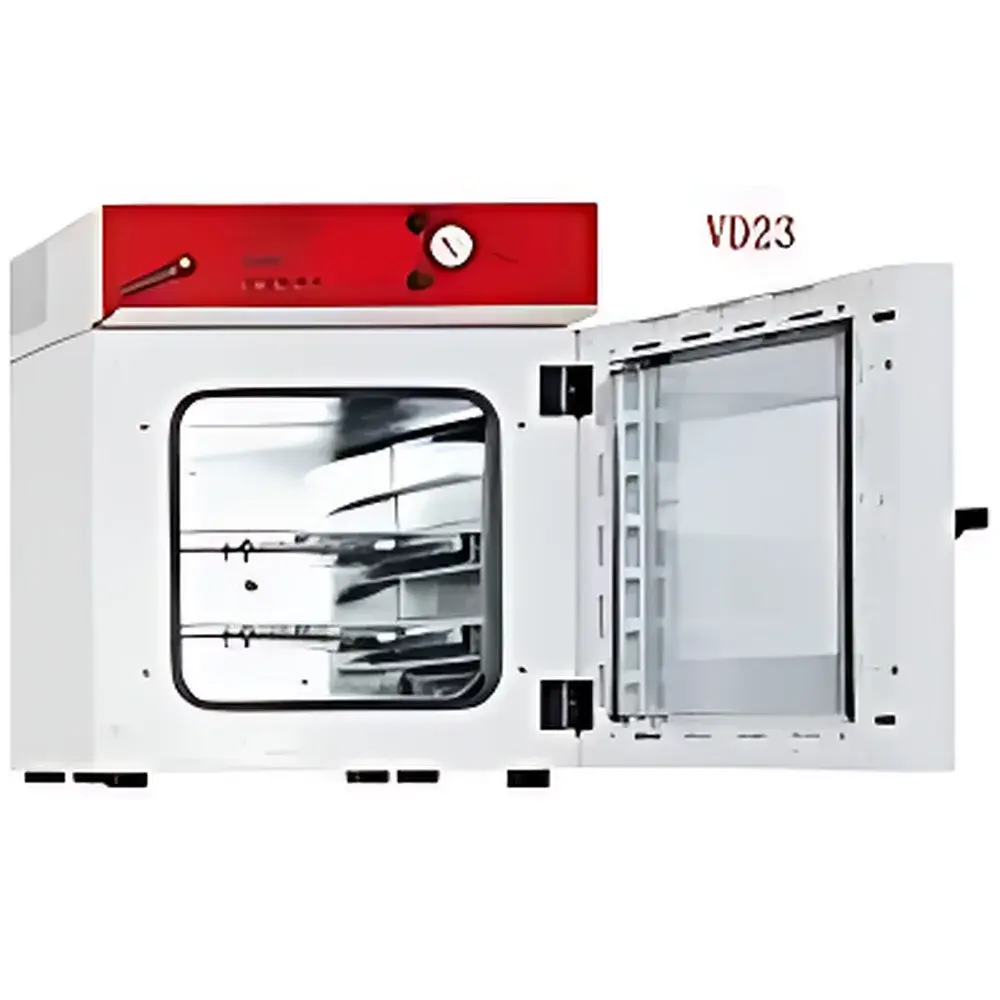
BINDER VD23 / VD53 / VD115 Vacuum Drying Oven
| Brand | BINDER |
|---|---|
| Origin | Germany |
| Model | VD23 / VD53 / VD115 |
| Temperature Range | Ambient +5 °C to 200 °C |
| Temperature Uniformity | ±0.4 °C |
| Interior Dimensions (W×H×D) | 285×285×285 mm (VD23) / 400×400×330 mm (VD53) / 506×506×450 mm (VD115) |
| Exterior Dimensions (W×H×D) | 515×655×500 mm (VD23) / 634×775×550 mm (VD53) / 740×900×670 mm (VD115) |
| Chamber Material | Electropolished Stainless Steel 1.4571 (AISI 316Ti) |
| Heating Method | Electric, APT.Line® Preheated Jacket |
| Vacuum Tightness | ≤0.01 mbar |
| Inert Gas Inlet | 3/8″ Fitting with Precision Flow Control Valve |
| Safety | Dual-Stage Independent Temperature Limit Controller (DIN 12880 Class 2), Explosion-Proof Tempered Glass Door, Silicone Gasket Sealing |
Overview
The BINDER VD23, VD53, and VD115 vacuum drying ovens are precision-engineered laboratory instruments designed for controlled, solvent-free drying, degassing, and moisture removal under reduced pressure. Operating on the fundamental principle of lowering the boiling point of volatile substances via vacuum application—combined with uniform conductive and convective heat transfer—the VD series enables reproducible thermal treatment of thermally sensitive, hygroscopic, or oxidation-prone samples. These ovens integrate BINDER’s proprietary APT.Line® technology: a preheated outer jacket surrounding the chamber ensures minimal thermal gradients across the entire interior volume, eliminating cold spots and condensation on chamber walls—a critical advantage when handling acidic, alkaline, or halogenated vapors. The electropolished stainless steel (1.4571 / AISI 316Ti) chamber resists corrosion from aggressive solvents and residual process gases, supporting long-term compliance with GLP and GMP environments.
Key Features
- APT.Line® preheated chamber jacket with extended shelf design—ensures temperature homogeneity ≤±0.4 °C and suppresses wall condensation during vacuum cycles
- Electropolished stainless steel (1.4571) interior and all wetted components—including valves, gas inlets, and welded pressure vessel elements—for maximum chemical resistance
- Dual-stage independent temperature safety system (DIN 12880 Class 2) with visual and audible alarm, providing fail-safe overtemperature protection
- Explosion-proof tempered safety glass door with high-integrity silicone gasket (heat-resistant to 300 °C), rated for continuous operation up to 200 °C
- Precision inert gas dosing system with calibrated flow control valve and 3/8″ inlet—enables purging with N₂, Ar, or other inert atmospheres under vacuum
- RS 422 interface compatible with APT-COM® software for remote monitoring, data logging, and audit-trail-compliant reporting (21 CFR Part 11 ready when paired with validated software configuration)
- MP programmable controller with flexible scheduling: two independent programs (10 segments each) or one extended program (20 segments), with segment duration adjustable up to 999:59 h
- Integrated differential pressure gauge showing real-time chamber-to-ambient pressure difference, plus rear-mounted 60 mm measurement port for external sensor integration
Sample Compatibility & Compliance
The VD series accommodates a broad spectrum of sample types including pharmaceutical active ingredients (APIs), polymer precursors, catalysts, battery electrode materials, ceramic green bodies, and biological matrices requiring low-residue dehydration. Its inert gas compatibility and corrosion-resistant construction meet requirements for ASTM D1654 (corrosion testing), ISO 11140 (sterilization validation support), and USP (container–closure integrity assessment). All models comply with IEC 61010-1 (electrical safety), EN 61326-1 (EMC), and EU Machinery Directive 2006/42/EC. The dual-stage temperature limiter satisfies DIN 12880 safety classification, while optional IQ/OQ documentation packages support qualification in regulated laboratories operating under FDA 21 CFR Part 11, EU Annex 11, or ISO/IEC 17025 frameworks.
Software & Data Management
Control and documentation are enabled via BINDER’s APT-COM® software suite, accessible through the standard RS 422 interface (RS 232 adapter available). APT-COM® supports real-time parameter visualization, multi-channel data export (CSV, XML), event-triggered alarms, and time-stamped audit trails—including user login, setpoint changes, program starts/stops, and safety limit activations. When deployed in validated configurations, the system meets ALCOA+ data integrity principles and supports electronic signatures per 21 CFR Part 11 Subpart B. Optional Ethernet modules enable integration into centralized LIMS or MES platforms via Modbus TCP or OPC UA protocols.
Applications
- Pharmaceutical: Residual solvent removal from lyophilized intermediates and final drug substances without thermal degradation
- Materials Science: Degassing of metal powders prior to sintering; moisture elimination from MOF precursors and battery cathode slurries
- Electronics: Outgassing of PCB laminates and encapsulation resins to prevent delamination and void formation
- Academic Research: Controlled dehydration of hydrogels, aerogels, and nanocomposites where atmospheric oxidation must be avoided
- Quality Control Labs: Standardized moisture content determination per ISO 554, ASTM E1064, or pharmacopoeial methods (e.g., USP <731>)
FAQ
What vacuum level can the VD series achieve?
All VD models attain a base pressure of ≤0.01 mbar with a certified leak rate ≤0.01 mbar/h when equipped with a suitable vacuum pump (e.g., dual-stage rotary vane or dry scroll pump).
Is inert gas purging mandatory—or optional?
Inert gas introduction is fully optional but highly recommended for oxygen-sensitive materials or when processing halogenated solvents; the integrated flow-controlled inlet allows precise, repeatable dosing.
Can the oven be validated for GMP use?
Yes—BINDER provides IQ/OQ documentation templates, factory calibration certificates traceable to DAkkS/NIST standards, and optional on-site SAT support; full 21 CFR Part 11 compliance requires configured APT-COM® software with role-based access and electronic signature modules.
How does APT.Line® improve drying efficiency compared to conventional vacuum ovens?
By maintaining the entire chamber envelope—including side walls and door—at process temperature, APT.Line® eliminates thermal lag and surface condensation, enabling faster equilibration, shorter cycle times, and higher batch-to-batch reproducibility—particularly critical for low-volatility solvents.
Are replacement shelves and gaskets available as spare parts?
Yes—stainless steel shelves (standard and extended), silicone door gaskets, and pressure relief valves are catalogued as service parts with documented shelf life and requalification guidelines.



