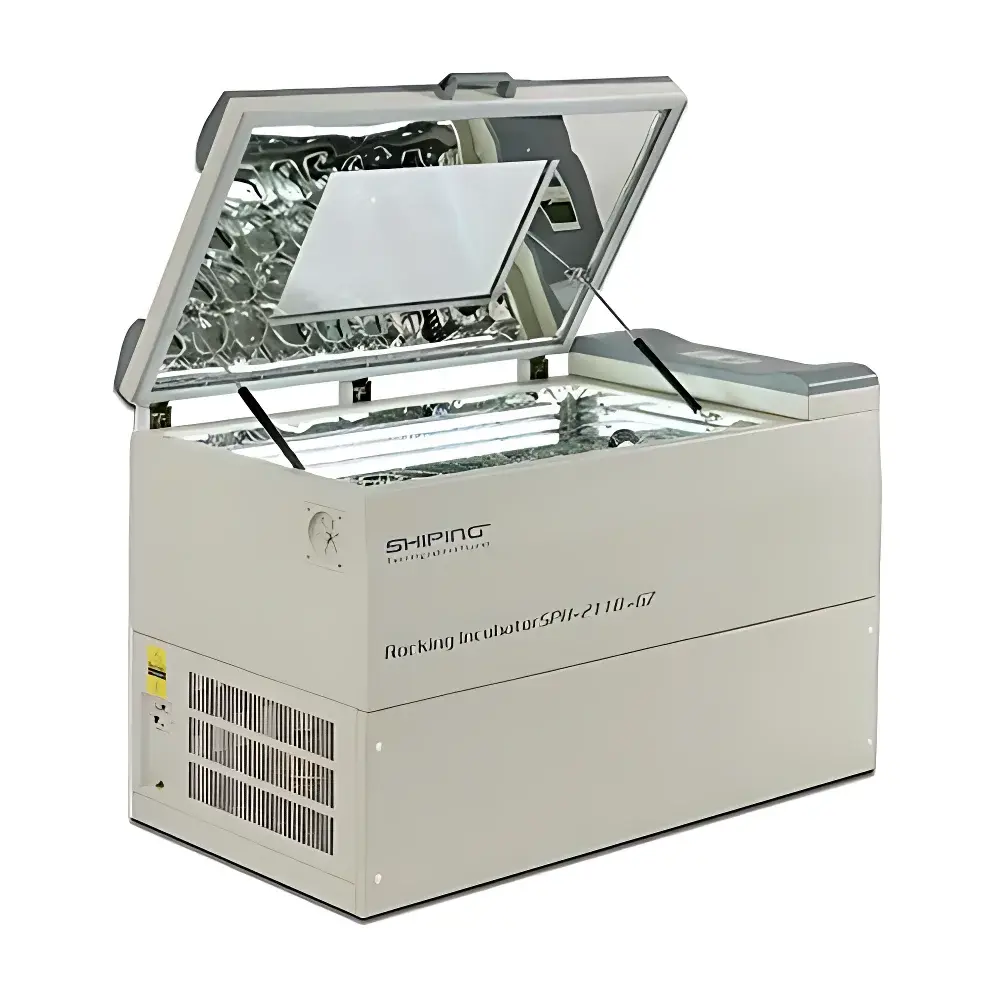
SPH-211B-GZ Large-Capacity Illuminated Temperature-Controlled Orbital Shaker
| Brand | Shanghai Shiping |
|---|---|
| Origin | Shanghai, China |
| Model | SPH-211B-GZ |
| Instrument Type | Full-Range Temperature-Controlled Shaker |
| Timer Range | 0–500 h |
| Oscillation Frequency | 50–300 rpm |
| Orbit Diameter | Φ25 mm |
| Temperature Range | 4–60 °C |
| Shelf Quantity | 1 |
| Temperature Accuracy | ±0.1 °C |
| Temperature Uniformity | ±0.5 °C |
| Rotation Accuracy | ±1 rpm |
| Illumination Intensity | 0–15,000 lx |
| Chamber Dimensions (W×D×H) | 970 × 550 × 350 mm |
| Platform Size | 920 × 500 mm |
| Max Load Capacity | 28 × 500 mL flasks (standard configuration) |
| Refrigerant | CFC-Free R-134a |
| Cooling Power | 200 W |
| Heating Power | 800 W |
| Total Power Consumption | 1120 W |
| Net Weight | 180 kg |
| Power Supply | AC 200–240 V, 50–60 Hz |
Overview
The SPH-211B-GZ is a large-capacity, illuminated, temperature-controlled orbital shaker engineered for reproducible and scalable cultivation of biological samples under precisely regulated thermal and photoperiodic conditions. It operates on the principle of controlled orbital motion—generating uniform, low-shear agitation ideal for suspension cultures of microorganisms, plant callus, insect cells, and small-animal models. Unlike standard incubator shakers, the SPH-211B-GZ integrates a high-intensity, adjustable white-light illumination system (0–15,000 lx), enabling simulation of diurnal light cycles critical for photobiological assays, seed germination studies, and photosynthetic organism cultivation. Its forced-air convection system, PID-driven microprocessor controller, and CFC-free R-134a refrigeration ensure stable temperature maintenance from 4 °C (refrigerated storage) to 60 °C (thermophilic culture), with accuracy of ±0.1 °C and uniformity of ±0.5 °C across the entire chamber volume.
Key Features
- Single-axis balanced drive mechanism (Chinese patent) ensures mechanical stability, low vibration transmission, and acoustic noise reduction (<55 dB(A) at 1 m), supporting long-term unattended operation.
- Wide-speed orbital control (50–300 rpm, ±1 rpm resolution) with soft-start acceleration logic to prevent splashing and cell pellet disruption during initiation.
- Large-format stainless-steel chamber (970 × 550 × 350 mm) and reinforced platform (920 × 500 mm) accommodate up to 28 × 500 mL Erlenmeyer flasks or equivalent volumetric configurations—optimized for high-throughput bioprocess development.
- Dual-display LCD interface shows real-time and setpoint values for temperature, speed, illumination intensity, and elapsed time; supports clock display, dual-temperature mode (chamber vs. ambient), and parameter calibration.
- Comprehensive safety architecture includes independent overtemperature cutoff, motor overheat protection, door-open interlock shutdown, current leakage detection, and automatic power recovery after grid interruption.
- CFC-free refrigeration (R-134a), 200 W cooling capacity, and 800 W heating element enable rapid thermal equilibration and sustained low-temperature operation without condensation buildup.
Sample Compatibility & Compliance
The SPH-211B-GZ supports diverse biological sample formats—including glass and polycarbonate flasks, culture bottles, petri dishes, and multi-well plates—across applications requiring strict environmental control. Its construction meets international safety standards including IEC 61010-1 (electrical safety for laboratory equipment) and ISO 14001-compliant manufacturing practices. The stainless-steel interior (imported mirror-finish grade 304) resists corrosion from sterilants (e.g., 70% ethanol, hydrogen peroxide vapor) and routine cleaning agents. While not certified for GMP or GLP environments out-of-the-box, its data logging capability, parameter memory, and alarm traceability support alignment with FDA 21 CFR Part 11 requirements when integrated with validated software protocols.
Software & Data Management
The embedded microprocessor implements a non-volatile parameter memory system that retains user-defined settings—including speed profiles, temperature ramps, light schedules, and timer sequences—across power cycles. Eight-segment programmable curve control allows complex multi-stage experiments (e.g., circadian entrainment, temperature-shift induction, or light/dark cycling). All operational events—including alarms, door openings, and setpoint changes—are timestamped and stored locally. Optional RS-485/Modbus RTU interface enables integration with centralized lab management systems for remote monitoring, audit trail generation, and automated report export compliant with ISO/IEC 17025 documentation frameworks.
Applications
- Plant tissue culture and seed germination under controlled photoperiods and thermocycles
- Microbial fermentation (E. coli, yeast, actinomycetes) and antibiotic production studies
- Insect cell line expansion (Sf9, Sf21) and baculovirus expression systems
- Algal biomass cultivation and photosynthetic efficiency screening
- Enzyme kinetics assays requiring simultaneous agitation and thermal regulation
- Environmental microbiology: biodegradation testing, soil slurry enrichment, and wastewater bioassays
- Preclinical small-mammal cell co-culture under physiologically relevant oxygen and light conditions
FAQ
What is the maximum flask loading configuration supported by the SPH-211B-GZ?
Standard configuration accommodates 28 × 500 mL Erlenmeyer flasks; alternative layouts include 10 × 2000 mL, 18 × 1000 mL, or 36 × 250 mL vessels—all verified for uniform mixing and thermal homogeneity.
Does the unit support continuous illumination during refrigerated operation (e.g., at 4 °C)?
Yes—the LED-based lighting system remains fully functional across the entire temperature range (4–60 °C), with no thermal interference or spectral drift.
Is the temperature sensor calibrated traceable to NIST standards?
The factory calibration uses reference-grade PT100 sensors; end-user recalibration is supported via accessible offset adjustment in service mode, and external validation against NIST-traceable thermometers is recommended annually.
Can the shaker operate in a CO₂-enriched environment?
No—the chamber is not gas-tight and lacks CO₂ monitoring or regulation; it is designed for ambient-air operation only.
What maintenance intervals are recommended for long-term reliability?
Motor and bearing inspection every 12 months; condenser coil cleaning every 6 months; verification of door seal integrity and illumination output every 3 months.