
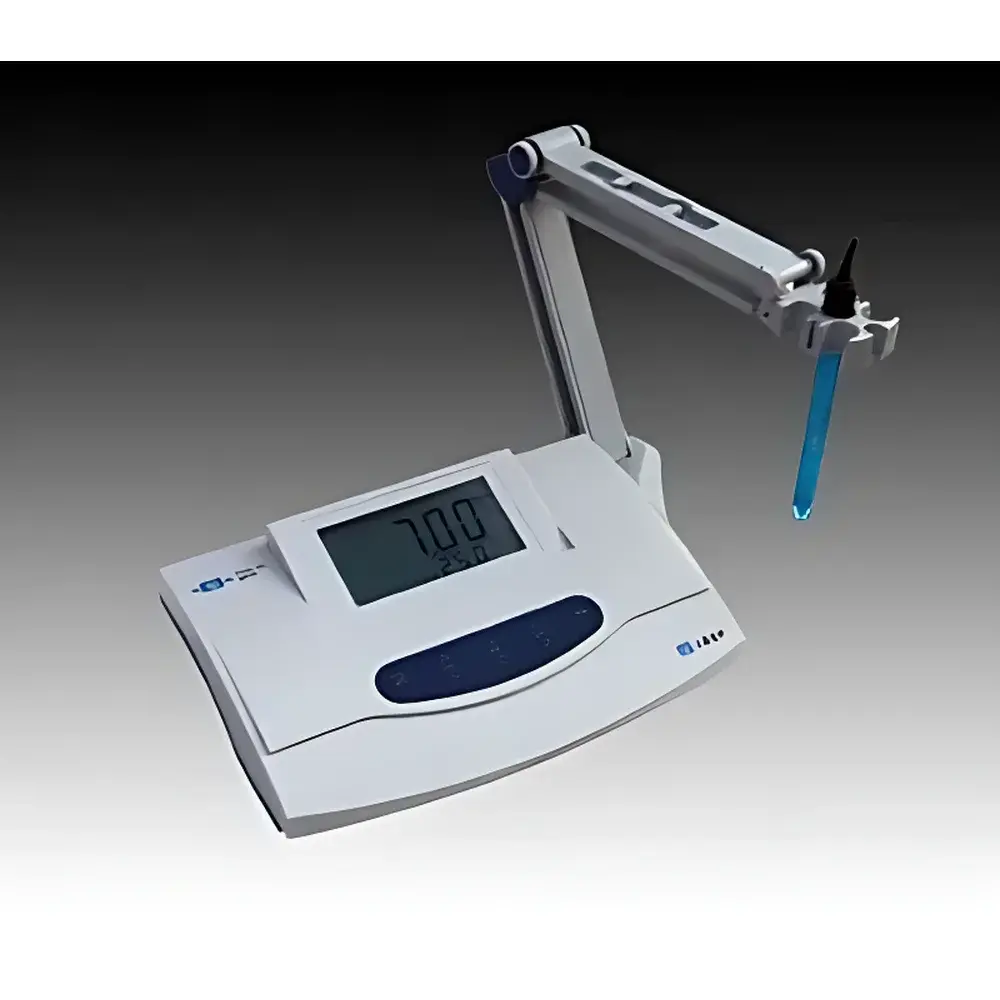
LeiCi PHS-3C Benchtop pH Meter
| Brand | LeiCi |
|---|---|
| Origin | Shanghai, China |
| Model | PHS-3C |
| Instrument Type | Benchtop |
| Parameter Types | Dual (pH/mV) |
| Measurement Range | 0.00–14.00 pH |
| Resolution | 0.01 pH / 1 mV |
| Accuracy | ±0.01 pH ±1 digit |
| Input Impedance | ≥1 × 10¹² Ω |
| Stability | ±0.01 pH ±1 digit / 3 h |
| Temperature Compensation Range | 0–60 °C |
| Sample Temperature Range | 5–60 °C |
| Power Supply | AC 220 V ±10%, 50 Hz |
| Dimensions (W×D×H) | 290 × 210 × 95 mm |
| Weight | 1.5 kg |
| Calibration Standard | NIST-traceable buffer solutions |
| Display | Large segment LCD with automatic polarity indication for mV |
Overview
The LeiCi PHS-3C is a precision benchtop pH meter engineered for routine electrochemical measurement in academic laboratories, quality control environments, and industrial process monitoring. It operates on the fundamental principle of potentiometric pH determination—measuring the potential difference between a pH-sensitive glass electrode and a stable reference electrode immersed in an aqueous solution. This voltage, governed by the Nernst equation, is converted into a pH value with high linearity across the full 0.00–14.00 pH range. Designed for robustness and operational simplicity, the PHS-3C delivers metrologically traceable results compliant with ISO 8655-4 (volumetric instruments), ASTM E70 (standard test method for pH of aqueous solutions), and general GLP documentation requirements. Its dual-parameter capability supports both pH and mV (redox) measurements without mode switching, enabling direct comparison of sample redox potential against standard reference electrodes such as Ag/AgCl or SCE.
Key Features
- High-input-impedance amplifier (≥1 × 10¹² Ω) minimizes loading error and ensures stable readings with high-resistance electrodes, including aged or low-ionic-strength samples.
- Segment LCD display with clear digit separation and automatic mV polarity indication enhances readability under varied lighting conditions and reduces operator interpretation errors.
- Two-point calibration protocol with automatic recognition of standard NIST-traceable buffers (e.g., pH 4.01, 7.00, 10.01) ensures rapid setup and traceable accuracy verification per ISO/IEC 17025 calibration guidelines.
- Manual temperature compensation (0–60 °C) allows users to input measured sample temperature directly—critical for accurate pH correction where automatic temperature probes are unavailable or impractical.
- Compact benchtop form factor (290 × 210 × 95 mm) and lightweight design (1.5 kg) facilitate integration into crowded lab workspaces while maintaining mechanical stability during extended use.
- Compliant power supply (AC 220 V ±10%, 50 Hz) meets IEC 61010-1 safety standards for laboratory electrical equipment, including overvoltage category II and pollution degree 2 specifications.
Sample Compatibility & Compliance
The PHS-3C is validated for use with standard pH composite electrodes (e.g., E-201-C type), compatible with most commercially available refillable and gel-filled reference systems. It accommodates aqueous samples within 5–60 °C and moderate ionic strength (≥0.1 mM). While not rated for hazardous or explosive atmospheres, it conforms to general-purpose laboratory safety norms and supports documentation workflows required for FDA 21 CFR Part 11–aligned environments when paired with external audit-log software. All calibration and measurement records can be manually transcribed into LIMS-compatible formats, satisfying basic data integrity expectations under ISO/IEC 17025 clause 7.7.
Software & Data Management
The PHS-3C operates as a standalone instrument without embedded data logging or USB connectivity. However, its stable analog output and consistent display resolution support reliable manual transcription into electronic lab notebooks (ELNs) or spreadsheet-based QA/QC databases. For labs requiring automated data capture, third-party RS-232 interfaces (available separately) enable ASCII-formatted serial output compatible with LabVIEW, MATLAB, or custom Python scripts. When integrated into regulated workflows, users may implement procedural controls—including defined calibration intervals, electrode maintenance logs, and daily system suitability checks—to meet GLP and GMP documentation expectations.
Applications
- Routine pH verification in pharmaceutical water systems (Purified Water, WFI) per USP and EP 2.2.39.
- Quality assurance testing of food and beverage products, including dairy, juices, and fermented goods.
- Environmental water analysis in municipal wastewater treatment and surface water monitoring programs.
- Academic teaching labs for foundational electrochemistry experiments involving buffer preparation, titration endpoint detection, and electrode characterization.
- Industrial process control for chemical synthesis, plating baths, and cleaning solution management where redox potential (mV mode) supplements pH assessment.
FAQ
What calibration standards are recommended for the PHS-3C?
NIST-traceable pH 4.01, 7.00, and 10.01 buffer solutions are recommended for two-point calibration. Use fresh, unopened sachets or properly stored stock solutions to avoid carbonate contamination.
Can the PHS-3C measure non-aqueous or low-ionic-strength samples?
It is optimized for aqueous solutions. For low-conductivity samples (<100 µS/cm), use a low-resistance electrode and minimize air exposure to reduce junction potential drift.
Is automatic temperature compensation (ATC) supported?
No—the PHS-3C requires manual entry of sample temperature. An external ATC probe is not integrated but may be used with compatible third-party adapters.
What is the expected service life of the E-201-C electrode when used with this meter?
Under typical lab conditions (daily use, proper storage in 3 M KCl, and regular cleaning), the E-201-C exhibits 12–18 months of functional stability before recalibration frequency increases significantly.
Does the PHS-3C comply with ISO/IEC 17025 for accredited testing?
As a measurement instrument, it supports compliance when operated within its specified accuracy limits, with documented calibration using traceable standards and maintained electrode performance records.
Related Products






