
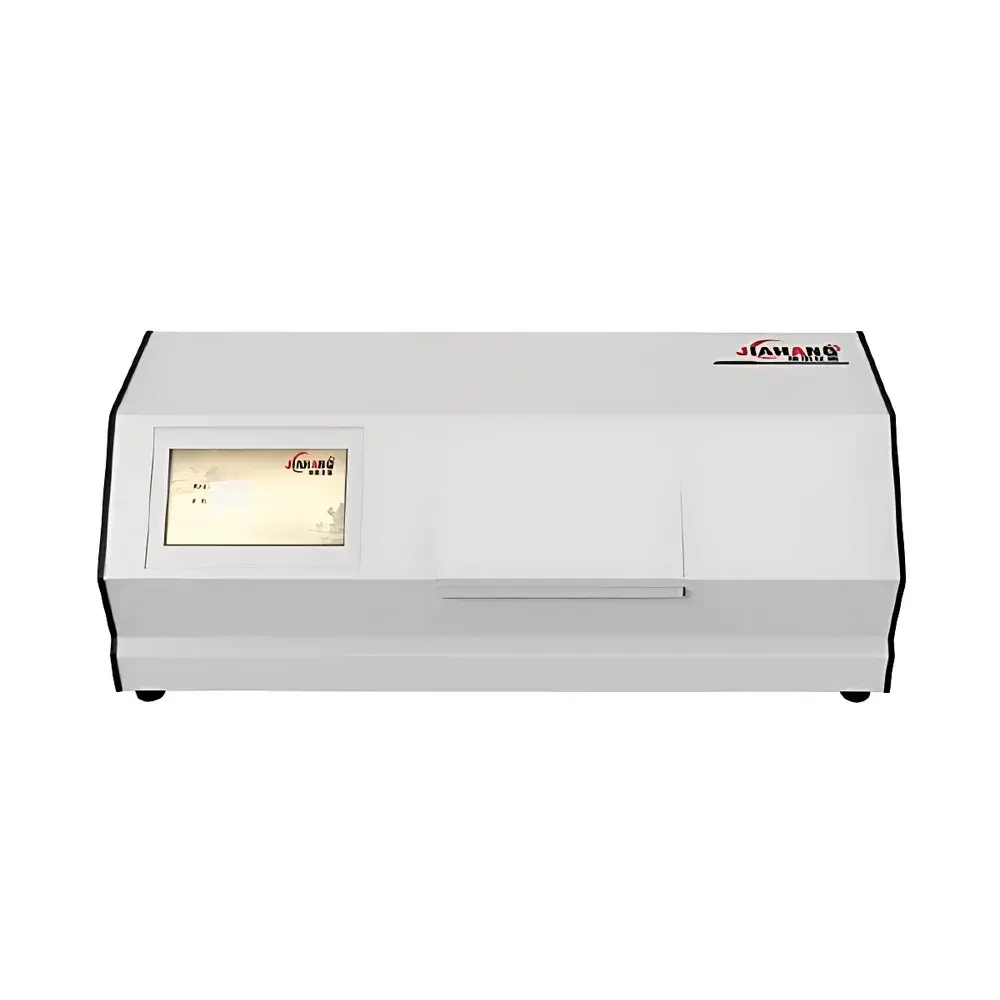
P400 Automated Polarimeter
| Origin | Shanghai, China |
|---|---|
| Manufacturer Type | Authorized Distributor |
| Origin Category | Domestic (PRC) |
| Model | P400 |
| Price Range | USD 1,400 – 7,000 |
| Product Type | Automatic Polarimeter |
| Temperature Control | Integrated Peltier |
| Digital Display | Yes |
| Light Source | High-Stability LED |
| Optical Rotation Range | ±89.99° |
| Sucrose Scale Range | ±259°Z |
| Measurement Accuracy | ±0.01° (within ±45°), ±0.02° (beyond ±45°) |
| Resolution | 0.001° |
| Repeatability (SD) | 0.002° |
| Temperature Range | 15–45°C |
| Temperature Stability | ±0.2°C |
| Display | 5.6″ TFT True-Color Touchscreen |
| Sample Cells | 100 mm (standard & thermostatted), 200 mm (standard) |
| Minimum Transmittance | 1% |
| Auto-Calibration | Yes |
| Interface | USB |
| Data Storage Capacity | 1,000 measurements |
| Power Supply | 220 V ±10%, 50 Hz ±1 Hz, 250 W |
| Net Weight | 24 kg |
Overview
The P400 Automated Polarimeter is an advanced optical measurement instrument engineered for high-precision determination of optical rotation—defined as the angular deviation of plane-polarized light induced by chiral compounds in solution. Operating at the sodium D-line equivalent wavelength of 589.3 nm (achieved via a stabilized LED source coupled with high-transmission interference filters), the instrument complies with fundamental principles outlined in pharmacopoeial standards including USP , EP 2.2.7, and ChP IV. Its core measurement capability spans optical rotation (±89.99°), specific rotation, concentration, and sucrose scale (±259°Z), making it suitable for quantitative analysis of enantiomeric purity, active pharmaceutical ingredient (API) assay, and carbohydrate content validation in regulated environments.
Key Features
- Stable 589.3 nm LED light source with >100,000-hour operational lifetime—eliminating spectral drift, warm-up delays, and thermal instability associated with sodium vapor or tungsten-halogen lamps;
- Integrated Peltier-based temperature control system (15–45°C, ±0.2°C stability) directly coupled to the sample cell mount—ensuring thermally invariant pathlength and refractive index conditions without external recirculation baths;
- True-color 5.6-inch capacitive touchscreen interface enabling intuitive navigation across measurement modes (optical rotation, specific rotation, concentration, °Z), real-time curve visualization, and on-device calibration workflows;
- Automatic zero-point and standard calibration routines compliant with ISO 13485 traceability requirements—supporting GLP/GMP audit readiness through timestamped calibration logs;
- Dual-path optical design with automatic photometric compensation for low-transmittance samples (down to 1% transmittance), minimizing signal attenuation artifacts in highly colored or turbid matrices;
- Modular cell support accommodating standard 100 mm and 200 mm tubes, plus dedicated thermostatted 100 mm cells for temperature-sensitive assays (e.g., enzymatic hydrolysis kinetics or thermolabile glycosides).
Sample Compatibility & Compliance
The P400 accommodates aqueous, alcoholic, and organic solvent-based solutions of chiral molecules—including monosaccharides, disaccharides, amino acids, antibiotics (e.g., penicillins, cephalosporins), and synthetic intermediates. Its measurement uncertainty profile meets the repeatability requirement (σ ≤ 0.002°) and accuracy specification (±0.01° within ±45° range) referenced in ASTM E1255-22 “Standard Practice for Polarimetric Analysis” and ICH Q5C guideline for stereochemical characterization. All firmware and data handling operations are structured to support 21 CFR Part 11-compliant electronic records when deployed with validated LIMS integration protocols.
Software & Data Management
Data acquisition, storage, and export are managed via embedded firmware with non-volatile memory supporting up to 1,000 full measurement records—including sample ID, date/time stamp, temperature, cell length, concentration input, raw rotation value, and calculated specific rotation. USB interface enables direct export of CSV-formatted datasets for post-processing in MATLAB, Python (NumPy/Pandas), or statistical validation packages. Audit trail functionality logs all user-initiated actions (e.g., calibration events, parameter modifications, data deletions) with operator ID and timestamp—essential for FDA inspection readiness and internal quality system documentation.
Applications
- Pharmaceutical QC/QA: Enantiomeric excess (ee) verification of chiral APIs per USP monographs; batch release testing of dextromethorphan, levodopa, and escitalopram;
- Sugar industry: Brix and polarization-based sucrose quantification in cane/beet juice, molasses, and refined syrups per ICUMSA Methods GS4/8-12;
- Academic research: Kinetic monitoring of asymmetric synthesis, enzyme-catalyzed racemization, and conformational studies of biomacromolecules;
- Food & beverage: Authenticity screening of honey, maple syrup, and fruit concentrates via optical rotation fingerprinting;
- Chemical manufacturing: In-process control of stereoselective hydrogenation, epoxidation, and resolution reactions.
FAQ
Does the P400 comply with pharmacopoeial wavelength requirements?
Yes—the integrated LED + interference filter assembly delivers spectrally narrow output centered precisely at 589.3 nm (FWHM < 1.5 nm), satisfying USP, EP, and JP specifications for polarimetric wavelength tolerance.
Can the instrument perform temperature-controlled measurements under GMP conditions?
Yes—its Peltier module maintains sample cell temperature within ±0.2°C over the full 15–45°C range, and all thermal parameters are logged alongside optical data to support IQ/OQ documentation.
Is external software required for data export or report generation?
No—all data management functions—including CSV export, calibration history review, and user-defined report templates—are fully implemented in the onboard firmware.
What maintenance is required for long-term accuracy?
Annual verification using NIST-traceable quartz control plates (e.g., ±5.0° and ±34.0°) is recommended; no lamp replacement or optical alignment is needed due to solid-state LED architecture and factory-aligned optics.




