
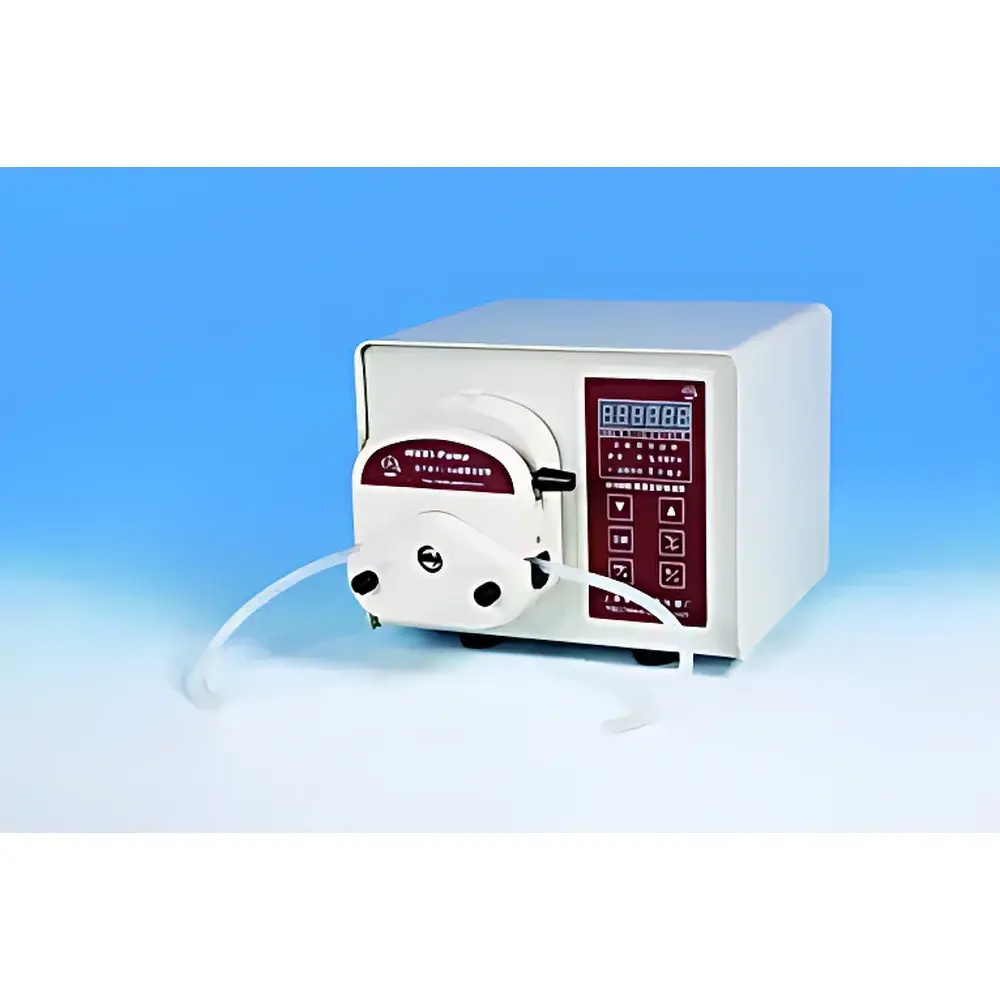
Truelab BT-100 Series Peristaltic Pump
| Brand | Truelab |
|---|---|
| Origin | Shanghai, China |
| Model Variants | BT-100, BT-100B, BT-100D, BT-100SD, BT-200B, BT-200D, BT-200SD, D100B, D200B, BT-1FJ, BT-4F, BT-100-4, BT-100-8 |
| Flow Rate Range | 0.3–27,000 mL/h (model-dependent) |
| Maximum Output Pressure | ≥2.0–3.0 kg/cm² |
| Speed Control | 0–155 rpm (digital display, stepless adjustment) |
| Channel Configuration | 1–8 independent channels |
| Timing Function | Run/Standby timer from 1 sec to 9 h 59 min 59 sec |
| Communication Interface | RS232 (BT-100SD & select models) |
| Drive Technology | Microcontroller-based细分 drive circuitry for low noise and stable operation |
| Compliance | Designed for general laboratory fluid handling per ISO 8573-1 (compressed air purity class not applicable), compatible with GLP/GMP environments when integrated into validated systems |
Overview
The Truelab BT-100 Series Peristaltic Pump is a modular, microcontroller-driven fluid transfer system engineered for precise, contamination-free metering in analytical, bioprocessing, and quality control laboratories. Operating on the principle of peristalsis—where rollers compress flexible tubing to displace fluid without contacting internal pump components—the series eliminates cross-contamination risk and enables rapid tubing changeover for multi-solvent or sterile applications. Unlike diaphragm or piston pumps, peristaltic designs maintain consistent volumetric accuracy across varying viscosity profiles (e.g., cell culture media, buffer solutions, polymer dispersions) without recalibration. All models feature brushless DC motors with closed-loop speed regulation, ensuring high reproducibility (<±1.5% full-scale deviation under constant load conditions) and long-term stability over extended duty cycles.
Key Features
- Multi-channel scalability: Single- to eight-channel configurations (BT-100-8) support parallel sample processing, gradient elution, or reagent dispensing in HPLC, ICP-MS autosamplers, and fermentation feed systems.
- Digital speed control: 0–155 rpm range with LED-displayed setpoint and real-time feedback; stepless adjustment enables fine-tuned flow resolution down to 0.1 mL/h at lowest ranges.
- Programmable timing architecture: Independent run and standby timers (1 sec–9 h 59 min 59 sec) allow unattended batch operation, pulse dosing, or circadian-cycle perfusion protocols.
- Low-noise drive electronics: Proprietary micro-stepping motor control reduces mechanical vibration and acoustic emission (<45 dB(A) at 1 m), critical for laminar-flow hoods and vibration-sensitive instrumentation.
- Modular tube compatibility: Accepts standard silicone, Viton®, and Tygon® tubing (ID 0.5–6.4 mm); head assemblies are interchangeable across BT-100 and BT-200 platforms for field-upgradable throughput.
- RS232 interface (BT-100SD, BT-200SD): Enables remote command execution (start/stop, speed setpoint, timer configuration) and status polling via ASCII protocol—compatible with LabVIEW™, Python pySerial, and custom SCADA integration.
Sample Compatibility & Compliance
The BT-100 Series handles aqueous, organic, and mildly corrosive fluids—including PBS, ethanol, 1M NaOH, and 10% HNO₃—when paired with chemically resistant tubing. It is not rated for explosive atmospheres (ATEX) or intrinsically safe operation. While not certified to IEC 61000-6-3 (EMC) or UL 61010-1 out-of-the-box, its electrical design conforms to basic safety principles for Class I, Division 2 laboratory equipment. For regulated environments, audit trails may be generated externally via RS232 logging; the pump itself does not implement FDA 21 CFR Part 11 electronic signature functionality. Tube wear monitoring requires manual visual inspection per ISO 15197:2013 Annex C guidance for peristaltic component lifecycle management.
Software & Data Management
No proprietary software is bundled; however, open-command documentation (AT-style ASCII instruction set) is provided for OEM integration. Example commands include “SPEED=87.5” (set rpm), “START”, “STOP”, and “TIMER=3600” (60-min run). Timestamped operational logs can be captured using third-party terminal emulators (e.g., Tera Term, PuTTY) or custom Python scripts. Data export formats include CSV and plain-text timestamps for traceability in QA/QC documentation. Firmware updates (if released) are delivered via serial bootloader mode—no USB or network dependency.
Applications
- Automated reagent addition in spectrophotometric assays (e.g., ASTM D129–22 sulfur analysis)
- Continuous feed in benchtop bioreactors (pH-controlled nutrient delivery per USP <1058>)
- Mobile phase delivery in preparative chromatography systems (ISO 17025-compliant calibration traceable to NIST SRM 2842)
- Cell culture media perfusion in 3D scaffold studies (flow consistency validated per ASTM F2971–13)
- Environmental water sampling—low-pulse-flow operation minimizes particulate resuspension in sediment-laden samples
- Calibration standard delivery for flowmeter verification (ISO/IEC 17025 Clause 6.4.10)
FAQ
What tubing sizes are supported?
Standard roller heads accommodate tubing inner diameters from 0.5 mm to 6.4 mm (1/16″ to 1/4″), including PharMed® BPT, Masterflex® L/S®, and Cole-Parmer® Chem-Dur® formulations.
Can the pump be integrated into a PLC-controlled process line?
Yes—digital I/O signals (start/stop, fault output) and RS232 communication enable direct interfacing with Siemens S7, Allen-Bradley CompactLogix, or Mitsubishi FX series controllers using Modbus RTU emulation.
Is pressure rating absolute or gauge?
All pressure specifications (≥2.0–3.0 kg/cm²) refer to maximum backpressure tolerance at zero flow—measured as gauge pressure per ISO 8573-1 Annex A definitions.
How often should tubing be replaced?
Service life depends on RPM, fluid chemistry, and tubing material; typical replacement intervals range from 100–500 hours of continuous operation—documented in maintenance logs per GLP Annex 13 requirements.
Does the BT-100SD support data logging internally?
No—internal memory is limited to last-set speed and timer values; persistent logging requires external host capture via RS232.



