
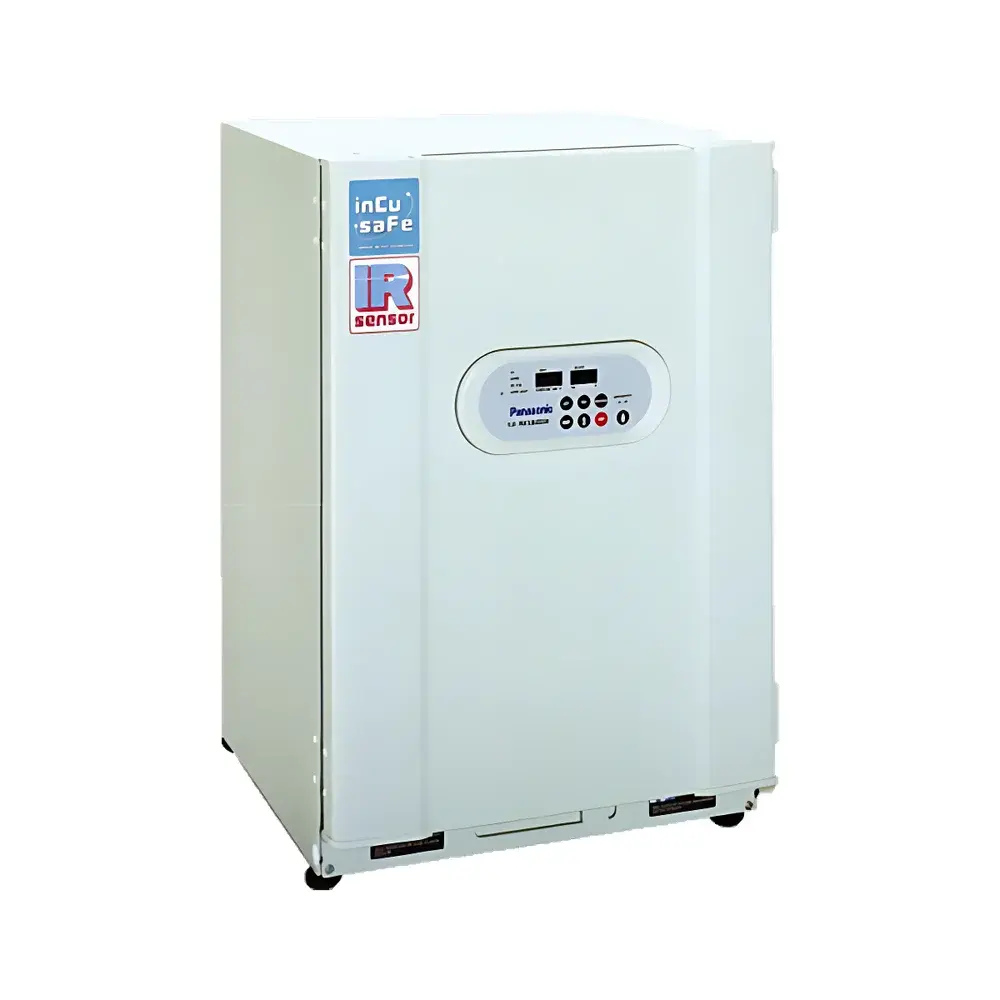
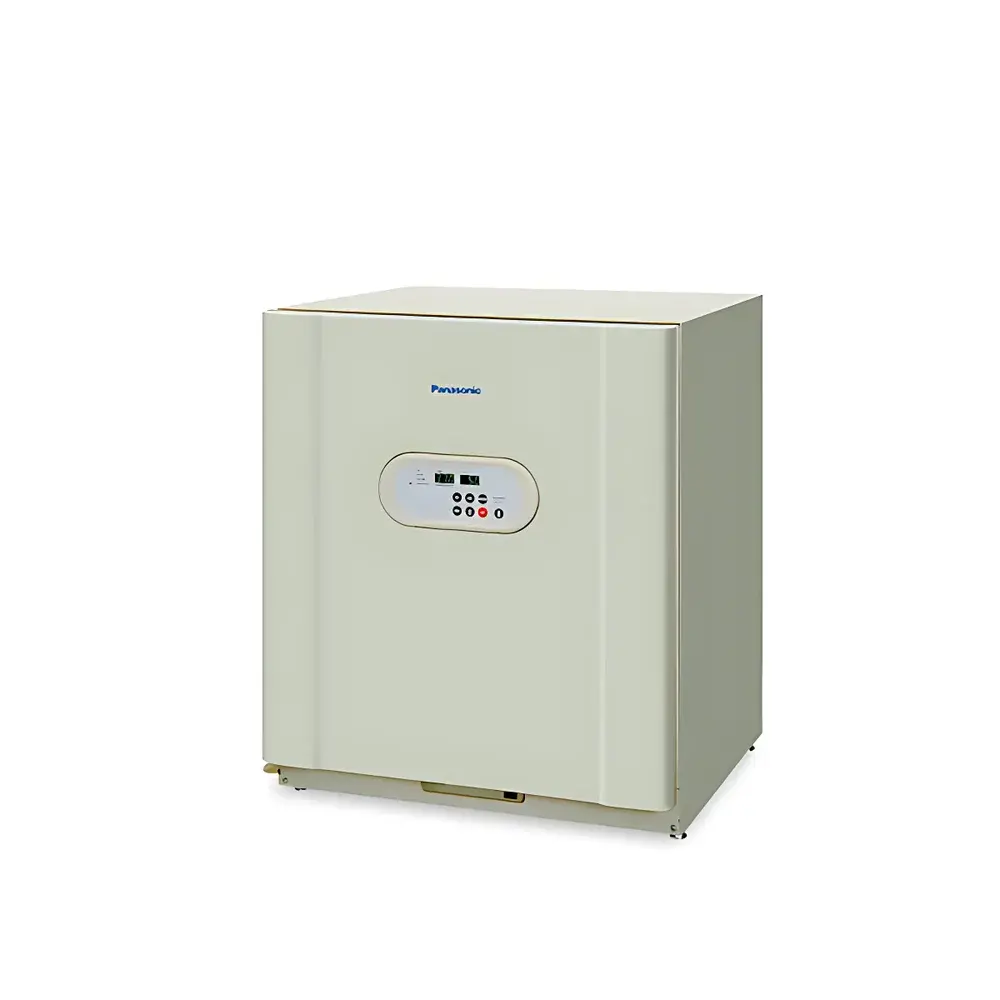
Panasonic MCO-18AIC and MCO-20AIC CO₂ Incubators
| Brand | Panasonic |
|---|---|
| Origin | Japan |
| Model | MCO-18AIC, MCO-20AIC |
| Temperature Range & Accuracy | +5 °C to 50 °C (ambient 5–35 °C) |
| Temperature Uniformity | ±0.25 °C (at 25 °C ambient, 37 °C setpoint, 5% CO₂, no load) |
| Humidity Control | Natural evaporation via stainless steel humidification tray |
| Internal Volume | 170 L / 215 L |
| Heating System | Direct Heat Air-jacket (DHA) with three independent PID-controlled heating units |
| CO₂ Sensing | Ceramic infrared (IR) sensor, ozone-free UV sterilization (4 W, 253.7 nm), Cu-alloy antibacterial inner chamber |
Overview
The Panasonic MCO-18AIC and MCO-20AIC CO₂ incubators are precision-engineered environmental control systems designed for reliable, contamination-resistant cell culture under physiologically relevant conditions. These incubators employ a direct heat air-jacket (DHA) architecture—comprising three independently controlled heating units—to deliver exceptional thermal stability and spatial uniformity across the entire chamber volume. Unlike traditional water-jacketed designs, the DHA system eliminates thermal lag and condensation risks while enabling rapid temperature recovery after door openings. CO₂ concentration is monitored in real time using a solid-state ceramic infrared (IR) sensor, immune to drift caused by high humidity or temperature gradients—a known limitation of older thermal conductivity (TC) sensors. The IR sensor feeds data to a microprocessor-based PID controller, achieving ±0.15% CO₂ stability at 5% setpoint under defined operating conditions. Both models maintain >95% relative humidity (R.H.) via passive evaporation from a removable stainless steel humidification tray, with optical water-level detection ensuring uninterrupted operation.
Key Features
- Antimicrobial copper-alloy inner chamber: Engineered to inhibit bacterial proliferation—including Mycoplasma—without compromising corrosion resistance; eliminates need for routine chamber sterilization cycles.
- Ozone-free UV sterilization (SafeCell™): 4 W, 253.7 nm UV-C lamp integrated into the air recirculation path; continuously sanitizes circulating air and surface moisture without generating ozone or impairing cell viability.
- DHA heating architecture: Three independent PID-regulated heating elements surrounding the chamber ensure minimal thermal gradient (<±0.25 °C uniformity) and ±0.1 °C short-term stability.
- Bidirectional door configuration: Hinges configurable for left- or right-handed opening; recessed ergonomic handles at all four corners improve accessibility in constrained lab layouts.
- Stackable design: Compatible with optional castor base (MCO-20RB) and inter-unit bracketing (MCO-20SB), reducing footprint in high-density core facilities.
- No-maintenance IR CO₂ sensing: Ceramic sensor requires no recalibration, exhibits no cross-sensitivity to water vapor or temperature fluctuations, and carries a 3-year warranty.
Sample Compatibility & Compliance
These incubators support standard T-flasks, Petri dishes, multiwell plates, roller bottles, and custom bioreactor vessels up to 15 adjustable shelves (MCO-18AIC: 4 standard, max 15; MCO-20AIC: 5 standard, max 15). Shelf load capacity is rated at 7 kg per shelf (MCO-18AIC) or 5 kg (MCO-20AIC), with dimensions accommodating both 450 × 450 mm and 580 × 450 mm formats. All internal surfaces comply with ISO 13485–aligned manufacturing protocols. The 0.3 µm CO₂ gas filter (99.97% efficiency) meets ASTM F2101 requirements for microbial retention. Optional accessories—including MCO-21GC automatic cylinder switchover and MCO-100L CO₂ pressure regulator—enable continuous operation in GLP/GMP environments. Alarm outputs (high/low temperature, CO₂ deviation, low water level, door ajar, independent overheat cutoff) support integration into centralized lab monitoring systems compliant with FDA 21 CFR Part 11 audit-trail requirements when paired with validated data logging software.
Software & Data Management
While the MCO-18AIC/MCO-20AIC operate via an intuitive front-panel interface with tactile buttons and LED display, full parameter logging and remote supervision require connection to Panasonic’s optional MCO Data Logger or third-party SCADA-compatible controllers via RS-232/RS-485. Real-time values—including chamber temperature, CO₂ %, humidity status, UV lamp cycle count, and alarm history—are timestamped and exportable as CSV. The system supports user-defined alarm thresholds and event-triggered email/SMS notifications when interfaced with network-enabled gateways. All firmware updates are performed via secure USB import, maintaining traceability under ISO/IEC 17025 calibration management frameworks. No cloud-based telemetry is embedded; local data sovereignty is preserved by default.
Applications
These incubators serve primary and secondary cell culture workflows across academic research, biopharmaceutical process development, and clinical diagnostics laboratories. Their stable CO₂/humidity/temperature triad supports sensitive applications including stem cell expansion, hybridoma maintenance, induced pluripotent stem cell (iPSC) differentiation, and co-culture assays requiring prolonged undisturbed conditions. The Cu-alloy chamber has demonstrated efficacy in reducing mycoplasma incidence in long-term adherent cultures without antibiotic supplementation—making it suitable for serum-free or low-serum media formulations. The absence of ozone generation and precise IR-based CO₂ control also make these units appropriate for organoid culture, 3D spheroid formation, and metabolic flux studies where extrinsic oxidative stress must be minimized.
FAQ
What is the difference between the MCO-18AIC and MCO-20AIC models?
The MCO-20AIC offers greater internal volume (215 L vs. 170 L), larger shelf dimensions (580 × 450 mm vs. 450 × 450 mm), one additional standard shelf (5 vs. 4), and higher power consumption (380 W vs. 310 W); external depth and height are identical.
Is the copper-alloy chamber compatible with common cleaning agents used in cell culture labs?
Yes—the alloy resists corrosion from 70% ethanol, isopropyl alcohol, and diluted sodium hypochlorite (≤0.5%), but prolonged exposure to acidic solutions (e.g., acetic acid) or high-concentration hydrogen peroxide (>3%) is not recommended.
Does the UV lamp operate continuously or only during scheduled cycles?
The SafeCell UV lamp is programmable for timed daily cycles (e.g., overnight) or manual activation; it does not run continuously during active incubation to avoid cumulative UV exposure to samples.
Can the incubator maintain CO₂ concentration during frequent door openings in shared-lab settings?
Yes—PID-controlled gas injection combined with the fast-response IR sensor enables CO₂ recovery to setpoint within ≤60 seconds after a 10-second door opening, validated under multi-user simulation protocols.
Is external humidification or external water supply required?
No—humidity is maintained solely through natural evaporation from the internal stainless steel tray; no external plumbing, steam generators, or ultrasonic humidifiers are needed or supported.




