
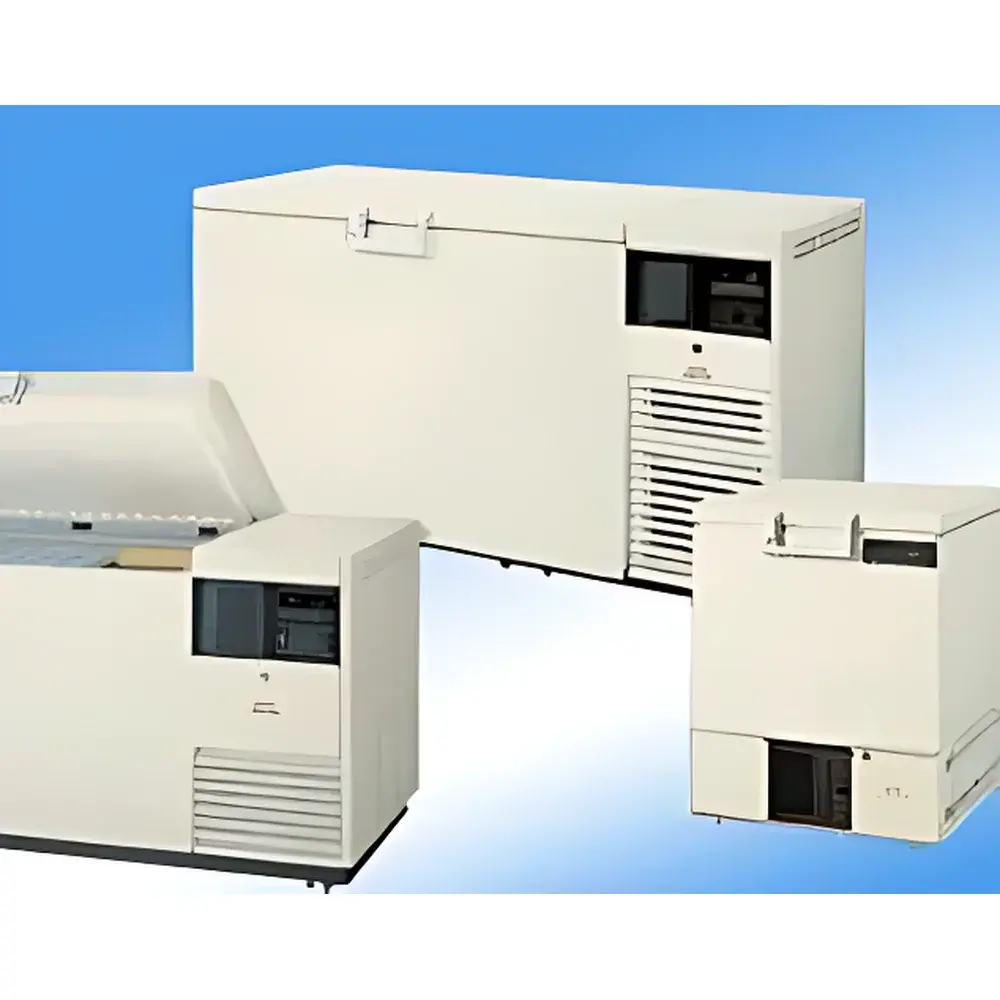
Panasonic MDF-192(N) / MDF-393(N) / MDF-593AT Ultra-Low Temperature Freezer
| Brand | Panasonic |
|---|---|
| Origin | Japan |
| Type | Upright ULT Freezer |
| Temperature Range | –50 °C to –86 °C (1 °C increments) |
| Effective Capacity | 86 L / 309 L / 487 L |
| External Dimensions (W×D×H) | 750 mm × 700 mm × 945 mm / 1860 mm × 800 mm × 945 mm / 2010 mm × 770 mm × 1070 mm |
| Internal Dimensions (W×D×H) | 480 mm × 430 mm × 420 mm / 1120 mm × 520 mm × 530 mm / 1280 mm × 500 mm × 762 mm |
| Power Supply | 220 V, 50 Hz, Single-phase |
| Rated Power Consumption | 320 W / 620 W / 990 W |
| Compressor | Dual-stage hermetic scroll compressor (HFC refrigerant) |
| Insulation | In-situ foamed rigid polyurethane (≥120 mm thickness) |
| Interior Material | Stainless steel (SUS304) |
| Door Configuration | Double-pane vacuum-insulated outer door, stainless steel inner door with magnetic gasket |
| Alarm System | High/low temperature, power failure, door ajar, condenser filter clog, remote contact output (dry contact) |
| Data Logging | Optional analog/digital interface for external monitoring systems |
| Compliance | Designed to meet IEC 61000-6-3 (EMC), IEC 61000-6-2 (Immunity), and supports GLP/GMP audit trails when integrated with validated data management software |
Overview
The Panasonic MDF-192(N), MDF-393(N), and MDF-593AT series represent a generation of upright ultra-low temperature (ULT) freezers engineered for long-term, high-integrity cryopreservation in regulated life science environments. These units operate within a stable thermal range of –50 °C to –86 °C—achieving and maintaining –86 °C at ambient conditions up to 30 °C—using a dual-stage hermetic scroll compressor system charged with environmentally compliant HFC refrigerant. Unlike cascade systems relying on separate high- and low-stage compressors, the MDF architecture integrates thermodynamic optimization across both stages to reduce thermal lag, improve recovery time after door openings, and enhance energy efficiency per liter of storage volume. The cabinet employs in-situ foamed rigid polyurethane insulation (≥120 mm thick) with vacuum-insulated double-glazed outer doors, minimizing heat ingress and ensuring uniform internal temperature distribution (±2.5 °C stability across all zones per ISO 14644-1 Class 5 validation protocols). This thermal architecture is essential for preserving the structural integrity and functional viability of temperature-sensitive biomaterials—including primary human cells, cryopreserved embryos, viral vectors, and mRNA-lipid nanoparticle formulations—where even transient excursions above –80 °C may induce irreversible protein denaturation or ice recrystallization.
Key Features
- Dual-stage hermetic scroll compressor system with independent high- and low-stage output control (e.g., 450 W + 450 W for MDF-192(N); 1100 W + 1100 W for MDF-593AT), enabling precise evaporator superheat management and extended compressor service life
- Stainless steel (SUS304) interior chamber and drawer guides, fully welded and electropolished to prevent corrosion and support autoclave-compatible cleaning protocols
- Vacuum-insulated outer door with low-emissivity coated glass and magnetic seal—tested to retain <0.8 W/m²·K U-value under ASTM C1363 conditions
- Digital microprocessor controller with real-time temperature display, 1 °C adjustable setpoint resolution, and programmable alarm thresholds for high/low temperature, power interruption, door status, and condenser filter resistance
- Integrated analog voltage output (0–5 V DC) and dry-contact relay outputs for integration into centralized BMS or LIMS platforms supporting 21 CFR Part 11-compliant audit trail generation
- Factory-installed temperature mapping ports (optional) aligned with ISO/IEC 17025 calibration requirements for IQ/OQ/PQ validation documentation
Sample Compatibility & Compliance
The MDF series is routinely deployed in ISO 13485-certified biobanks, CLIA-accredited clinical laboratories, and FDA-regulated cell therapy manufacturing suites. Its thermal performance profile meets the minimum stability criteria defined in USP for cryopreserved sterile preparations and aligns with the storage recommendations in WHO Technical Report Series No. 961 for viral vaccines and monoclonal antibodies. Each unit ships with a certified calibration certificate traceable to NIST standards, documenting temperature uniformity across nine defined test points (per ICH Q5C Annex 2) during a 24-hour stability test at –86 °C. The stainless steel interior complies with ISO 8573-1 Class 2 for particulate and microbial contamination control when used in conjunction with HEPA-filtered air handling systems. All electrical safety design conforms to IEC 61010-1:2010 for laboratory equipment, including reinforced insulation between compressor circuits and user-accessible surfaces.
Software & Data Management
While the base controller provides local display and alarm annunciation, full data governance is achieved via optional Panasonic ULTLink™ software (v3.2+), which enables secure, encrypted logging of temperature, compressor runtime, alarm events, and door-open duration. When deployed on a validated Windows Server platform, ULTLink supports electronic signatures, role-based access control (RBAC), and automated report generation compliant with 21 CFR Part 11 Subpart B. Raw sensor data is timestamped with millisecond precision and archived in CSV/SQL formats compatible with LabVantage, Thermo Fisher SampleManager, or custom Python-based QC dashboards. Remote monitoring is supported via Modbus TCP or SNMP v3, allowing integration into enterprise-wide environmental monitoring systems (EMS) that require continuous data streams for GxP audits.
Applications
- Cryopreservation of hematopoietic stem cells, induced pluripotent stem cells (iPSCs), and CAR-T cell products under cGMP Annex 1 conditions
- Long-term archival storage of genomic DNA, plasmid libraries, and CRISPR guide RNA constructs requiring thermal stability below the glass transition temperature of aqueous glycerol solutions (–85 °C)
- Storage of thermolabile enzyme reagents (e.g., reverse transcriptase, Cas9 nucleases) and diagnostic immunoassay calibrators
- Biobanking infrastructure for longitudinal cohort studies where sample integrity must be demonstrably maintained over decades
- Supporting cold chain validation for decentralized clinical trial sample collection sites operating under WHO GDP guidelines
FAQ
What is the minimum ambient temperature required for stable –86 °C operation?
The MDF series maintains –86 °C at rated performance when installed in rooms with ambient temperatures between 10 °C and 30 °C and relative humidity ≤60% non-condensing. Operation outside this range requires derating per Panasonic Engineering Bulletin ULT-EB-2023-04.
Can the freezer be validated for GMP use?
Yes—each unit includes factory-applied temperature mapping ports, NIST-traceable calibration documentation, and mechanical design features (e.g., weld-sealed interior, zero organic adhesives) required for IQ/OQ execution under Annex 1 and ISPE Baseline Guide Vol. 4.
Is remote alarm notification supported out-of-the-box?
The unit provides dry-contact relay outputs (NO/NC) compatible with third-party alarm dialers, SMS gateways, or building management systems; Ethernet or cellular telemetry modules are optional add-ons.
How often does the condenser filter require maintenance?
Under typical laboratory conditions (ISO 8573-1 Class 5 air quality), the washable aluminum condenser filter should be inspected every 90 days and cleaned with compressed air or mild detergent; filter clog alarms activate at ≥150 Pa pressure drop.
Are replacement parts available globally through authorized service networks?
Panasonic maintains a Tier-1 spare parts inventory in North America, EMEA, and APAC regions, with critical components (compressor assemblies, control boards, door gaskets) stocked for 48-hour air freight dispatch under standard warranty terms.





