
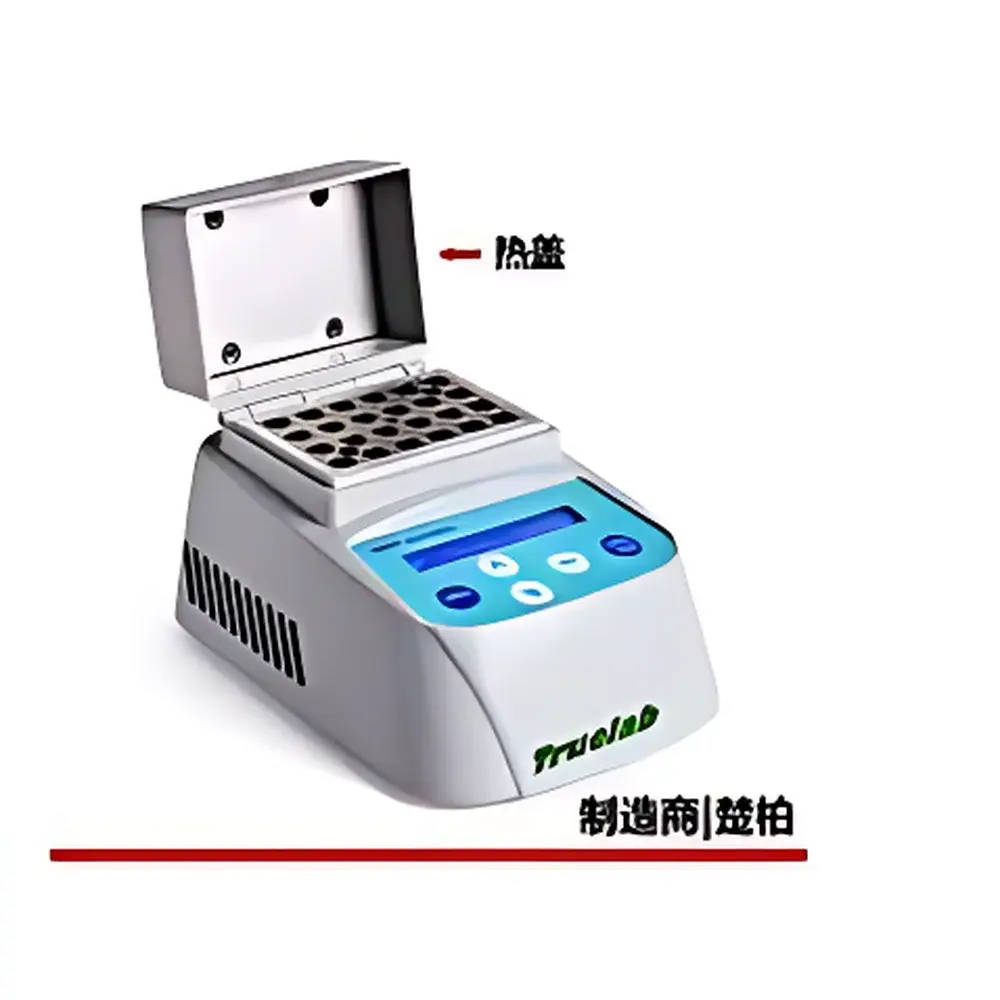
Truelab HB-100MC Compact Refrigerated Metal Block Heater with PCR Thermal Lid
| Brand | Truelab |
|---|---|
| Origin | Shanghai, China |
| Model | HB-100MC |
| Temperature Range | −10 °C to 100 °C |
| Temperature Display Resolution | 0.1 °C |
| Temperature Stability @ 100 °C | ≤ ±0.5 °C |
| Block Uniformity @ 40 °C | ≤ ±0.3 °C |
| Heating Time (20 °C → 100 °C) | ≤ 15 min |
| Cooling Time (RT → RT−20 °C) | ≤ 30 min |
| Timer Range | 0–999 min |
| Power Consumption | 120 W |
| Dimensions (W×D×H) | 200 × 250 × 200 mm |
| Net Weight | 1.4 kg |
| Power Input | 24 V DC |
| Thermal Lid | Yes |
| Module Compatibility | M-A (40×0.2 mL), M-B (24×0.5 mL), M-C (15×1.5 mL), M-D (15×2.0 mL), M-E (8–12.5×12.5 mm cuvettes), M-F (4×15 mL), M-G (2×50 mL) |
Overview
The Truelab HB-100MC is a compact, dual-mode refrigerated metal block heater engineered for precise thermal control of biological and chemical samples in resource-constrained or mobile laboratory environments. Unlike conventional dry baths relying solely on resistive heating, the HB-100MC integrates thermoelectric (Peltier) cooling with active thermal lid regulation—leveraging PCR-grade thermal sealing technology to suppress sample evaporation during prolonged incubation or low-temperature stabilization. Its operating range spans −10 °C to 100 °C, enabling applications from enzyme inactivation and cold-chain sample conditioning to high-fidelity nucleic acid amplification prep. The unit employs a solid aluminum heating/cooling block with optimized thermal mass distribution, ensuring rapid equilibration and minimal spatial gradient across the module surface. Designed for GLP-compliant workflows, it delivers traceable temperature stability (≤ ±0.5 °C at 100 °C) and uniformity (≤ ±0.3 °C at 40 °C), meeting foundational requirements for ISO/IEC 17025-accredited testing laboratories.
Key Features
- Thermoelectric (Peltier) cooling + resistive heating architecture enables seamless bidirectional temperature control without external chillers or cryogens
- Integrated PCR-style thermal lid maintains consistent pressure and vapor barrier over sample wells, reducing evaporation by >85% versus open-block systems (measured per ASTM E2912)
- High-resolution 0.1 °C digital display with real-time setpoint/sensor feedback and countdown timer (0–999 min)
- Dual safety system: hardware-based overtemperature cutoff (independent of microcontroller) and auto-calibrating deviation compensation algorithm
- 24 V DC input enables field deployment via vehicle power outlets, portable battery stations, or solar regulators—no AC infrastructure required
- Modular interchangeability: seven standardized aluminum blocks (M-A through M-G) support tubes from 0.2 mL to 50 mL and cuvettes up to 12.5 × 12.5 mm; all blocks feature laser-etched calibration markings and anti-slip grooves
- Low thermal inertia design achieves full heating ramp (20 °C → 100 °C) in ≤15 minutes and active cooling (ambient → ambient−20 °C) in ≤30 minutes
Sample Compatibility & Compliance
The HB-100MC accommodates standard microcentrifuge tubes (0.2–50 mL), PCR strips, and spectrophotometric cuvettes without adapter modification. All contact surfaces are electropolished anodized aluminum (ASTM B580 Type II), ensuring corrosion resistance against common buffers (e.g., Tris-HCl, EDTA, SDS) and compatibility with alcohol-based decontamination protocols. The device complies with IEC 61010-1:2010 for laboratory electrical equipment safety and meets EMC Class B limits per CISPR 11. While not FDA 21 CFR Part 11–certified out-of-box, its deterministic timer logging, non-volatile parameter storage, and absence of network connectivity make it suitable for audit-ready environments when paired with lab-specific SOPs and manual logbooks per GLP Annex 13.
Software & Data Management
The HB-100MC operates as a standalone instrument with no embedded firmware updates or cloud dependency. All operational parameters—including setpoint, duration, block ID, and last-calibration timestamp—are retained in EEPROM across power cycles. No proprietary software is required; temperature validation reports may be generated using external calibrated NIST-traceable probes (e.g., Fluke 1523 with 0.02 °C uncertainty) per ISO/IEC 17025 clause 6.4.2. For quality assurance documentation, users may record batch-specific performance verification (e.g., stability checks at 4 °C, 37 °C, and 95 °C) in paper or LIMS-integrated spreadsheets.
Applications
- Pre-PCR thermal equilibration of master mixes and restriction digests
- Controlled thawing of cryopreserved cell suspensions (−10 °C to 4 °C ramp)
- Enzyme kinetic assays requiring stable sub-ambient temperatures
- Antibody conjugation reactions sensitive to thermal denaturation
- Field-deployed environmental microbiology—soil DNA extraction pre-incubation under variable ambient conditions
- QC release testing of temperature-sensitive reagents (e.g., polymerases, ligases) per USP environmental monitoring guidelines
FAQ
Does the HB-100MC support external temperature probe input for independent validation?
No—the unit relies exclusively on internal Pt1000 sensors embedded in the block and lid. Independent validation requires external calibrated probes placed directly in representative wells.
Can the thermal lid be disabled for use with tall vessels?
Yes. The lid mechanism disengages manually; however, temperature uniformity and evaporation control degrade significantly above 15 mL tube height due to reduced thermal coupling.
Is the 24 V DC input compatible with automotive cigarette lighter sockets?
Yes, provided the socket supplies ≥5 A continuous current and includes overvoltage protection (≤32 V peak). A fused inline 7.5 A breaker is recommended.
How often does the temperature calibration require verification?
Per ISO/IEC 17025, initial verification upon installation and semiannual checks thereafter—or after any physical impact, extended storage (>6 months), or observed drift exceeding 0.3 °C.
Are replacement modules available with custom well geometries?
Standard M-series modules are stocked globally; custom configurations (e.g., 96-well plate inserts) require minimum order quantities and 8-week lead time—contact Truelab Technical Support for feasibility assessment.



