
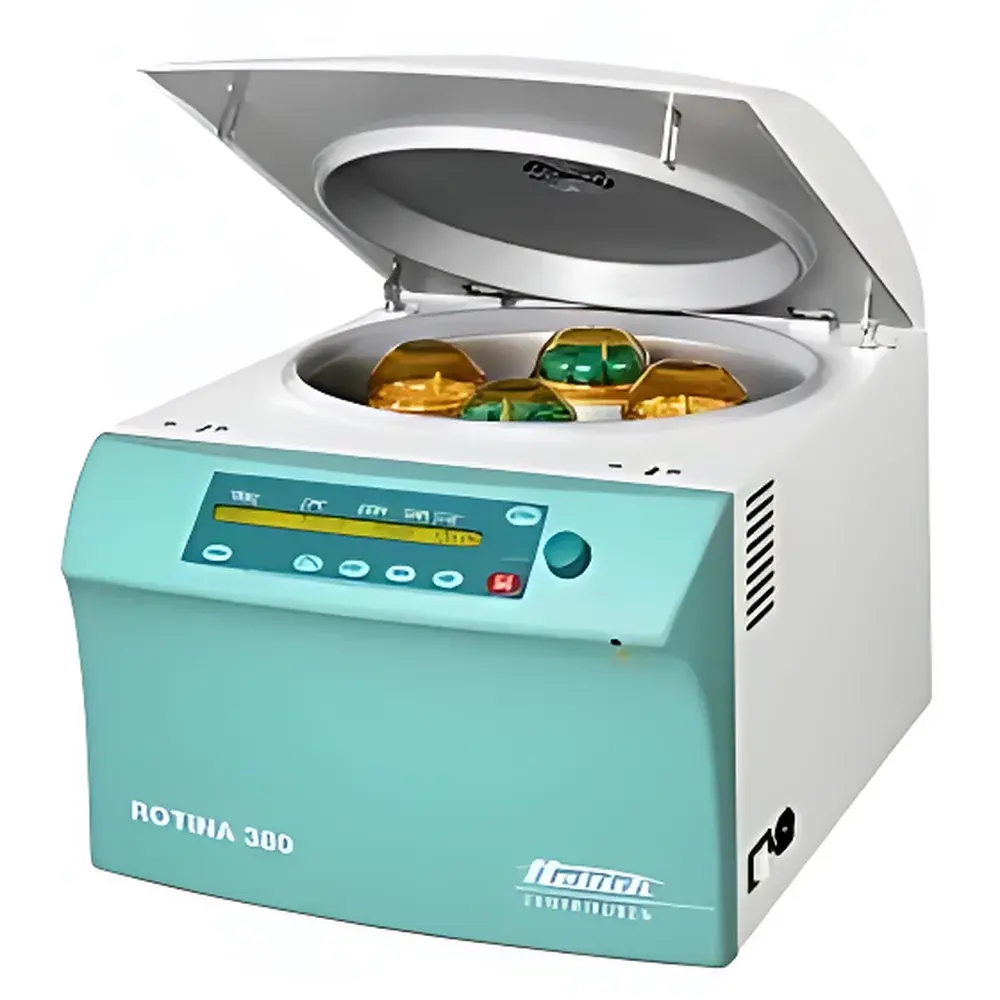
Hettich ROTINA 380 Benchtop Refrigerated Centrifuge
| Brand | Hettich |
|---|---|
| Origin | Germany |
| Model | ROTINA 380 |
| Instrument Type | Benchtop Refrigerated Centrifuge |
| Max Capacity (Horizontal Rotor) | 4 × 290 mL |
| Max Capacity (Fixed-Angle Rotor) | 6 × 94 mL or 30 × 2.0 mL |
| Max Speed | 15,000 rpm |
| Max RCF | 24,400 × g |
| Dimensions (H×W×D) | 418 × 457 × 600 mm |
| Weight | ~51 kg |
| Cooling Type | Ventilated (Non-refrigerated) |
| Rotor Compatibility | Fixed-angle, horizontal, slide, and drum rotors |
| Application Class | Biomolecular separation (nucleic acids, proteins, organelles) |
| Key Rotors | 30-place 2.0 mL fixed-angle rotor (Cat. No. 1789-A, 24,400 × g), 4-place 290 mL horizontal rotor (Cat. No. 1754, 4,863 × g), 6-place 94 mL fixed-angle rotor (Cat. No. 1792, 16,504 × g), 8-place microscope slide rotor (Cat. No. 1748, 2,415 × g) |
Overview
The Hettich ROTINA 380 is a high-performance benchtop centrifuge engineered for precision, reproducibility, and operational flexibility in demanding laboratory environments. Designed and manufactured in Germany, it operates on the principle of sedimentation-based separation under controlled rotational force—utilizing both fixed-angle and horizontal rotor configurations to achieve optimal pelleting efficiency across diverse sample types. While classified as a ventilated (non-refrigerated) unit, its robust motor architecture, low-vibration drive system, and precisely balanced rotor recognition ensure stable operation at speeds up to 15,000 rpm and relative centrifugal forces (RCF) reaching 24,400 × g. Its mechanical design prioritizes user safety, regulatory compliance, and long-term reliability—making it suitable for routine QC workflows, academic research, and clinical sample preparation where consistent g-force delivery and rotor interchangeability are critical.
Key Features
- German-engineered brushless frequency-controlled motor delivering high torque and extended service life with minimal maintenance
- Intuitive rotary dial interface with digital speed/RCF display and real-time acceleration/deceleration profiling
- Automatic rotor identification via mechanical coding—ensures safe operating limits are enforced per rotor type
- Five programmable memory slots for repeat protocols, including speed, time, and brake profile settings
- Soft-start and soft-brake functions minimize sample resuspension and protect sensitive pellets
- Low-noise operation (<65 dB(A) at maximum speed) enabled by optimized airflow management and vibration-damping chassis
- CE-marked and compliant with IEC 61010-1 (Safety Requirements for Electrical Equipment for Measurement, Control, and Laboratory Use)
Sample Compatibility & Compliance
The ROTINA 380 supports a broad spectrum of biological and chemical sample formats—including microcentrifuge tubes (0.2–2.0 mL), conical tubes (15–50 mL), universal bottles (up to 290 mL), microscope slides, and specialized containers for cell culture harvest. Its rotor library includes ISO-compliant fixed-angle, horizontal, drum, and slide carriers—each certified to EN 61010-2-020 for centrifuge-specific safety. While not a refrigerated model, its ventilated cooling design maintains ambient temperature stability during prolonged runs, avoiding thermal shock to thermolabile samples. The system meets GLP documentation requirements through traceable parameter logging (when paired with optional RS232/USB data export), and all rotors undergo rigorous dynamic balancing certification per DIN ISO 1940-1 (G2.5 grade).
Software & Data Management
The ROTINA 380 operates as a standalone instrument with no proprietary software dependency. All run parameters—including speed (rpm), RCF, time, and braking mode—are stored locally in non-volatile memory. Optional RS232 or USB interfaces enable direct connection to LIMS or ELN platforms for automated protocol transfer and audit-trail generation. When integrated into regulated environments (e.g., ISO 17025-accredited labs or FDA-regulated bioprocessing), the device supports 21 CFR Part 11–compliant data capture when used with validated third-party acquisition software—ensuring electronic records retain integrity, authenticity, and attributable timestamps. Rotor usage history and calibration logs can be exported for internal QA review or external audit preparation.
Applications
- Isolation of plasmid DNA, genomic DNA, and RNA from bacterial, mammalian, and plant lysates using high-RCF fixed-angle rotors
- Purification of subcellular fractions (mitochondria, nuclei, lysosomes) via differential centrifugation with horizontal and angle rotors
- Clarification of cell culture supernatants, fermentation broths, and serum samples prior to downstream chromatography or ELISA
- Preparation of diagnostic specimens—including blood fractionation, urine sediment concentration, and CSF analysis—in clinical pathology labs
- Routine quality control testing of reagents, vaccines, and biologics requiring standardized pelleting protocols per USP or EP 2.2.11
- Material science applications involving nanoparticle dispersion stabilization and polymer phase separation studies
FAQ
Is the ROTINA 380 a refrigerated centrifuge?
No—it is a ventilated (air-cooled) benchtop centrifuge. It does not feature active refrigeration; ambient heat dissipation is managed via internal fans and chassis ventilation.
Can I use this centrifuge for virus purification?
Yes, provided appropriate biosafety containment (e.g., sealed buckets or sealed rotors) and validated protocols are employed. The 24,400 × g capability supports ultracentrifugation-grade pelleting of enveloped and non-enveloped viruses when used with compatible rotors.
Does the ROTINA 380 support rotor auto-balancing?
It does not perform active balancing, but its mechanical rotor detection system prevents operation outside certified mass and symmetry tolerances—and the rotor hub design inherently minimizes imbalance-induced vibration.
What safety certifications apply to this instrument?
It complies with CE marking requirements under the Low Voltage Directive (2014/35/EU) and EMC Directive (2014/30/EU), and conforms to IEC 61010-1:2010 and IEC 61010-2-020:2016 for laboratory centrifuges.
How often does the ROTINA 380 require calibration?
Speed calibration is recommended annually or after any major service event. Hettich-certified technicians use traceable tachometric standards (NIST-traceable optical tachometer) to verify rpm and RCF accuracy against factory specifications.



