
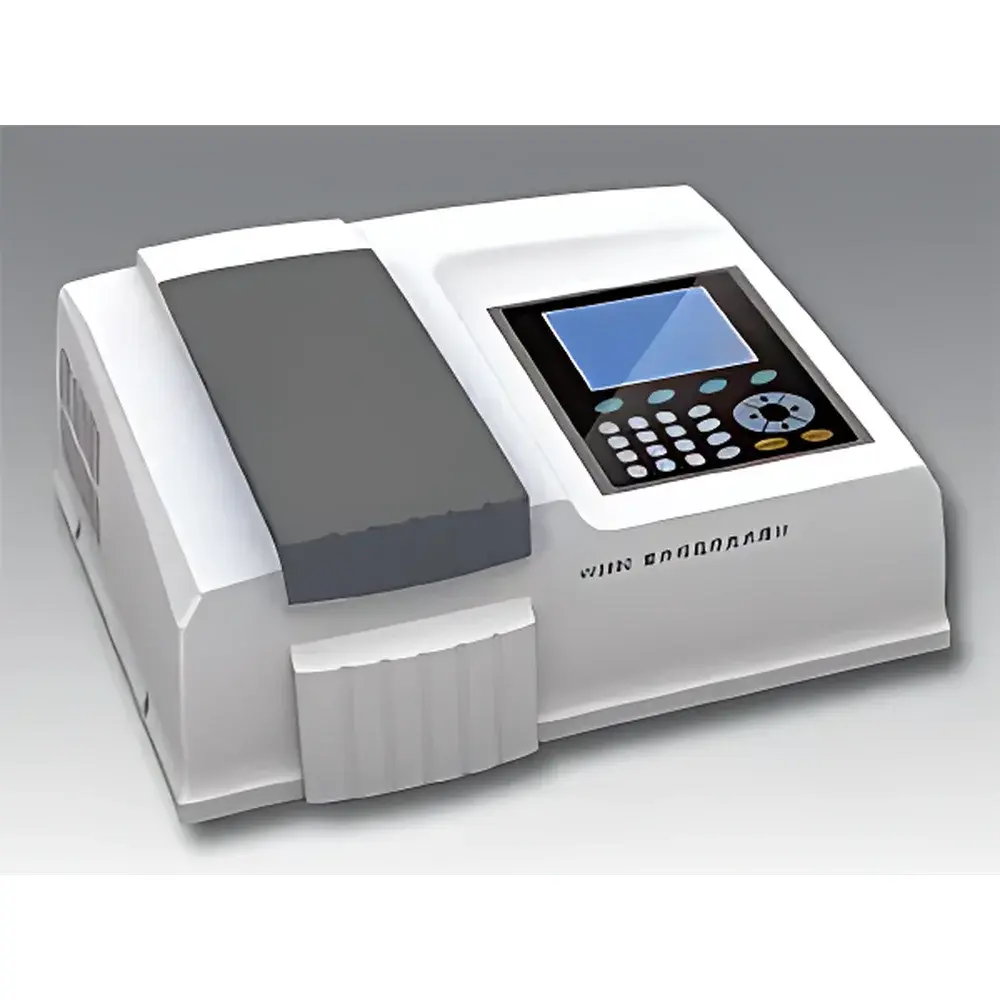
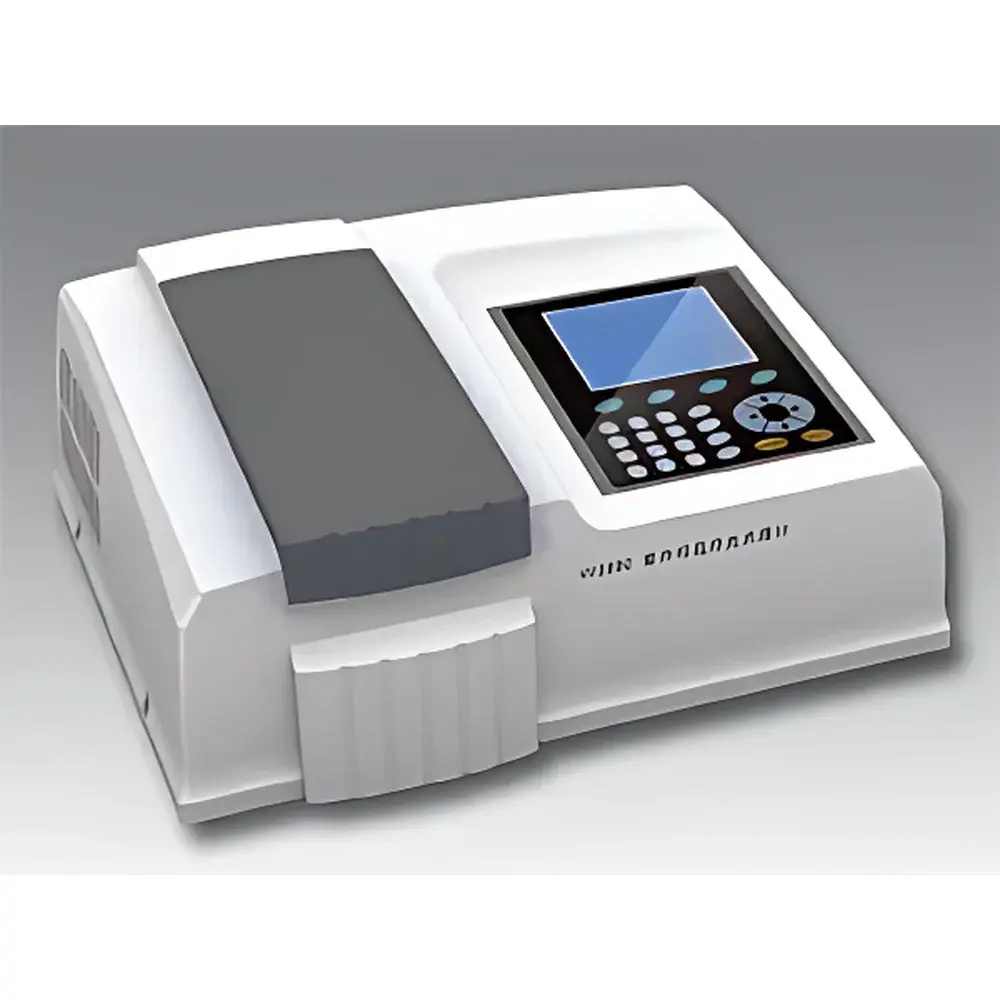
Truelab UV-2800 / UV-2800PC Dual-Beam Scanning Ultraviolet-Visible Spectrophotometer
| Brand | Truelab |
|---|---|
| Origin | Shanghai, China |
| Model | UV-2800 / UV-2800PC |
| Optical Design | Dual-beam |
| Detector | Photodiode Array (PDA) |
| Wavelength Range | 190–1100 nm |
| Spectral Bandwidth | 1.8 nm |
| Wavelength Accuracy | ±0.3 nm |
| Wavelength Repeatability | ±0.15 nm |
| Stray Light | ≤0.05% T |
| Baseline Flatness | ±0.001 A |
| Baseline Drift | ≤0.0005 A/h |
| Photometric Accuracy | ±0.3% T |
| Photometric Repeatability | ±0.15% T |
| Display | 320 × 240 LCD |
Overview
The Truelab UV-2800 and UV-2800PC are dual-beam scanning ultraviolet-visible (UV-Vis) spectrophotometers engineered for precision quantitative and qualitative analysis across research, quality control, and teaching laboratories. Based on the principle of Beer–Lambert law absorption spectroscopy, these instruments employ a balanced dual-beam optical architecture to compensate for source intensity fluctuations and detector drift in real time—ensuring exceptional baseline stability and measurement reproducibility over extended operation periods. The system utilizes a high-efficiency holographic grating monochromator coupled with a photodiode array (PDA) detector, enabling rapid spectral acquisition without mechanical slit adjustment. With a wavelength coverage from 190 nm to 1100 nm, the UV-2800 supports both deep-UV nucleic acid/protein characterization and near-infrared material screening. Its 1.8 nm spectral bandwidth delivers optimal resolution for sharp absorbance peaks while maintaining sufficient radiant throughput for low-concentration or scattering-prone samples.
Key Features
- Dual-beam optical path design with real-time reference beam correction for enhanced photometric stability and reduced baseline drift (≤0.0005 A/h)
- Photodiode array (PDA) detection system enabling full-spectrum acquisition in under 1 second per scan, eliminating moving parts associated with traditional single-detector mechanisms
- Ultra-low stray light performance (≤0.05% T at 220 nm), critical for accurate high-absorbance measurements (e.g., concentrated protein solutions or colored dyes)
- Integrated deuterium and tungsten-halogen lamps with tool-free, flange-mounted lamp housing—enabling rapid lamp replacement without optical realignment
- 320 × 240 pixel backlit LCD display with intuitive icon-driven interface; supports direct instrument operation without PC connection
- Modular hardware architecture compatible with optional accessories including temperature-controlled cuvette holders, fiber-optic probes, solid-sample reflectance modules, and micro-volume adapters
Sample Compatibility & Compliance
The UV-2800 series accommodates standard 10 mm pathlength quartz, glass, or plastic cuvettes (including matched pairs for dual-beam referencing), as well as microvolume platforms supporting down to 0.5 µL sample volumes. It complies with core international performance standards relevant to analytical spectrophotometry, including ISO 6223 (spectrophotometer calibration procedures), ASTM E275 (describing methods for measuring spectral bandpass and stray light), and USP (Ultraviolet-Visible Spectrophotometry). While not pre-certified for regulated GxP environments, its data integrity features—including user-accessible audit trails, electronic signature support via UV-Solution 3.0 software, and exportable raw data in ASCII (.txt) and bitmap (.bmp) formats—facilitate alignment with FDA 21 CFR Part 11 requirements when deployed within validated laboratory workflows.
Software & Data Management
The UV-Solution 3.0 software suite provides comprehensive instrument control and data processing capabilities. It supports method-driven workflows compliant with GLP documentation practices, including timestamped test logs, operator ID tracking, and version-controlled method storage. Key functionalities include: multi-order polynomial curve fitting (up to third-order) for quantitative analysis using up to 20 calibration standards; kinetic/time-scan mode with adjustable intervals from 0.5 s to 60 s and total duration up to 7 days; customizable wavelength scanning (0.1–5 nm step increments) with advanced post-processing tools such as 1st–4th derivative calculation, spectral overlay (up to 8 curves), smoothing algorithms (Savitzky-Golay), and automatic peak/valley detection. All spectra and quantitative results can be exported in non-proprietary formats for integration into LIMS or statistical analysis platforms (e.g., JMP, OriginLab, or Python-based analysis pipelines).
Applications
- Quantitative determination of nucleic acids (A260) and proteins (A280/A260 ratio) in molecular biology and biopharmaceutical QC labs
- Pharmaceutical assay validation per USP , including dissolution testing, excipient compatibility studies, and content uniformity analysis
- Environmental water quality monitoring (e.g., nitrate, phosphate, COD estimation via colorimetric reactions)
- Chemical kinetics studies requiring high-temporal-resolution absorbance tracking over hours or days
- Educational use in undergraduate chemistry and biochemistry curricula due to robust construction, intuitive interface, and broad spectral range
- Materials science applications such as thin-film transmittance/reflectance profiling and semiconductor bandgap estimation
FAQ
What is the difference between the UV-2800 and UV-2800PC models?
The UV-2800 operates as a standalone instrument with built-in LCD interface and basic onboard functions. The UV-2800PC includes a dedicated USB interface and is bundled with UV-Solution 3.0 software for full PC-based control, advanced data processing, and regulatory-compliant reporting.
Is the instrument suitable for GMP-regulated environments?
While the hardware meets fundamental metrological requirements, formal GMP compliance depends on site-specific validation protocols—including IQ/OQ/PQ documentation, change control procedures, and periodic performance verification against traceable standards.
Can I perform DNA/RNA purity assessment directly on the instrument?
Yes—the UV-Solution 3.0 software includes dedicated nucleic acid analysis modules that automatically calculate A260/A280 and A260/A230 ratios, concentration (ng/µL), and expected yield based on user-defined extinction coefficients.
Does the system support spectral subtraction or baseline correction?
Yes—both real-time background subtraction (using solvent or blank reference scans) and post-acquisition baseline correction (linear, polynomial, or rolling-ball algorithms) are available in UV-Solution 3.0.
What maintenance is required for long-term reliability?
Routine maintenance includes quarterly verification of wavelength accuracy using holmium oxide or didymium filters, annual lamp replacement (typical deuterium lamp lifetime: ~1000 h), and periodic cleaning of optical windows and cuvette compartments with lint-free wipes and spectroscopic-grade solvents.




