
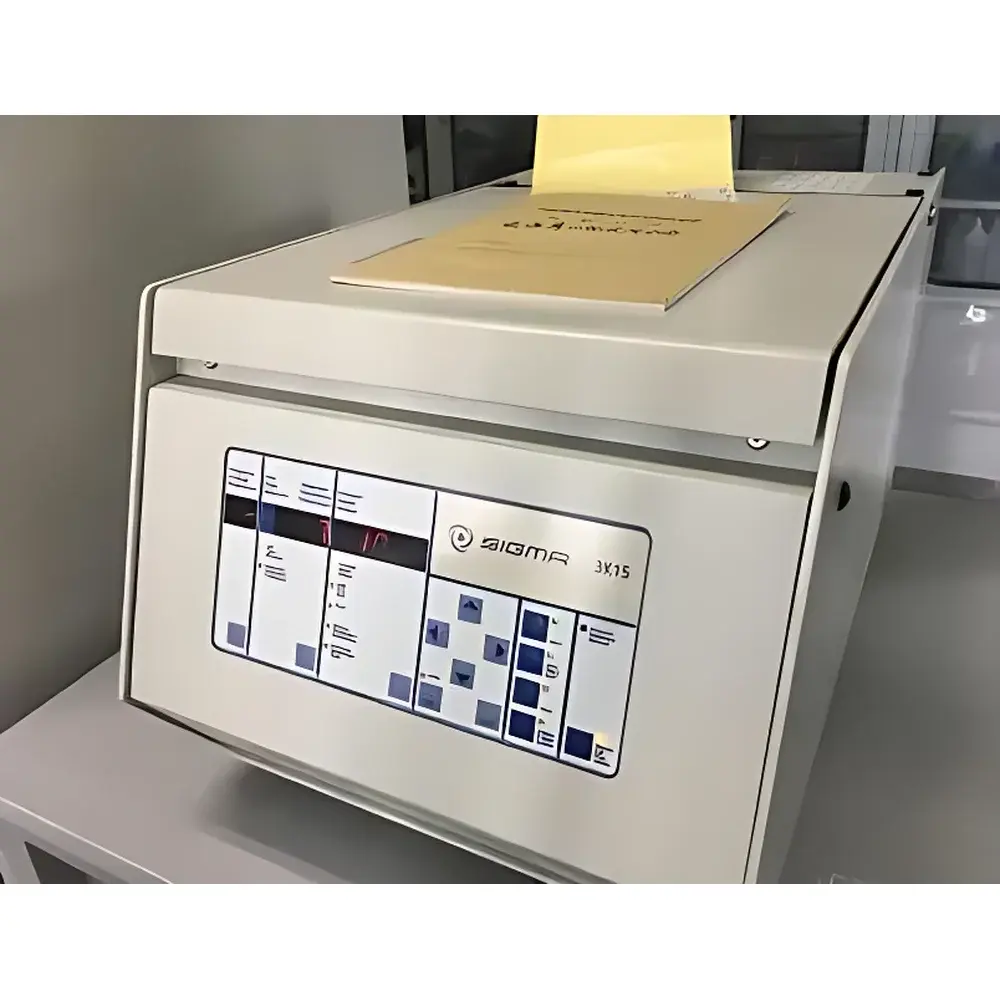
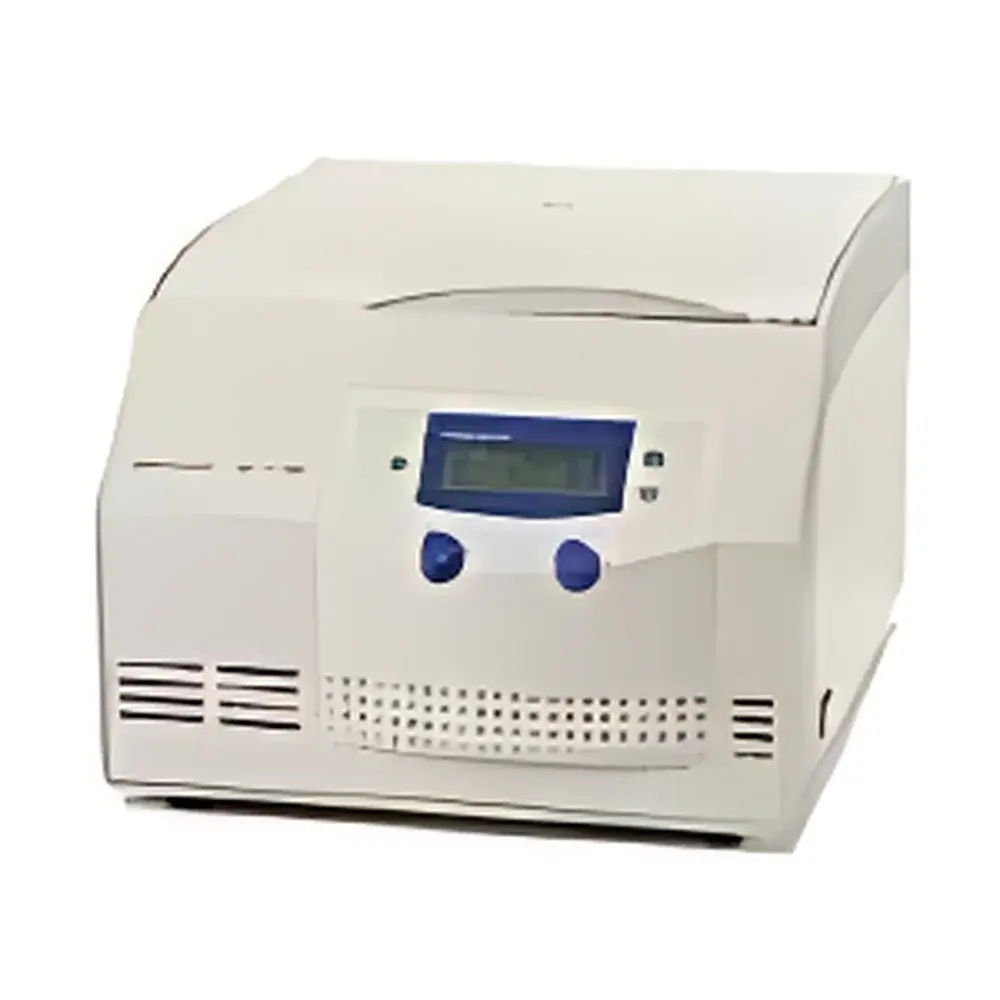
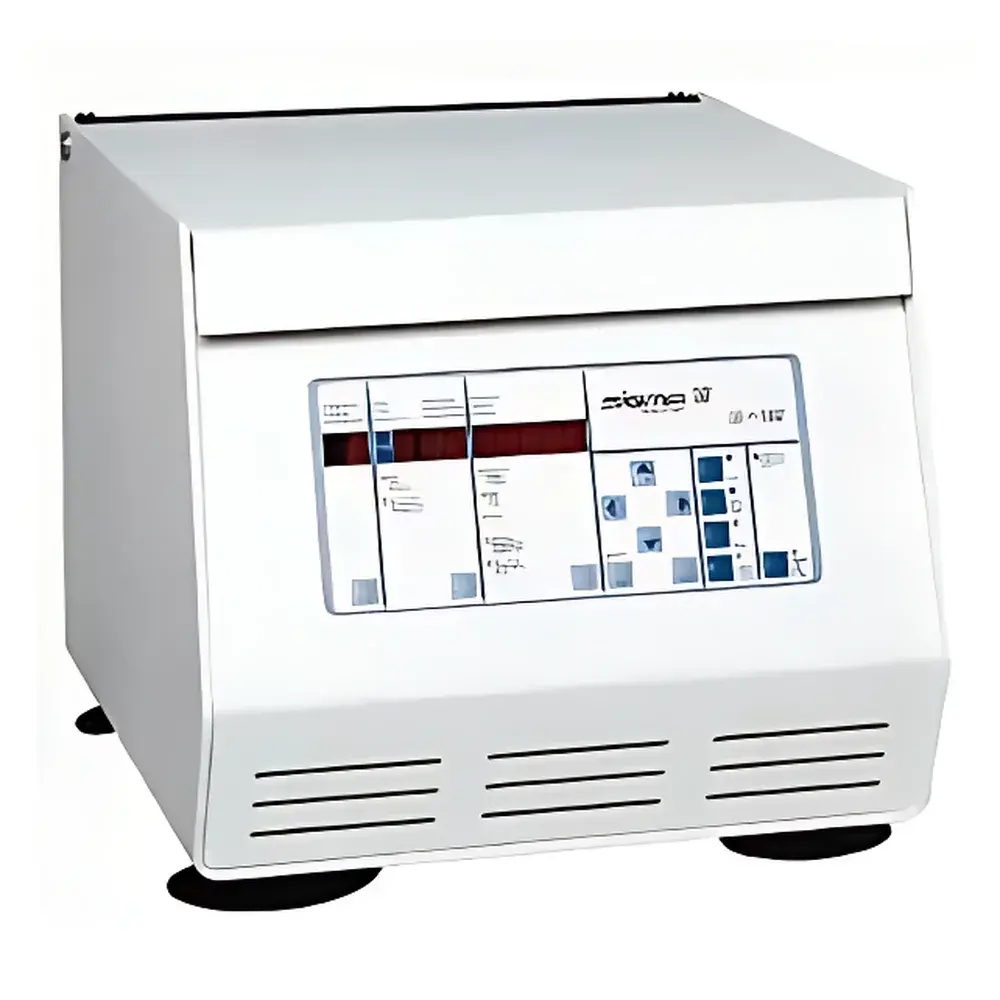
Sigma 3K-15 High-Speed Refrigerated Benchtop Centrifuge
| Brand | Sigma |
|---|---|
| Origin | Germany |
| Model | Sigma 3K-15 |
| Instrument Type | Benchtop Centrifuge |
| Speed Range | 100–15,300 rpm |
| Max RCF | 23,031 × g |
| Max Capacity | 4 × 200 mL |
| Temperature Range | −20 °C to +40 °C |
| Dimensions (W×D×H) | 375 × 410 × 675 mm |
| Net Weight (without rotor) | 64 kg |
| Noise Level | <63 dB(A) |
| Acceleration Time | 20 s |
| Minimum Deceleration Time | 28 s |
| Motor | Brushless Frequency-Controlled Drive |
| Power Supply | 230 V, 50/60 Hz |
| Centrifugation Power | 460 W |
| Cooling Power | 550 W |
| Refrigerant | R134a (CFC-free) |
| Safety Compliance | IEC 61010-1, ISO 9001 certified |
Overview
The Sigma 3K-15 is a high-performance refrigerated benchtop centrifuge engineered for precision separation of biological macromolecules—including proteins, nucleic acids, organelles, and subcellular particles—in research, clinical, and quality control laboratories. Utilizing advanced brushless frequency-controlled motor technology and magnetic rotor recognition, the system delivers exceptional rotational stability, thermal consistency, and operational safety across its full speed range (100–15,300 rpm). Its design adheres strictly to IEC 61010-1 for electrical safety and incorporates active pre-cooling functionality—enabling temperature equilibration of the chamber and rotor prior to sample loading—critical for preserving thermolabile biomolecules during high-speed pelleting or density gradient separations. The unit’s compact footprint (375 × 410 × 675 mm) and 64 kg net weight ensure stable operation on standard laboratory benches without requiring dedicated anchoring.
Key Features
- Brushless, maintenance-free drive motor with extended service life and low electromagnetic interference
- Magnetic rotor identification system prevents overspeeding by automatically detecting rotor type and enforcing maximum safe speed limits
- Microprocessor-based control panel with real-time digital display of speed (rpm), relative centrifugal force (×g), time, and chamber temperature
- Programmable acceleration and deceleration profiles: 20 user-selectable curves to minimize sample disturbance during spin-up/spin-down
- 10 programmable memory slots for storing frequently used protocols—including time (up to 9 h 59 min or continuous mode), temperature setpoint, and rotor-specific parameters
- R134a refrigerant cooling system enabling rapid temperature stabilization from −20 °C to +40 °C, with precise ±1 °C regulation accuracy
- Low-noise operation (<63 dB[A]) achieved via optimized airflow management and vibration-dampened rotor housing
- Automatic lid lock with mechanical and electronic interlocks compliant with IEC 61010-1 safety requirements
Sample Compatibility & Compliance
The Sigma 3K-15 supports a broad spectrum of sample formats through interchangeable rotors—including fixed-angle, swing-bucket, and specialized adapters—accommodating volumes from 0.2 mL microtubes to 4 × 200 mL bottles. Certified rotor configurations include 24 × 2.2 mL (15,300 rpm / 21,460 × g), 30 × 2.2 mL (14,000 rpm / 21,918 × g), 6 × 85 mL (8,000 rpm / 6,941 × g), and 4 × 200 mL swing-bucket (5,500 rpm / 5,039 × g). All rotors are manufactured to DIN EN ISO 13485 standards and validated for repeated sterilization cycles (e.g., autoclaving at 121 °C for 20 min where applicable). The instrument meets GLP-relevant operational traceability requirements when paired with optional data logging software and complies with FDA 21 CFR Part 11 principles for electronic record integrity when audit trails are enabled.
Software & Data Management
While the Sigma 3K-15 operates as a standalone instrument, its embedded controller supports optional USB data export for protocol archiving and routine verification. Timestamped run logs—including start/stop time, final speed, actual RCF, chamber temperature deviation, and rotor ID—are retained in non-volatile memory for up to 1,000 cycles. For regulated environments, integration with laboratory information management systems (LIMS) is achievable via RS-232 or optional Ethernet module (sold separately), enabling remote monitoring, SOP-driven parameter locking, and electronic signature support per 21 CFR Part 11 Annex 11 guidelines. Firmware updates are delivered via secure authenticated channels to maintain cybersecurity compliance.
Applications
This centrifuge is routinely deployed in molecular biology workflows for plasmid DNA purification, viral pellet recovery, and ribosome isolation; in cell biology for mitochondrial enrichment and nuclear fractionation; and in biopharmaceutical QC for particle removal in monoclonal antibody formulations. Its −20 °C capability enables cryoprecipitation of fibrinogen and cold-sensitive enzyme complexes, while its high RCF capacity supports rapid clarification of bacterial lysates and mammalian cell culture supernatants. In clinical diagnostics, it fulfills CLSI EP05-A3 requirements for reproducibility in serum/plasma separation and meets ISO 15189 criteria for centrifugation step validation in accredited labs.
FAQ
Does the Sigma 3K-15 support rotor auto-recognition?
Yes—integrated magnetic sensing identifies each certified rotor upon installation and enforces corresponding speed and temperature limits.
Can the chamber be pre-cooled with the lid open?
Yes—pre-cooling is permitted with the lid open to accelerate thermal equilibration before sample loading.
Is the unit compatible with ISO 15189-accredited laboratory workflows?
Yes—when used with documented calibration records, validated rotor sets, and optional electronic audit trail modules, it satisfies critical process control requirements.
What refrigerant is used, and is it environmentally compliant?
R134a is employed—a zero-ozone-depletion-potential (ODP = 0), low-global-warming-potential (GWP = 1430) refrigerant compliant with EU F-Gas Regulation (EU) No 517/2014.
How is maintenance tracked under the manufacturer’s warranty?
Sigma provides a 24-month parts-and-labor warranty from commissioning date, backed by certified field service engineers trained to ISO/IEC 17025 competency standards.



