
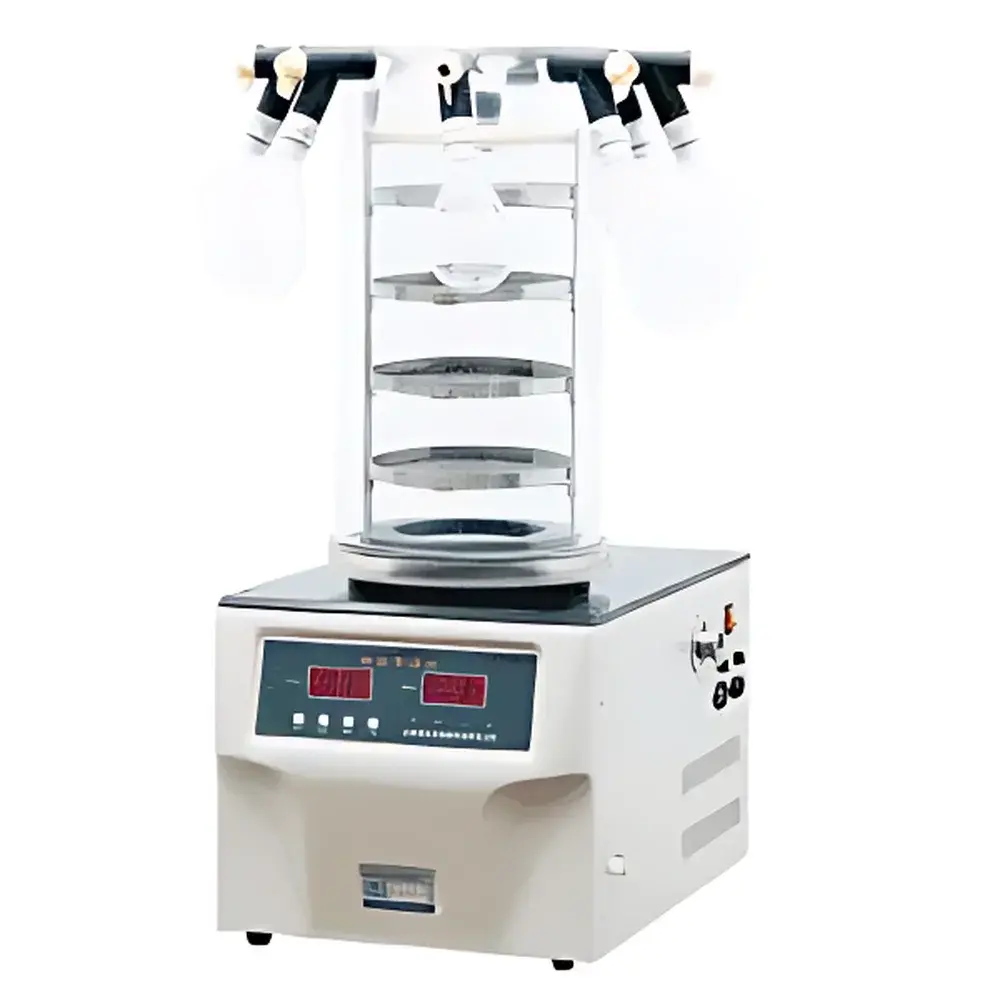
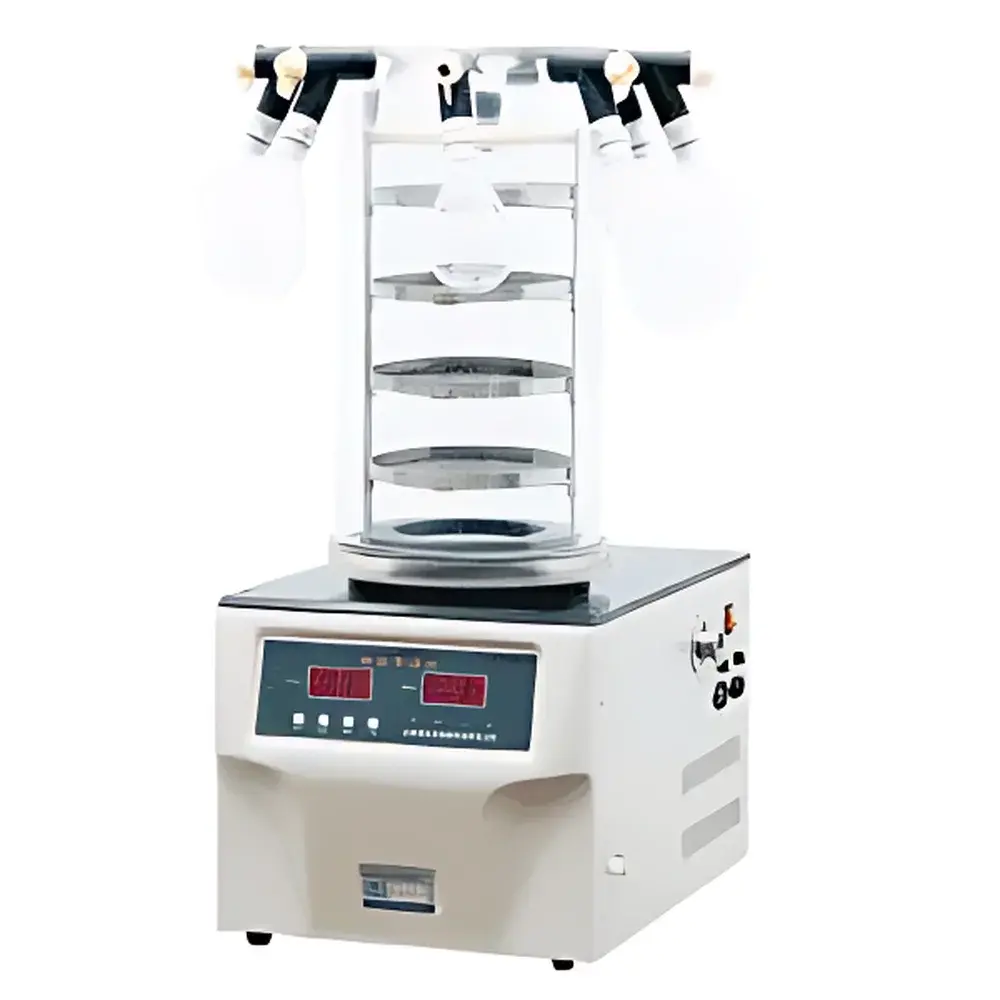
BIOCOOL FD-1C-50 & FD-1C-80 Manifold-Type Benchtop Freeze Dryer
| Brand | BIOCOOL |
|---|---|
| Origin | Shanghai, China |
| Model | FD-1C-50 / FD-1C-80 |
| Instrument Type | Manifold-type freeze dryer |
| Application Scale | Pilot-scale |
| Freeze-drying Area | 0.12 m² |
| Ultimate Vacuum | < 20 Pa |
| Condenser Temperature | −50 °C (FD-1C-50) / −80 °C (FD-1C-80) |
| Water Capture Capacity | 3 kg/24 h |
| Condenser Dimensions | Ø200 mm × 4 trays |
| Power Supply | 220 V, 50 Hz, 800–850 W |
| Main Unit Dimensions (W×D×H) | 380×300×645 mm (FD-1C-50) / 500×500×750 mm (FD-1C-80) |
| Standard Configuration | Benchtop主机, 2 L domestic vacuum pump, manifold drying assembly, 8 rubber stopcock valves, 8 glass freeze-drying flasks, stainless steel sample shelf |
Overview
The BIOCOOL FD-1C-50 and FD-1C-80 are compact, benchtop manifold-type freeze dryers engineered for pilot-scale lyophilization of heat-sensitive biological, pharmaceutical, and analytical samples. These systems operate on the fundamental principles of sublimation under deep vacuum and low-temperature condensation—where frozen water is removed directly from the solid phase to vapor without passing through the liquid state. The process preserves structural integrity, bioactivity, and chemical stability of labile compounds such as enzymes, vaccines, antibodies, and natural extracts. Designed for laboratories requiring flexibility between flask-based and tray-based drying, the FD-1C series integrates a high-efficiency refrigeration system with a large-diameter stainless-steel condenser chamber and a transparent bell-jar drying chamber—enabling real-time visual monitoring while maintaining operator safety and process transparency.
Key Features
- Two condenser temperature options: −50 °C (FD-1C-50) and −80 °C (FD-1C-80), enabling optimal water vapor capture across diverse sample matrices—including those with low eutectic points or high solute concentrations.
- Patented baffle-guided airflow design maximizes effective condenser surface area, accelerating primary drying kinetics without compromising ice-layer uniformity.
- Full stainless-steel condenser chamber with no internal coil structure—ensuring corrosion resistance, easy cleaning, and unrestricted ice accumulation capacity up to 3 kg per 24-hour cycle.
- Manifold configuration with eight independently controllable rubber stopcock valves allows simultaneous drying of multiple samples in standard lyophilization flasks (e.g., 100 mL, 250 mL, 500 mL), supporting parallel process development and formulation screening.
- Integrated pre-freezing capability within the condenser chamber eliminates the need for external ultra-low temperature freezers, streamlining workflow and reducing cross-contamination risk.
- Digital vacuum and condenser temperature display with ±1 Pa and ±0.5 °C resolution supports precise process documentation and reproducible method transfer.
- Standardized KF-25 vacuum interface ensures compatibility with a broad range of domestic and international vacuum pumps—including oil-lubricated, dry scroll, and diaphragm types—meeting ISO 2859-1 sampling requirements for vacuum system qualification.
Sample Compatibility & Compliance
The FD-1C series accommodates a wide spectrum of sample formats: aqueous solutions, suspensions, emulsions, and viscous gels loaded into borosilicate glass flasks or shallow stainless-steel trays (Ø200 mm × 4 layers). Its 0.12 m² drying area supports batch capacities up to 1.2 L of solution volume. All wetted surfaces comply with ASTM F838-22 for extractables testing and meet USP material compatibility criteria for pharmaceutical use. While not GMP-certified out-of-the-box, the system supports GLP-compliant operation when paired with audit-trail-capable data loggers and validated vacuum sensors—facilitating alignment with FDA 21 CFR Part 11 requirements for electronic records in regulated environments.
Software & Data Management
The base configuration includes analog vacuum and temperature readouts; optional digital controllers provide RS-485 or USB connectivity for integration with LabVIEW, MATLAB, or custom SCADA platforms. Real-time logging of condenser temperature, chamber pressure, and (when equipped) sample thermocouple readings enables full traceability for method validation. Data export in CSV format supports statistical process control (SPC) analysis per ISO 13485 Annex C and facilitates compliance with ICH Q5C stability protocol reporting standards.
Applications
- Pharmaceutical R&D: Lyophilization of monoclonal antibody formulations, peptide APIs, and sterile drug product intermediates.
- Biotechnology: Stabilization of viral vectors, CRISPR-Cas complexes, and cell lysates prior to long-term storage or transport.
- Food & Agriculture: Preservation of probiotics, plant extracts, and microbial cultures without thermal degradation.
- Academic Research: Preparation of calibration standards for mass spectrometry, reference materials for elemental analysis, and archival storage of rare biological specimens.
- Environmental Testing: Concentration and stabilization of waterborne pathogens and dissolved organic matter for subsequent qPCR or LC-MS analysis.
FAQ
What is the difference between FD-1C-50 and FD-1C-80?
The primary distinction lies in condenser operating temperature: FD-1C-50 achieves −50 °C, suitable for most aqueous buffers and low-viscosity formulations; FD-1C-80 reaches −80 °C, recommended for high-solute-content samples, organic-aqueous mixtures, or materials with eutectic temperatures below −50 °C.
Can this system be used for GMP manufacturing?
It is designed for laboratory-scale development and pilot studies—not for commercial production. However, its modular architecture, standardized interfaces, and compatibility with qualified vacuum pumps allow it to serve as a platform for process characterization aligned with QbD principles under ICH Q8.
Is sample temperature monitoring included by default?
No—sample temperature sensing is an optional add-on. A calibrated PT100 probe with dedicated port can be installed for direct measurement of product interface temperature during primary drying.
What vacuum pump is recommended for optimal performance?
A two-stage oil-sealed rotary vane pump rated at ≤2 m³/h and ultimate vacuum ≤5 × 10⁻² Pa is recommended. Dry scroll pumps may be used but require careful evaluation of vapor load tolerance and potential backstreaming contamination.
How often should the condenser be defrosted?
Defrosting is required when ice accumulation exceeds 80% of chamber volume—or after each complete 24-hour cycle if operating continuously. Manual defrost via ambient air or controlled warm nitrogen purge is advised to avoid thermal shock to stainless-steel components.
Related Products



