
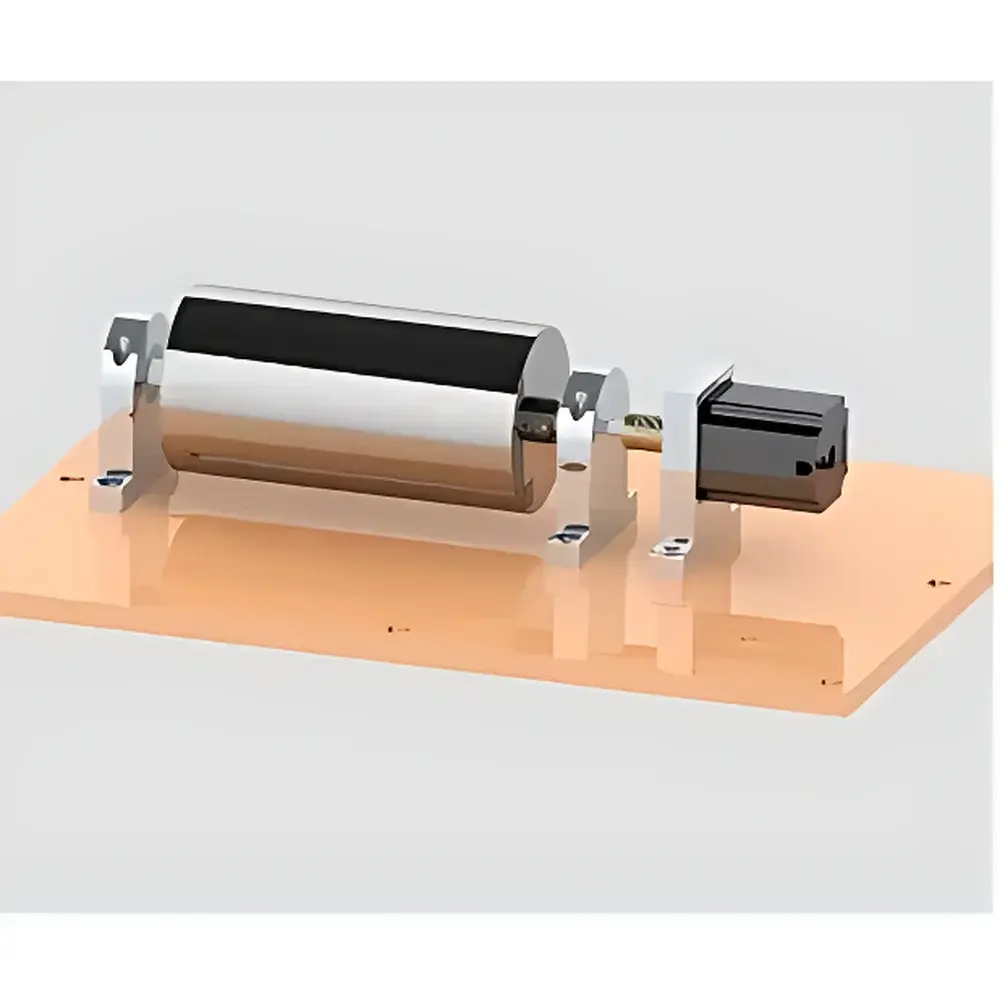
Truelab Drum Collector for Electrospinning (300–3600 rpm)
| Brand | Truelab |
|---|---|
| Origin | Shanghai, China |
| Manufacturer Type | Authorized Distributor |
| Country of Origin | China |
| Model | Drum Collector 300–3600 rpm |
| Motor | Brushless DC High-Speed Motor |
| Speed Range | 300–3600 rpm ±20 rpm |
| Drum Material | AISI 304 Stainless Steel |
| Drum Dimensions | Ø102 mm × L200 mm |
| Base Material | Phenolic Resin (Bakelite), Electrically Insulated |
| Base Dimensions | W520 × D388 × H20 mm |
| Overall Dimensions | W520 × D388 × H135 mm |
| Weight | 18 kg |
Overview
The Truelab Drum Collector for Electrospinning (300–3600 rpm) is a precision-engineered rotational collection system designed specifically for high-efficiency nanofiber deposition in laboratory-scale electrospinning processes. It operates on the principle of centrifugal alignment and electrostatic attraction: as the grounded, rotating drum intercepts charged polymer jets, its surface velocity—tuned via precise angular control—enhances fiber orientation, packing density, and uniformity. Unlike passive collectors, this system enables active control over fiber morphology through tunable tangential speed, making it essential for producing aligned nanofibrous mats used in tissue engineering scaffolds, filtration membranes, and piezoelectric sensor substrates. The unit is not a standalone power source but functions as an integrated mechanical subsystem, requiring external coordination with high-voltage power supplies (e.g., 0–30 kV DC) and syringe pump systems. Its design prioritizes electromagnetic compatibility, mechanical stability under sustained rotation, and material compatibility with common electrospinning solvents (e.g., DMF, chloroform, HFIP).
Key Features
- Brushless DC high-speed motor delivering stable torque across the full 300–3600 rpm range, with speed accuracy of ±20 rpm—critical for reproducible fiber alignment studies.
- AISI 304 stainless steel drum (Ø102 mm × 200 mm L) offering corrosion resistance, non-magnetic properties, and ease of cleaning between polymer formulations.
- Electrically insulated phenolic resin (Bakelite) base—UL94 HB rated—with integrated grounding terminals to prevent charge accumulation and ensure operator safety during high-voltage operation.
- Bi-directional rotation control via K12-compatible interface, enabling comparative studies of fiber deposition under forward vs. reverse drum motion.
- Robust mechanical architecture: reinforced mounting points, low-vibration bearing assembly, and rigid base geometry (W520 × D388 × H20 mm) to minimize resonance at high rotational speeds.
- Compact footprint (W520 × D388 × H135 mm) optimized for integration into Class II biosafety cabinets or fume hoods without compromising access or airflow.
Sample Compatibility & Compliance
The collector accommodates standard electrospinning setups using single- or multi-nozzle spinnerets. Compatible with aqueous and organic solvent-based polymer solutions including PCL, PLA, PAN, PVDF, gelatin, and collagen derivatives. All wetted surfaces are non-porous and chemically inert to common solvents. The device complies with IEC 61000-6-2 (immunity) and IEC 61000-6-3 (emission) standards for laboratory equipment. While not certified for GMP manufacturing environments, its construction supports GLP-aligned documentation workflows—including logbook-integrated speed calibration records and maintenance tracking per ISO/IEC 17025 Annex A.3 guidelines.
Software & Data Management
The collector interfaces exclusively with the optional K12 programmable controller (sold separately), which provides analog/digital I/O for synchronization with auxiliary instruments (e.g., syringe pump start/stop triggers, HV supply ramp signals). The K12 firmware supports up to 10 pre-programmed speed profiles, real-time RPM feedback logging (via RS-485), and timestamped audit trails exportable as CSV. For regulated environments, the K12 platform optionally supports 21 CFR Part 11-compliant user authentication, electronic signatures, and immutable data archiving when paired with validated PC-based acquisition software.
Applications
- Controlled alignment of polymeric nanofibers for neural tissue engineering and ligament regeneration studies.
- Rapid screening of solution conductivity and voltage effects on fiber diameter distribution (via correlated SEM + ImageJ analysis).
- Deposition of core–shell fibers onto rotating substrates to induce helical morphology.
- High-throughput collection of nanofiber mats for subsequent mechanical testing (tensile strength, elongation at break per ASTM D638).
- Integration into hybrid electrospinning–electrospraying platforms for composite particle/fiber co-deposition.
FAQ
What voltage supply is required to operate the drum collector?
The drum collector itself requires only a 24 V DC input for the motor driver. It does not generate high voltage; external high-voltage power supplies (0–30 kV) must be sourced separately for the electrospinning process.
Is the drum balanced dynamically before shipment?
Yes—each drum undergoes static and dynamic balancing per ISO 1940-1 G2.5 grade prior to factory calibration to ensure vibration < 0.71 mm/s RMS at 3600 rpm.
Can the collector be mounted vertically or at an angle?
No—it is engineered exclusively for horizontal orientation. Tilting compromises bearing load distribution and introduces axial runout beyond specification limits.
Does the system include speed calibration certification?
A NIST-traceable tachometer verification report is provided with each unit, documenting speed accuracy across five setpoints (300, 1200, 2000, 3000, and 3600 rpm) at ambient 23 ± 2 °C.
What maintenance intervals are recommended?
Motor bearings require re-lubrication every 2000 operational hours; drum surface inspection and cleaning with isopropanol are advised after each polymer batch to prevent residue buildup.



