
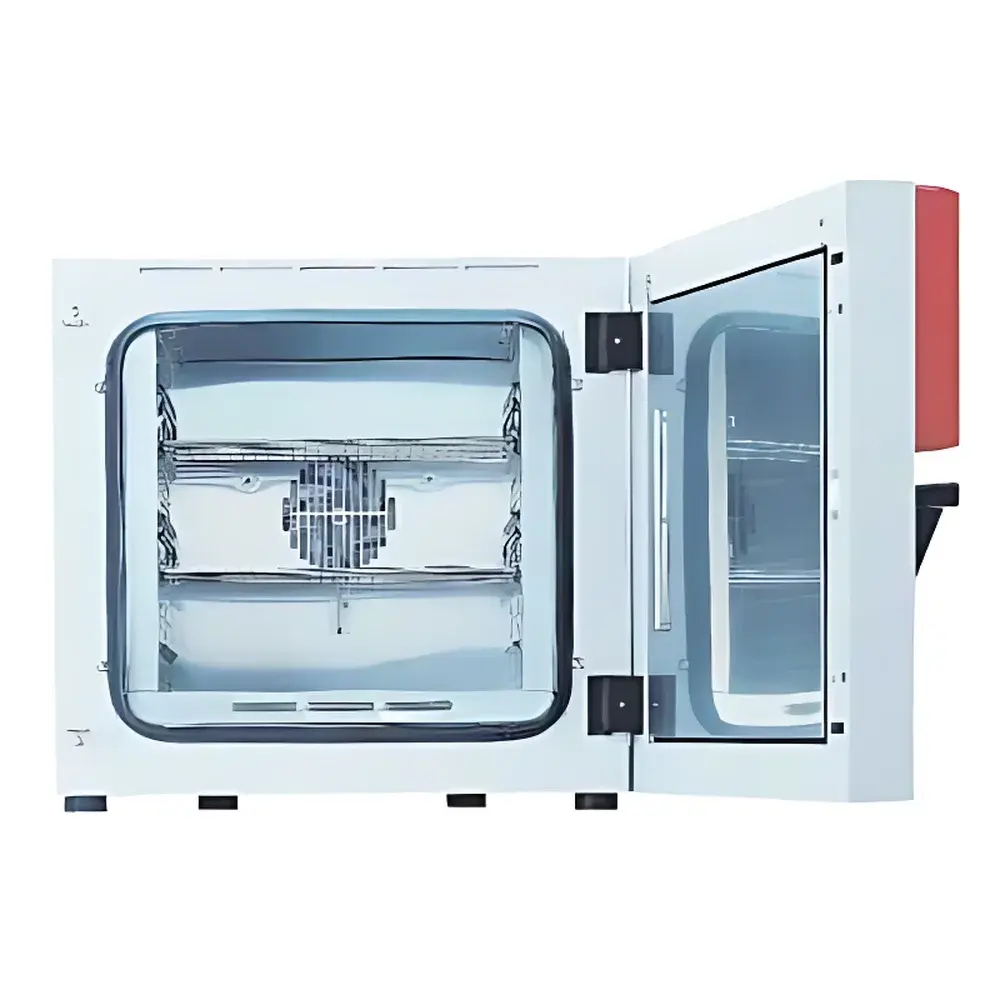
BINDER FD115 Forced-Convection Drying Oven
| Brand | BINDER |
|---|---|
| Origin | Germany |
| Model | FD115 |
| Temperature Range | Ambient +5 °C to 300 °C |
| Temperature Uniformity | ±0.7 °C at 150 °C (DIN 12880) |
| Temperature Fluctuation | ±0.3 °C |
| Internal Dimensions (W×H×D) | 600 × 480 × 400 mm |
| Internal Volume | 115 L |
| Chamber Material | Stainless Steel (AISI 304) |
| Heating Method | Electric, Forced-Air Convection with APT.line® Preheating Technology |
| External Dimensions (W×H×D) | 834 × 702 × 645 mm |
| Net Weight | 62 kg |
| Power Supply | 230 V, 1.6 kW, 50/60 Hz |
| Standard Shelving | 2 chrome-plated stainless steel shelves (20 kg load per shelf, 50 kg total) |
| Safety | Dual-stage independent temperature safety device (DIN 12880 Class 2), visual alarm |
| Ventilation | Adjustable front baffle + rear 50 mm exhaust duct |
| Controller | DS digital controller with electronic timer (0–99 h 59 min), 1 °C setpoint resolution |
Overview
The BINDER FD115 Forced-Convection Drying Oven is a precision-engineered laboratory drying and conditioning system designed for applications demanding high thermal stability, repeatability, and spatial uniformity across the entire working chamber. Built in Tuttlingen, Germany, and compliant with DIN 12880 Class 2 safety standards, the FD115 employs BINDER’s proprietary APT.line® preheating technology—a thermally integrated chamber wall system that actively preheats the inner chamber walls prior to and during operation. Unlike conventional convection ovens relying solely on air circulation, APT.line® eliminates vertical thermal gradients by establishing a uniform thermal boundary layer around the cavity, resulting in exceptional temperature homogeneity—even under full-load conditions and during dynamic thermal transitions. This architecture ensures traceable, reproducible thermal environments essential for material drying, moisture analysis, polymer curing, stability testing, and pre-conditioning of samples prior to analytical procedures such as gravimetric analysis or chromatography sample preparation.
Key Features
- APT.line® preheating technology: Actively heated chamber walls ensure uniform temperature distribution (±0.7 °C at 150 °C, per DIN 12880) and minimize recovery time after door opening (≤2 min to re-attain 70 °C following 30-second door exposure).
- Digital DS controller with precise 1 °C setpoint resolution, programmable timer (0–99 h 59 min), and continuous operation mode.
- Independent dual-stage overtemperature safety device (DIN 12880 Class 2) with visual alarm—certified for use in GLP and GMP-regulated laboratories.
- Forced-air convection system with adjustable front ventilation baffle and rear 50 mm exhaust duct for controlled air exchange (29 h⁻¹ at 70 °C; 32 h⁻¹ at 150 °C).
- Stainless steel (AISI 304) interior chamber (600 × 480 × 400 mm; 115 L volume) with rounded corners for easy cleaning and contamination control.
- Two chrome-plated stainless steel shelves rated for 20 kg each (50 kg total); optional shelving kits available for expanded capacity and load distribution.
- Robust insulation and energy-efficient heating (1.6 kW, 230 V) enabling rapid ramp rates: ≤7 min to 70 °C; ≤28 min to 150 °C; ≤49 min to 300 °C.
Sample Compatibility & Compliance
The FD115 accommodates a broad range of sample types—including glassware, metal components, polymer substrates, pharmaceutical excipients, ceramic powders, and biological matrices—without risk of cross-contamination or thermal degradation due to its inert stainless steel chamber and absence of catalytic surfaces. Its validated thermal performance supports compliance with multiple international standards: ASTM E145 (Standard Specification for Gravity-Convection and Forced-Ventilation Ovens), ISO 17025 (for calibration traceability of temperature sensors), USP (Thermal Analysis), and ICH Q1A–Q1E (stability testing guidelines). The dual-stage safety system satisfies requirements for unattended operation in regulated environments, while the controller’s non-volatile memory retains settings during power interruption—supporting audit readiness per FDA 21 CFR Part 11 when paired with appropriate validation documentation.
Software & Data Management
While the FD115 operates natively via its embedded DS controller, it is fully compatible with BINDER’s optional CLEVERLINE software suite (via RS485 interface) for remote monitoring, data logging, and protocol-driven operation. CLEVERLINE enables real-time graphing of chamber temperature, event-triggered alarms, export of CSV-formatted temperature logs with timestamps, and generation of IQ/OQ/PQ validation reports. All logged data include operator ID, setpoint history, deviation alerts, and safety system status—ensuring full traceability for GLP, GMP, and ISO 17025 quality systems. The controller itself maintains internal event logs (e.g., door openings, safety trips, timer completions) with time/date stamps for internal review.
Applications
- Moisture content determination (per AOAC 950.46, ISO 5530-1, and USP ) using gravimetric loss-on-drying protocols.
- Pre-drying of filter papers, crucibles, and volumetric glassware prior to quantitative analysis.
- Curing and post-baking of coatings, adhesives, and printed circuit board (PCB) laminates under controlled thermal profiles.
- Accelerated stability testing of active pharmaceutical ingredients (APIs) and formulated products per ICH Q1 guidelines.
- Conditioning of hygroscopic reference materials and calibration standards prior to weighing or spectroscopic analysis.
- Thermal decontamination of reusable labware in research and diagnostic laboratories adhering to ISO 15189 or CLIA requirements.
FAQ
What is the significance of APT.line® technology compared to standard forced-convection ovens?
APT.line® actively heats the chamber walls to create a thermally balanced boundary condition—reducing vertical temperature stratification and improving uniformity by up to 40% versus conventional designs. This is critical for multi-shelf loading and regulatory-compliant drying protocols.
Does the FD115 support validation for GMP environments?
Yes—the oven includes hardware-level safety redundancy, stable thermal performance verified per DIN 12880, and compatibility with BINDER’s CLEVERLINE software for electronic records and audit trails required under FDA 21 CFR Part 11.
Can the ventilation rate be adjusted for solvent evaporation applications?
Yes—air exchange is manually regulated via the front ventilation baffle and rear 50 mm exhaust port, allowing optimization for volatile organic compound (VOC) removal while maintaining thermal stability.
Is the internal chamber accessible for cleaning and maintenance?
The seamless AISI 304 stainless steel interior features radius-curved corners and removable shelves; all surfaces are compatible with common laboratory disinfectants and passivation agents.
What is the maximum permissible load for validated thermal uniformity?
Thermal uniformity specifications (±0.7 °C at 150 °C) are validated at full load—defined as six standard shelves loaded to 20 kg each—as specified in BINDER’s factory test reports and IQ/OQ documentation packages.



