
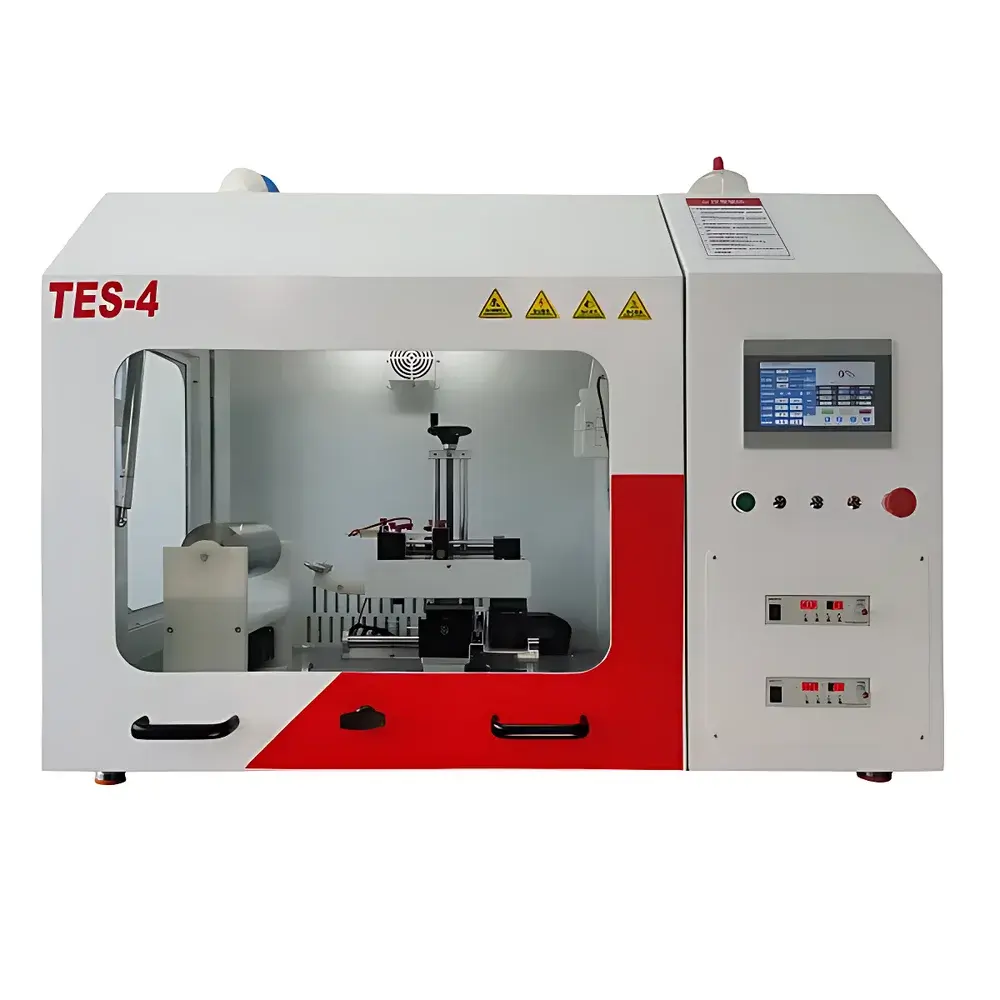
Truelab TES-4 Multifunctional Laboratory Electrospinning System
| Brand | Truelab |
|---|---|
| Origin | Shanghai, China |
| Model | TES-4 |
| Voltage Output | ±30 kV (standard), optional ±60 kV |
| Collector | 304 stainless steel roller, servo-driven, max. 3000 rpm |
| Syringe Pump | Dual-channel, 2–60 mL compatibility, high-voltage rated |
| Motion Control | X (280 mm, manual), Y (180 mm auto-reciprocating, up to 3000 mm/min), Z (100 mm, manual) |
| Environmental Control | PID-controlled heating (far-infrared), condensation dehumidification, thermal evaporation humidification |
| Safety | Emergency stop, grounded conductive structure, explosion-proof tempered glass viewport, anti-static floor mat, UV germicidal lamp, observation lamp |
| Compliance | Designed for GLP-compliant electrospinning R&D environments |
| Software | Proprietary PLC-based electrospinning OS with real-time environmental logging, parameter recall, and audit-ready operation history |
Overview
The Truelab TES-4 Multifunctional Laboratory Electrospinning System is an engineered platform for reproducible nanofiber fabrication via electrohydrodynamic processing. It operates on the principle of applying high-voltage electric fields (±30 kV standard) across a polymer solution or melt, inducing jet formation and solvent evaporation to yield continuous submicron-to-nanometer diameter fibers. Unlike single-purpose benchtop units, the TES-4 integrates synchronized motion control, environmental regulation, and multi-modal collector compatibility—enabling systematic investigation of fiber morphology, alignment, crystallinity, and deposition uniformity under controlled temperature (±0.5 °C stability) and relative humidity (±3% RH accuracy). Its architecture supports both fundamental polymer physics studies and translational development of functional membranes for filtration, tissue engineering scaffolds, battery separators, and drug delivery matrices.
Key Features
- Expanded working chamber with top-hinged access door and left-side sliding panel—facilitating rapid collector exchange, membrane retrieval, and in situ process intervention.
- Explosion-resistant tempered glass viewport backed by matte black interior surface—optimizing visual contrast for real-time jet trajectory assessment and Taylor cone monitoring without optical distortion.
- Full-system grounding architecture: all conductive components—including roller collector shafts, injection manifolds, and chassis—are bonded to a dedicated earth reference point via low-impedance contact columns, minimizing charge accumulation and arcing risk.
- Dual-axis programmable motion stage: Y-axis employs dual linear rails with closed-loop servo positioning (0.01 mm resolution, 3000 mm/min max speed); X- and Z-axes feature calibrated manual translation with locking mechanisms and engraved metric scales for precise nozzle-to-collector gap definition (critical for field strength calibration).
- Integrated environmental management: far-infrared heating elements enable rapid, flameless thermal ramping; condensation-based dehumidification maintains low dew-point conditions during solvent-sensitive spinning (e.g., chloroform-based PCL solutions); PID-regulated thermal evaporation humidification allows dynamic RH setpoint modulation between 10–90% RH.
- Dedicated electrospinning power supply with comprehensive protection logic—overvoltage, overcurrent, and arc detection trigger immediate voltage cutoff and status flagging in the control log.
Sample Compatibility & Compliance
The TES-4 accommodates diverse feedstock chemistries including synthetic polymers (PVA, PAN, PLA, PVDF), biopolymers (collagen, chitosan, gelatin), ceramic precursors (PVP–TiO₂, PVP–SiO₂), and composite suspensions containing nanoparticles or bioactive agents. Its modular collector interface supports rotary drums (standard), static plates, rotating mandrels, liquid baths (for bead-free fiber harvesting), and roll-to-roll substrates—enabling morphology tuning from random mats to highly aligned arrays. The system conforms to electrical safety standards IEC 61010-1 (Laboratory Equipment) and incorporates design elements aligned with Good Laboratory Practice (GLP) documentation requirements: timestamped operational logs, parameter versioning, user-access levels, and non-volatile storage of environmental profiles per run.
Software & Data Management
Control is executed via a proprietary PLC-driven operating system displayed on a 7-inch industrial touchscreen HMI. The interface provides real-time visualization of temperature/humidity curves, voltage/current waveforms, pump flow rates, and motor position feedback. All process parameters—including voltage polarity, ramp rate, dwell time, Y-axis reciprocation amplitude/frequency, and environmental setpoints—are stored as named protocols with metadata (user ID, date/time, version number). Audit trails record all manual interventions and safety events (e.g., emergency stop activation). Data export is supported in CSV format for post-processing in MATLAB, Python, or statistical analysis packages. The software architecture is compatible with networked lab infrastructure and satisfies traceability prerequisites for ISO/IEC 17025-accredited materials testing laboratories.
Applications
- Development of hierarchical nanofibrous membranes for air/water filtration with tunable pore size distribution and surface functionality.
- Preclinical scaffold fabrication for neural, vascular, or osteogenic tissue regeneration—leveraging fiber alignment cues and controlled release kinetics.
- Electrospun solid polymer electrolytes for next-generation Li-ion and solid-state batteries.
- Encapsulation of therapeutics (proteins, siRNA, small molecules) within core–shell nanofibers using coaxial nozzle configurations.
- Rapid prototyping of piezoelectric nanogenerators via aligned PVDF-TrFE fiber mats.
- Process–structure–property correlation studies under systematically varied electrostatic, rheological, and environmental boundary conditions.
FAQ
What safety certifications does the TES-4 meet?
The system complies with IEC 61010-1 for electrical safety in laboratory equipment. Grounding integrity, interlocked access doors, and redundant high-voltage shutdown logic are validated per internal quality protocol QM-ESP-002.
Can the TES-4 operate under inert atmosphere?
Yes—the chamber features dual gas purge ports (inlet/outlet) compatible with N₂ or Ar lines. Optional glovebox integration kits are available for O₂/H₂O < 1 ppm environments.
Is remote monitoring supported?
The PLC controller includes Ethernet port and Modbus TCP support. Third-party SCADA systems can poll real-time sensor values and alarm states via standard industrial protocols.
What maintenance is required for long-term stability?
Biannual verification of high-voltage insulation resistance (>100 MΩ at 1 kV DC), annual recalibration of temperature/humidity sensors against NIST-traceable references, and routine inspection of syringe pump tubing wear.
Does the system support FDA 21 CFR Part 11 compliance?
Electronic records generated by the OS include digital signatures, audit trails, and immutable timestamps. Full Part 11 readiness requires deployment on validated Windows OS with domain authentication—available as an enterprise configuration option.






