
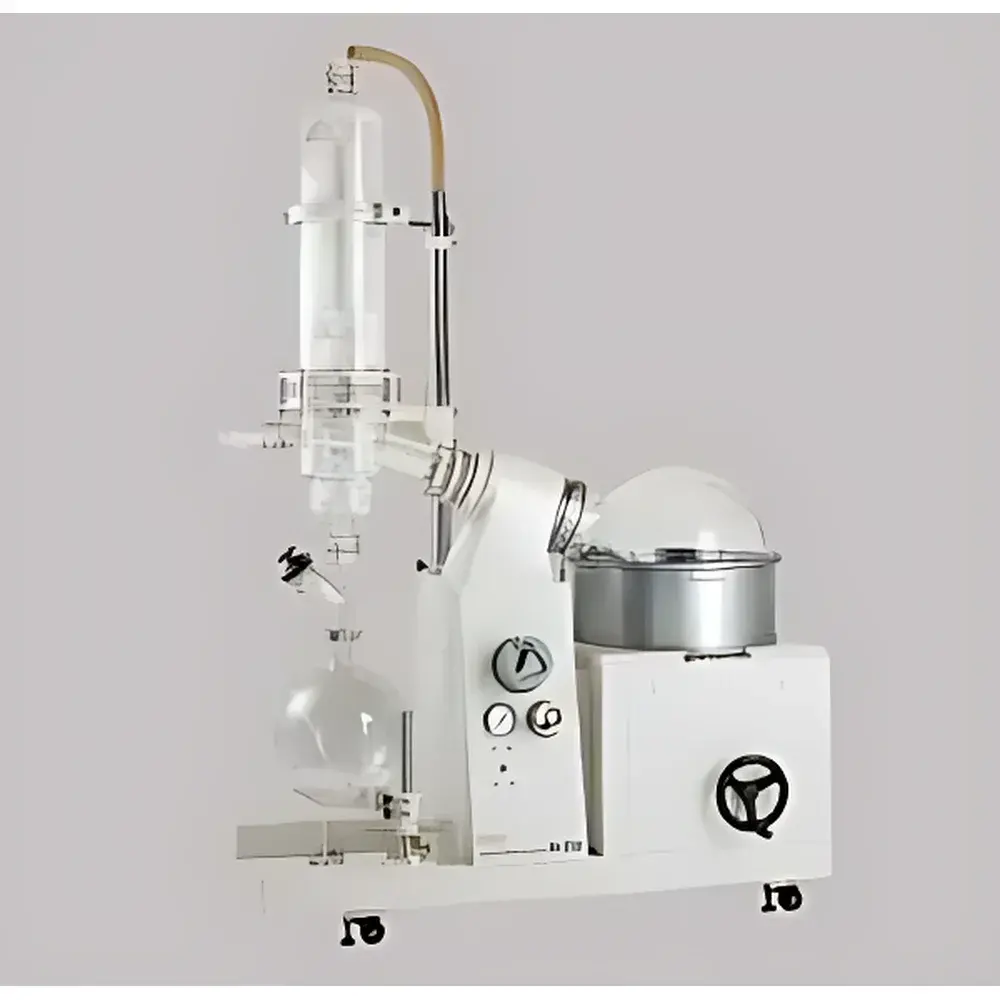
EYELA N-51 50L Rotary Evaporator
| Brand | EYELA |
|---|---|
| Origin | Japan |
| Model | N-51 |
| Capacity | 50 L (evaporation flask), 20 L (recovery flask) |
| Ultimate Vacuum | ≤2.6 hPa (≤2 Torr) |
| Rotation Speed | 10–80 rpm |
| Bath Temperature Range | +5 to 80 °C |
| Temperature Control Accuracy | ±1–2 °C |
| Condenser Type | Vertical quadruple coil |
| Cooling Surface Area | 2.0 m² |
| Bath Dimensions | Ø560 × 300 mm (H) |
Overview
The EYELA N-51 is a high-capacity, laboratory-grade rotary evaporator engineered for reliable, large-scale solvent removal and concentration tasks in demanding research and production environments. Designed and manufactured in Japan by Tokyo Rikakikai Co., Ltd. (EYELA), this system operates on the fundamental principle of reduced-pressure distillation: by lowering the ambient pressure above a rotating sample, the boiling point of volatile solvents is significantly depressed—enabling gentle, efficient evaporation at controlled bath temperatures. With a 50 L evaporation flask and 20 L collection flask, the N-51 supports batch processing of viscous or heat-sensitive materials common in life sciences, natural product isolation, polymer synthesis, and pharmaceutical process development. Its robust stainless-steel frame, integrated vacuum control interface, and precision-engineered glassware set meet international expectations for durability, repeatability, and operator safety.
Key Features
- Vertical quadruple-coil condenser with 2.0 m² effective cooling surface area—optimized for high vapor load handling and rapid condensate recovery across diverse solvent systems (e.g., water, ethanol, ethyl acetate, DCM).
- Adjustable rotation speed from 10 to 80 rpm via digital motor control—ensuring stable film formation on flask walls and minimizing bumping or foaming during evaporation of low-surface-tension or foaming-prone samples.
- Heated water bath with precise temperature regulation (+5 to 80 °C) and ±1–2 °C accuracy—compatible with PID feedback control and external PT100 probe input for enhanced thermal stability.
- Ultimate vacuum capability of ≤2.6 hPa (≤2 Torr), achievable using standard diaphragm or oil-sealed vacuum pumps—sufficient for efficient removal of medium-to-high volatility solvents under controlled conditions.
- Explosion-proof configuration options (N-51B variant available)—featuring intrinsically safe electronics, grounded conductive glassware, and optional nitrogen purge ports for use with flammable or oxygen-sensitive compounds.
- Ergonomic design with height-adjustable condenser lift mechanism and quick-release flask clamps—facilitating safe, tool-free setup and cleaning of large-volume glassware.
Sample Compatibility & Compliance
The N-51 accommodates a broad range of sample types, including aqueous extracts, organic reaction mixtures, polymer solutions, and crude bioprocess broths. Its large-diameter vapor pathway and optimized condenser geometry minimize carryover and cross-contamination risks between runs. All wetted parts—including borosilicate 3.3 glass flasks, PTFE-coated stopcocks, and silicone-free gaskets—are compliant with USP Class VI and ISO 10993-5 standards for biocompatibility. The system supports GLP/GMP-aligned workflows through traceable operation logs (when paired with optional data acquisition modules) and is compatible with ASTM E2656-20 (Standard Guide for Validation of Rotary Evaporators) and ISO 21748:2017 (Guidance on measurement uncertainty in physical testing).
Software & Data Management
While the base N-51 operates via intuitive analog/digital hybrid controls, it is fully compatible with EYELA’s optional CCA-1100 Central Control Adapter and associated LabSolutions software suite. This integration enables remote parameter setting, real-time monitoring of bath temperature, rotation speed, and vacuum level, as well as time-stamped CSV export of operational data. Audit trails, user access levels, and electronic signatures align with FDA 21 CFR Part 11 requirements when deployed in regulated environments. Data integrity is preserved through non-volatile memory backup and automatic error logging during power interruptions.
Applications
- Concentration of cell culture supernatants and fermentation broths in upstream bioprocessing.
- Removal of residual solvents following solid-phase extraction (SPE) or liquid–liquid extraction (LLE) in analytical sample preparation.
- Batch-scale purification of natural product isolates (e.g., alkaloids, terpenes) without thermal degradation.
- Distillative recovery of high-boiling-point solvents (e.g., DMF, DMSO) in fine chemical synthesis.
- Preparative-scale solvent exchange for nanoparticle dispersion stabilization prior to lyophilization.
FAQ
What is the maximum recommended working volume for the 50 L evaporation flask?
For optimal film formation and bumping prevention, the recommended fill level is 40–45 L (80–90% capacity). Overfilling may compromise rotational stability and condensation efficiency.
Can the N-51 be used with corrosive solvents such as concentrated HCl or HF?
No—standard N-51 configurations are not resistant to hydrohalic acids or strong oxidizers. For such applications, consult EYELA’s chemically resistant variants featuring Hastelloy C-276 vapor pathways and fluoropolymer-coated baths.
Is vacuum calibration required before routine use?
Yes—periodic verification against a calibrated reference gauge (e.g., MKS Baratron) is recommended per ISO/IEC 17025 guidelines, especially when validating methods for regulatory submissions.
Does the system include a vacuum controller with automatic pressure regulation?
The base N-51 does not include active vacuum regulation; however, it features a built-in vacuum release valve and is compatible with EYELA’s V-1000 or V-2000 vacuum controllers for programmable ramp-and-hold profiles.
What maintenance intervals are recommended for long-term reliability?
Daily: Inspect condenser seals and bath fluid level. Weekly: Clean condenser coils with isopropanol and verify rotation belt tension. Annually: Replace bath heater element gaskets and calibrate temperature sensor via external reference.



