
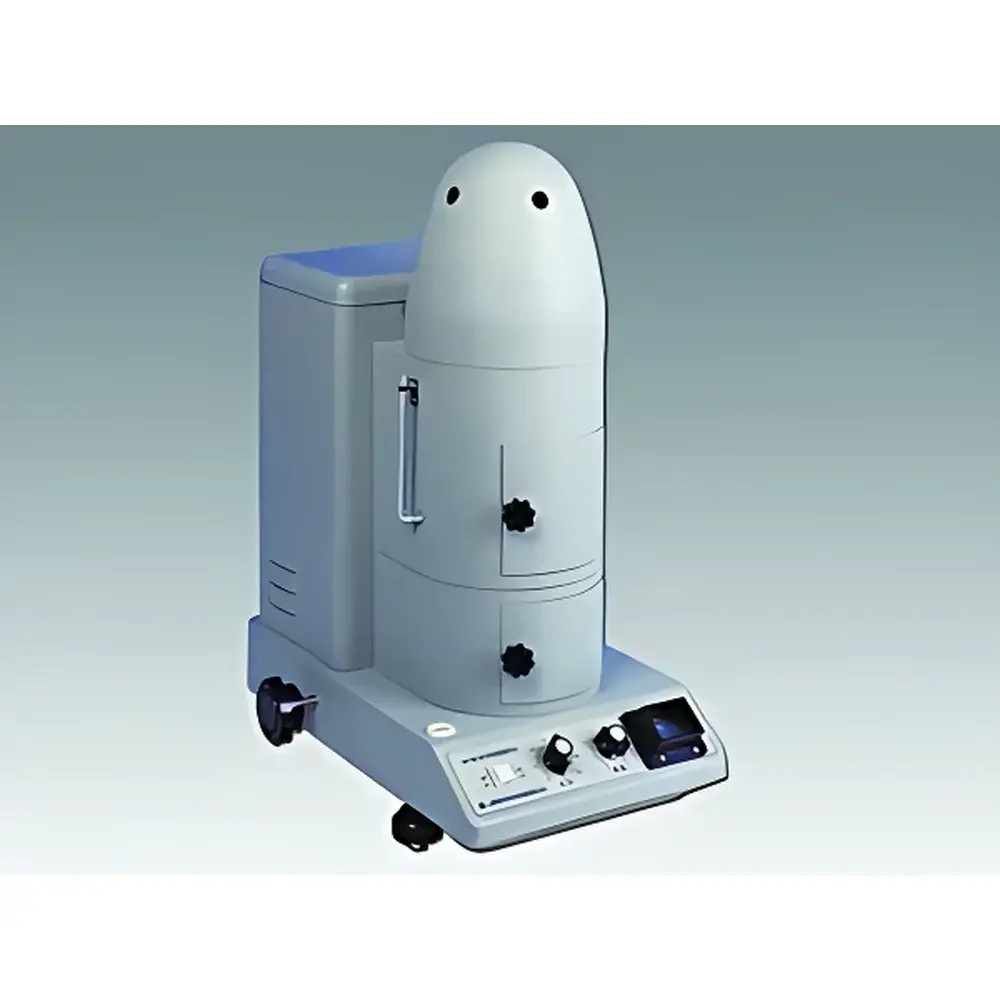
SH10A Capacitance Moisture Analyzer by SOPTOP
| Brand | SOPTOP |
|---|---|
| Origin | Shanghai, China |
| Model | SH10A |
| Maximum Capacity | 10 g |
| Readability | 0.005 g |
| Temperature Range | 60–170 °C (±2 °C) |
| Timer Range | 1–30 min |
| Measurement Modes | % Moisture, g Dry Weight |
| Accuracy | ±0.2% |
| Display Range | 0–1 g |
| Pan Diameter | Ø100 mm |
| Dimensions | 290 × 365 × 560 mm |
Overview
The SH10A Capacitance Moisture Analyzer, manufactured by SOPTOP and distributed under the Truelab portfolio, is a benchtop, thermogravimetric moisture determination instrument engineered for rapid, reliable quantification of free (surface and loosely bound) moisture in solid and semi-solid samples. Unlike Karl Fischer titration or near-infrared (NIR) spectroscopy, the SH10A employs a dual-sensor principle combining precision analytical weighing with controlled thermal drying—operating on the fundamental thermogravimetric principle: mass loss upon heating correlates directly to moisture content when volatiles other than water are negligible or pre-characterized. Its design targets routine QC/QA environments where speed, repeatability, and ease of operation outweigh the need for molecular specificity. The instrument is calibrated and validated for use across regulated and non-regulated settings—including food processing labs, pharmaceutical excipient testing, agricultural commodity inspection, and industrial raw material screening—where ASTM D4442, ISO 4463, and USP provide contextual methodological alignment.
Key Features
- Dual-pan configuration enables simultaneous tare and sample placement, minimizing handling time and reducing operator-induced variability.
- Electromagnetic damping system ensures stable, vibration-resistant weighing performance—critical for maintaining readability of 0.005 g during dynamic drying cycles.
- Programmable temperature control (60–170 °C, ±2 °C tolerance) allows method optimization for heat-sensitive matrices (e.g., dairy powders, herbal extracts) or refractory materials (e.g., clays, mineral ores).
- Adjustable timer (1–30 minutes) supports both fixed-duration protocols and endpoint-triggered drying, facilitating method transfer between laboratories.
- Integrated display simultaneously shows real-time moisture percentage (%), dry weight (g), and elapsed time—eliminating manual calculation and transcription errors.
- Robust mechanical architecture with stainless-steel heating chamber and Ø100 mm aluminum sample pan ensures thermal uniformity and long-term dimensional stability.
Sample Compatibility & Compliance
The SH10A accommodates heterogeneous particulates, granules, flakes, and compressed tablets within its 10 g capacity limit. Verified applications include cereal grains (wheat, rice, corn), powdered APIs and excipients (lactose, microcrystalline cellulose), dried botanicals, paper pulp, textile fibers, and polymer pellets. While not compliant with FDA 21 CFR Part 11 out-of-the-box (lacking electronic audit trail, user authentication, or data encryption), the instrument supports GLP/GMP-aligned workflows when paired with documented SOPs, periodic calibration against NIST-traceable standards (e.g., certified anhydrous sodium tartrate), and manual logbook entries. It meets general requirements for ISO/IEC 17025-compliant moisture testing when operated within defined uncertainty budgets and environmental controls (e.g., draft-free enclosure, ambient humidity <60% RH).
Software & Data Management
The SH10A operates as a standalone hardware unit with no embedded firmware-based data export capability (e.g., USB, RS-232, or Bluetooth). All measurements are displayed locally and retained only until power-off or next measurement cycle. For traceable recordkeeping, users must manually transcribe results into LIMS or Excel-based tracking systems. To meet regulatory documentation expectations, laboratories commonly integrate the SH10A into broader quality systems via external digital scales with serial output or by employing third-party data capture devices that interface with the analog display signal. No proprietary software suite is supplied; however, generic CSV logging tools may be adapted for batch reporting when combined with auxiliary hardware.
Applications
- Food & Feed Industry: Rapid verification of moisture in flour, soy meal, pet food kibble, and roasted coffee beans to ensure shelf-life compliance and prevent microbial growth.
- Pharmaceutical Manufacturing: In-process checks of granule moisture prior to tablet compression—critical for binder efficacy and content uniformity.
- Agricultural Testing Labs: Field-deployable screening of harvested grain moisture to inform storage decisions and comply with national trading standards (e.g., GB/T 5497 in China, USDA FGIS guidelines).
- Chemical & Polymer Suppliers: Release testing of hygroscopic intermediates (e.g., PVP, silica gels) where residual solvent or adsorbed water affects reactivity or formulation viscosity.
- Paper & Packaging QA: Monitoring moisture in linerboard and corrugating medium to maintain tensile strength and printability specifications.
FAQ
What is the measurement principle of the SH10A?
It uses thermogravimetric analysis: sample mass is recorded before and after controlled heating; the difference is reported as % moisture, assuming water is the primary volatile component.
Can the SH10A measure bound water or crystalline hydrates?
No—it quantifies free and loosely bound moisture only. Dehydration of crystalline hydrates (e.g., CuSO₄·5H₂O) requires higher temperatures and longer dwell times beyond its operational envelope and may yield inaccurate results.
Is calibration required before each use?
Daily verification using certified reference standards (e.g., 0% and ~5% moisture check standards) is recommended; full calibration per manufacturer’s procedure should occur at least weekly or after maintenance.
Does the SH10A support automatic shutdown after completion?
Yes—the unit powers down automatically upon timer expiration or manual stop, with audible alert and visual confirmation on the LED display.
What environmental conditions affect accuracy?
Air currents, ambient temperature fluctuations >±2 °C, and relative humidity >65% RH can destabilize the balance mechanism and induce drift; operation inside a dedicated, draft-free workstation is strongly advised.







