
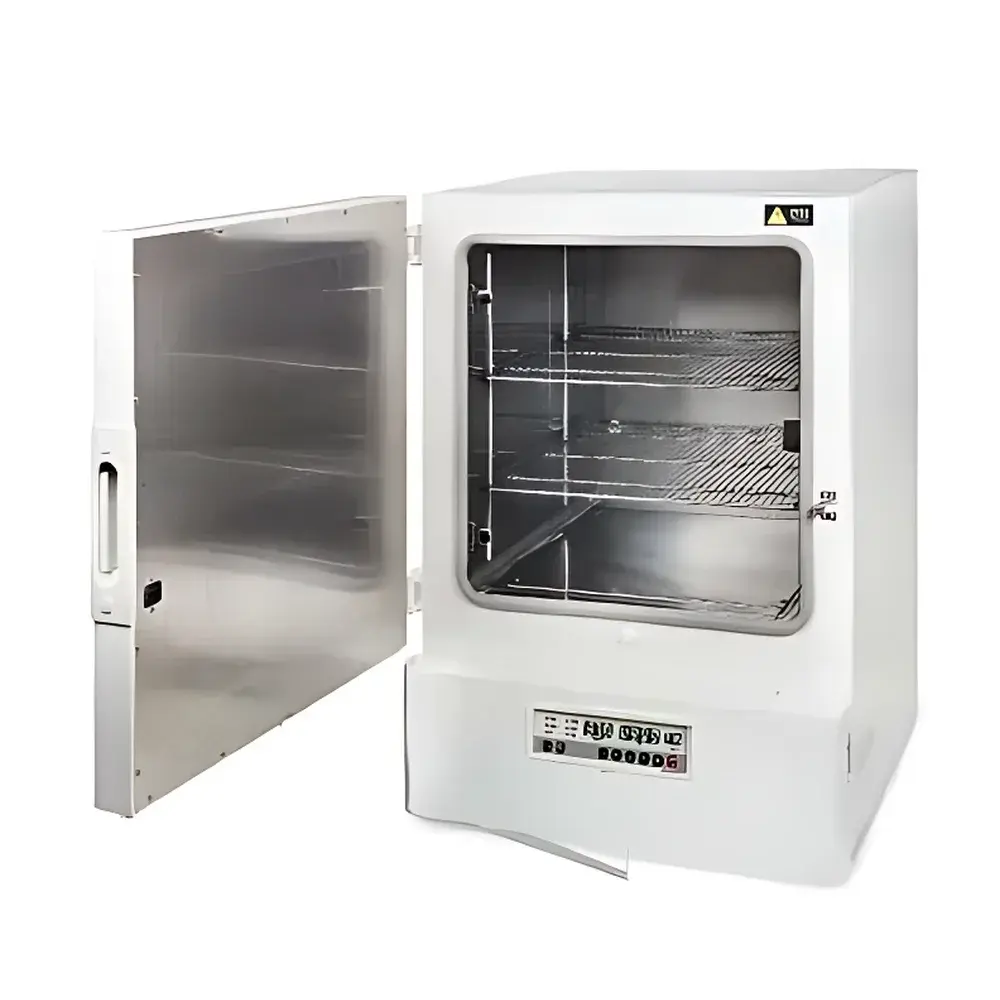
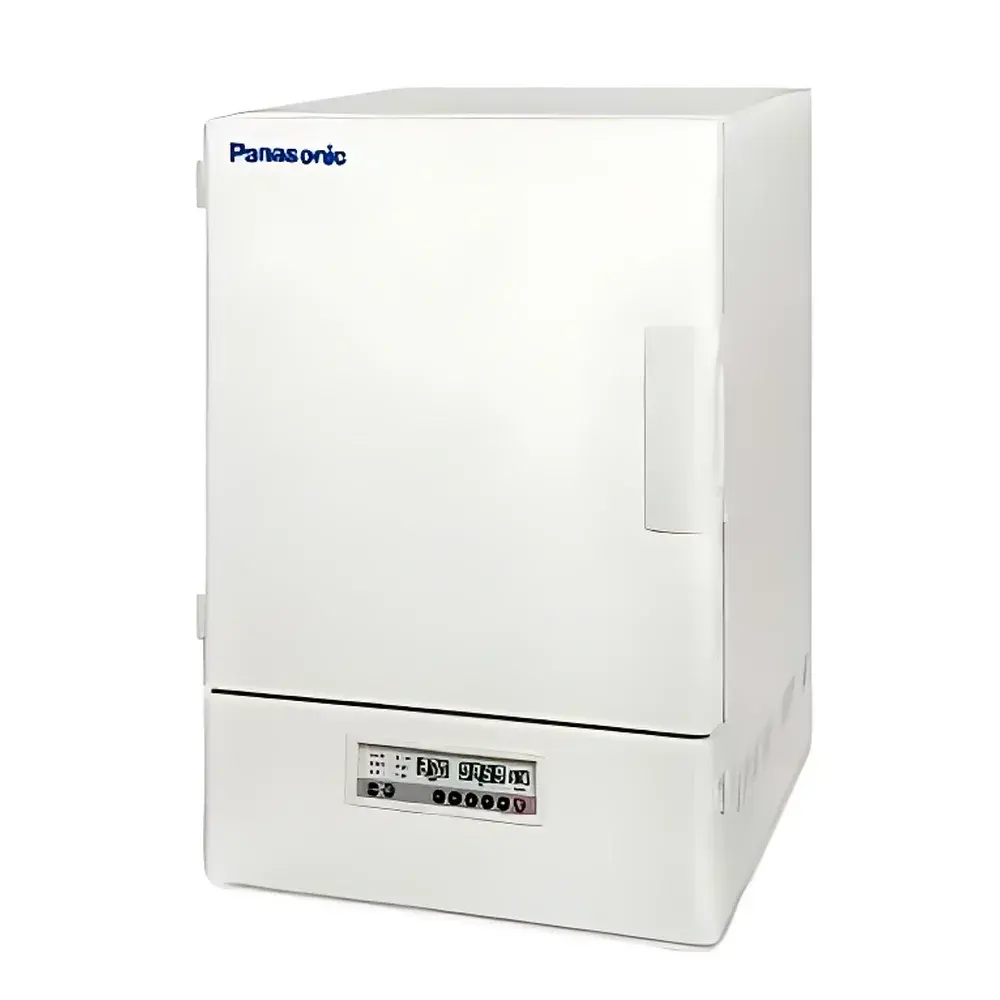
Panasonic MIR-180 and MIR-280 Precision Incubators
| Brand | Panasonic |
|---|---|
| Origin | Liaoning, China |
| Model | MIR-180, MIR-280 |
| Temperature Range | Ambient +5°C to 80°C (at 20°C ambient) |
| Temperature Uniformity | ±0.5°C (at 20°C ambient, 37°C setpoint, no load) |
| Capacity | 97 L / 167 L |
| Power Supply | AC 220 V, 50 Hz |
| Internal Material | SUS304 Stainless Steel |
| Air Circulation | Natural Convection |
| Control System | Microprocessor-based PID Fuzzy Logic Controller |
| Display Resolution | 0.1°C |
| Temperature Fluctuation | ±0.2°C (5–60°C), ±0.5°C (60–80°C) |
| Timer Range | 0–5999 min with Delay Start Function |
| Weight | ~56 kg / ~72 kg |
| External Dimensions (W×D×H) | 580×600×829 mm / 700×685×906 mm |
| Internal Dimensions (W×D×H) | 450×460×470 mm / 570×540×545 mm |
| Sealing | High-temp silicone foam gasket |
| Safety Alarms | Door-open, temperature deviation, sensor fault |
Overview
The Panasonic MIR-180 and MIR-280 are precision-engineered benchtop incubators designed for stable, reproducible thermal environments in microbiological, mycological, and cell culture applications. These units operate on a natural convection principle—eliminating forced-air fans—to ensure silent, vibration-free operation and minimal disturbance to sensitive biological samples. The microprocessor-based PID fuzzy logic control system continuously monitors and adjusts heating output to maintain setpoint accuracy within ±0.2°C across the mid-range (5–60°C) and ±0.5°C at elevated temperatures (60–80°C). With a wide operating range from ambient +5°C to 80°C and verified uniformity of ±0.5°C at 37°C (no load, 20°C ambient), the MIR series supports both standard bacterial cultivation and high-temperature fungal growth protocols—including Aspergillus, Penicillium, and other thermotolerant mold isolates. Constructed entirely with corrosion-resistant SUS304 stainless steel interiors and reinforced with high-density glass wool insulation, these incubators meet long-term reliability requirements in GLP-compliant laboratories and QC environments.
Key Features
- Natural convection air circulation—no internal fan—ensures ultra-low noise (<35 dB(A)) and eliminates sample desiccation or mechanical stress on delicate cultures.
- PID fuzzy logic temperature controller with 0.1°C display resolution and adaptive tuning for rapid stabilization and minimal overshoot.
- Comprehensive safety suite: door-open detection, real-time temperature deviation alarm, and sensor failure monitoring with audible/visual alerts.
- Programmable timer (0–5999 minutes) supporting both immediate start and delay-start modes—enabling unattended overnight or weekend incubation cycles.
- Ergonomic interior design featuring fully rounded corners and seamless welds for effortless cleaning and reduced microbial retention.
- Dual-layer insulated door with high-temperature silicone foam gasket ensures thermal integrity and prevents condensation buildup during extended high-temp operation.
- Front-panel key lock function prevents accidental parameter changes—critical in shared-lab or multi-user facilities.
Sample Compatibility & Compliance
The MIR-180 and MIR-280 accommodate standard Petri dishes (up to 150 mm), multi-well plates, test tubes, and flasks without airflow-induced evaporation artifacts. Their stainless-steel chamber and non-porous surfaces support rigorous decontamination using 70% ethanol, hydrogen peroxide vapor (HPV), or UV-C irradiation—aligning with ISO 14644-1 Class 5 cleanroom maintenance protocols. While not humidity-controlled, their sealed architecture maintains consistent internal moisture levels during short-to-medium duration assays (≤72 h). Units comply with IEC 61010-1:2010 for laboratory electrical safety and carry CE marking for EMC and low-voltage directives. Documentation packages include factory calibration certificates traceable to NIST standards, supporting audit readiness under FDA 21 CFR Part 11 (when paired with compliant data logging software) and ISO/IEC 17025 accreditation requirements.
Software & Data Management
These incubators operate as standalone instruments with embedded firmware—no proprietary PC software required for basic operation. However, optional RS-232 or USB interfaces (available via authorized service channels) enable integration with third-party laboratory information management systems (LIMS) or SCADA platforms for automated event logging. All alarms, setpoint changes, and runtime data are timestamped and stored in non-volatile memory for up to 30 days—supporting root-cause analysis during quality investigations. For regulated environments, external validated data loggers (e.g., DeltaTRAK or Elpro) may be deployed to capture continuous temperature profiles meeting USP analytical instrument qualification (AIQ) criteria.
Applications
- Mycological cultivation: isolation and enumeration of filamentous fungi (e.g., Aspergillus spp., Fusarium spp.) per ISO 21527-1 and AOAC 995.14.
- Bacterial growth testing: aerobic plate counts (APC), coliform screening, and pathogen enrichment at 35–37°C per ISO 4833-1 and FDA BAM Chapter 3.
- Thermal stability studies: accelerated shelf-life testing of biologics, enzymes, or diagnostic reagents at 45–80°C.
- Environmental simulation: controlled-temperature incubation for ASTM D5511 anaerobic biodegradability assays.
- Pharmaceutical QC: media fill simulations and sterility test incubation per USP and EP 2.6.1.
FAQ
What is the recommended ambient operating environment for optimal performance?
The incubators are rated for use between 5°C and 35°C ambient temperature; operation outside this range may affect temperature uniformity and controller response time.
Can these units be used for CO₂-independent cell culture?
Yes—they provide stable thermal environments suitable for certain adherent or suspension cultures requiring only temperature control (e.g., insect Sf9 cells, some hybridoma lines), though CO₂ regulation and humidity control require supplemental equipment.
Is calibration verification supported by the manufacturer?
Panasonic provides factory calibration reports upon request; users should perform periodic in-house verification using NIST-traceable PT100 probes per ISO/IEC 17025 Section 6.5.
Are spare parts and service available globally?
Authorized Panasonic Life Sciences service centers in North America, EMEA, and APAC offer technical support, preventive maintenance contracts, and genuine component replacement—including heaters, sensors, and control boards.
Does the unit meet GMP documentation requirements?
While the hardware itself is not “GMP-certified,” its design, alarm logging, and traceable calibration history support compliance with Annex 11 (EU GMP) and FDA guidance on computerized system validation when integrated into a documented quality management system.





