
Panasonic MPR-721 & MPR-721R Pharmaceutical Stability Chambers
| Brand | Panasonic |
|---|---|
| Origin | Japan |
| Model | MPR-721, MPR-721R |
| Temperature Range | +2°C to +14°C (ambient −5°C to 0°C) / +2°C to +23°C (ambient 0°C to 35°C) |
| Internal Volume | 684 L (MPR-721-PC), 671 L (MPR-721R-PC) |
| External Dimensions (W×D×H) | 770 × 830 × 1955 mm |
| Net Weight | 174 kg (MPR-721), 193 kg (MPR-721R) |
| Power Consumption | 280 W (220 V, 50 Hz) |
| Insulation | In-situ foamed rigid polyurethane |
| Refrigerant | HFC |
| Control System | Microprocessor-based thermistor controller with digital display (1°C resolution) |
| Air Circulation | Forced convection |
| Alarm Functions | High/low temperature, door open, backup memory, self-diagnosis, temperature lock, remote alarm contact, component replacement alert |
| Optional Accessories | MTR-G04 temperature recorder, MPR-S7 mounting kit, RP-G04 chart paper, PG-R pen, MTR-0621LH recorder, MPR-S30 kit, RP-06 paper |
Overview
The Panasonic MPR-721 and MPR-721R Pharmaceutical Stability Chambers are precision-engineered environmental storage systems designed to meet stringent regulatory requirements for the controlled storage of pharmaceuticals, biologics, clinical specimens, and research reagents. Unlike domestic refrigeration units—whose temperature stability is compromised by ambient fluctuations, defrost cycles, and manual dial-based control—these chambers employ a dual-mode thermal management architecture combining high-efficiency sealed compressors, resistive heating elements, and forced-air circulation. This ensures continuous, uniform temperature maintenance across the entire working volume, independent of external ambient conditions ranging from −5°C to +35°C. The system operates within a validated range of +2°C to +23°C (dependent on ambient), with enhanced stability at +2°C to +14°C under colder ambient conditions—making it suitable for ICH Q5C-compliant stability testing, USP storage compliance, and GLP/GMP-aligned cold chain integrity. Its robust construction, in-situ foamed rigid polyurethane insulation (≥80 mm thickness), and double-glazed self-closing door minimize thermal ingress and ensure reproducible chamber performance during frequent access.
Key Features
- Microprocessor-controlled thermistor sensing system with digital temperature display (1°C resolution) and ±0.5°C typical stability (at setpoint, steady-state, no-load)
- Forced-air convection system enabling rapid temperature recovery (<15 minutes to return to setpoint after 30-second door opening) and uniformity ≤±1.5°C across all zones (per ISO 14644-1 Class 8 spatial mapping protocol)
- Dual-mode thermal regulation: compressor-based cooling supplemented by PTC heater for precise sub-ambient and ambient-range control
- Integrated safety architecture including audible/visual high/low temperature alarms, door-open detection, automatic heater cutoff upon overtemperature event, and electronic temperature lockout
- Four heavy-duty casters (two with brakes) and ergonomic handle for safe relocation; optional locking mechanism secures valuable inventory
- Three 30-mm-diameter access ports (two lateral, one top-mounted) for sensor insertion, tubing, or data logging interfaces
- Corrosion-resistant color-coated steel interior and exterior; non-porous surface compatible with routine disinfection per CDC/EPA guidelines
Sample Compatibility & Compliance
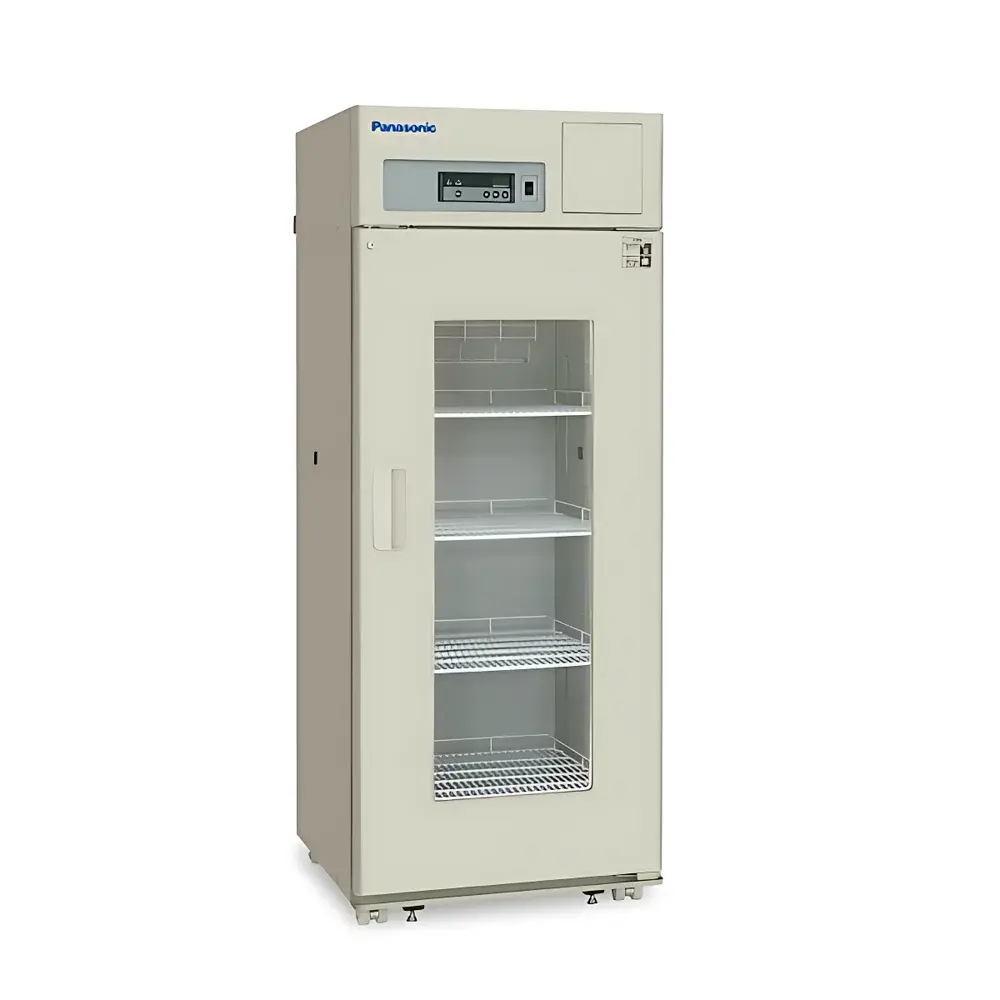
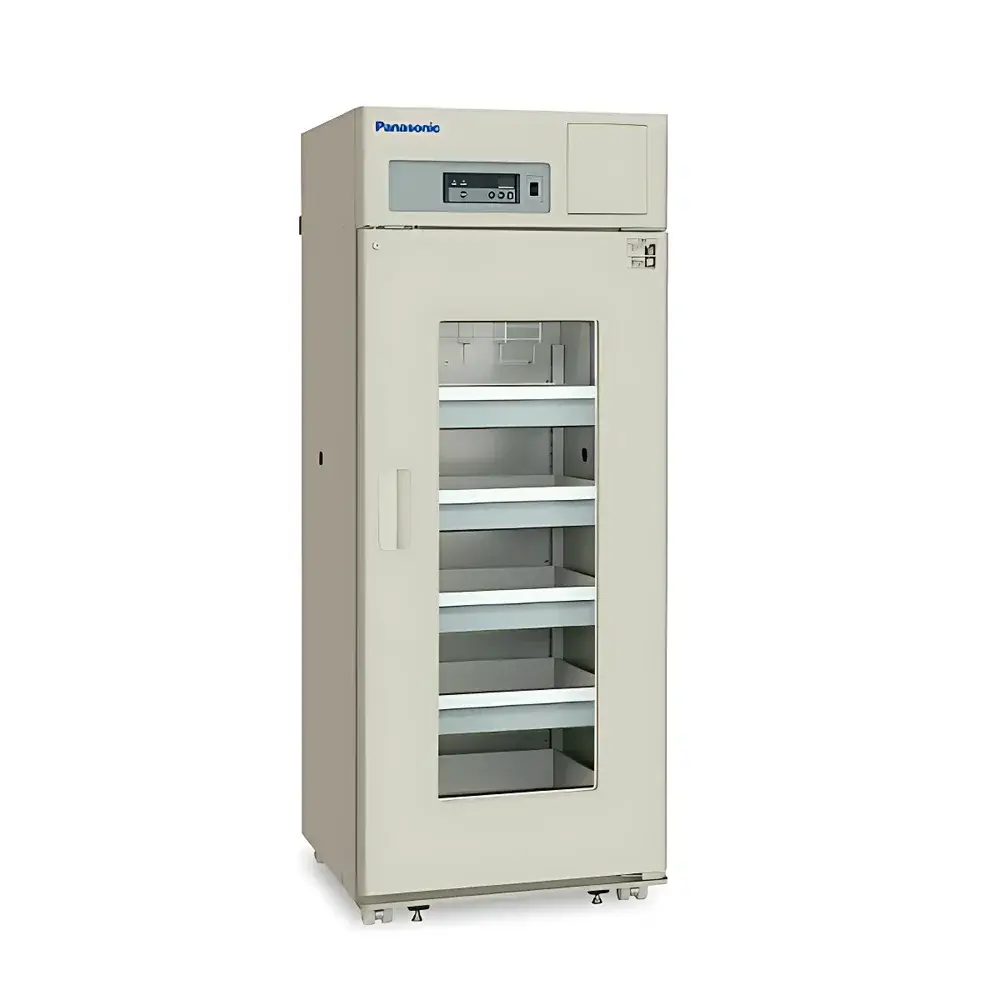
The MPR-721 series accommodates diverse sample formats—including vials, bottles, trays, fraction collectors, and multi-well plates—within its deep (710 mm), tall (1500 mm internal height) cavity. The MPR-721-PC variant features four adjustable wire shelves (50 kg load capacity per shelf), while the MPR-721R-PC replaces shelves with five full-extension drawers (100 mm height, 530 mm depth), each rated for ≥15 kg and optimized for standardized reagent kits and unit-dose packaging. Both configurations comply with ISO 14744:2019 (pharmaceutical cold storage), support 21 CFR Part 11–compliant data integrity when paired with optional MTR-G04 or MTR-0621LH recorders, and facilitate audit-ready documentation for FDA, EMA, and PMDA inspections. The chamber’s thermal mapping capability—enabled via standardized probe placement per WHO TRS 961 Annex 9—supports qualification (IQ/OQ/PQ) and ongoing performance verification.
Software & Data Management
While the base unit operates via embedded firmware without cloud connectivity, Panasonic provides validated peripheral solutions for regulated environments. The MTR-G04 chart recorder (with MPR-S7 mounting kit) delivers analog traceability with RP-G04 thermal paper (10-day continuous recording at 1-min intervals). For digital compliance, the MTR-0621LH recorder integrates seamlessly with the chamber’s remote alarm contact and temperature output signal, supporting CSV export, password-protected configuration, and electronic signature functionality aligned with ALCOA+ principles. All recorded data retain immutable timestamps, user attribution, and change history—meeting FDA 21 CFR Part 11 requirements for audit trails, electronic records, and signature validation. Optional software packages enable automated report generation compliant with ISO/IEC 17025 clause 7.8.2.
Applications
- ICH Q5C stability studies for biopharmaceuticals under long-term (25°C/60% RH) and accelerated (40°C/75% RH) conditions—when used in conjunction with humidity-add-on modules (sold separately)
- Controlled storage of reference standards, calibration materials, and potency assay reagents per USP
- Clinical trial supply chain management: retention samples, blinded kits, and comparator drug storage at defined temperature bands
- Biobanking of primary cells, PBMCs, and serum aliquots requiring consistent +2°C to +8°C preservation
- QC/QA laboratories performing compendial testing where temperature-sensitive reagents (e.g., enzymes, antibodies, chromogenic substrates) must remain within narrow operational windows
- Academic and industrial research labs managing compound libraries, metabolite standards, and oligonucleotide stocks
FAQ
What is the minimum ambient temperature at which the MPR-721 maintains +2°C internally?
The unit guarantees operation down to −5°C ambient, sustaining +2°C to +14°C internal setpoints without performance degradation.
Can the chamber be validated for GxP use?
Yes—its design supports IQ/OQ/PQ protocols; Panasonic provides factory calibration certificates traceable to JCSS, and optional mapping services are available through authorized partners.
Is humidity control integrated into the MPR-721 series?
No—humidity regulation requires external add-on modules; the base unit provides only temperature-controlled dry storage.
How does the forced-air system improve temperature uniformity compared to passive convection units?
Active airflow eliminates stratification, reduces recovery time post-access by >60%, and ensures ≤±1.5°C spatial variance—critical for multi-shelf consistency in stability studies.
Are replacement parts and service support available outside Japan?
Panasonic maintains certified service networks across North America, EMEA, and APAC; spare compressors, controllers, and door gaskets are stocked regionally with ≤5-business-day lead time.



