
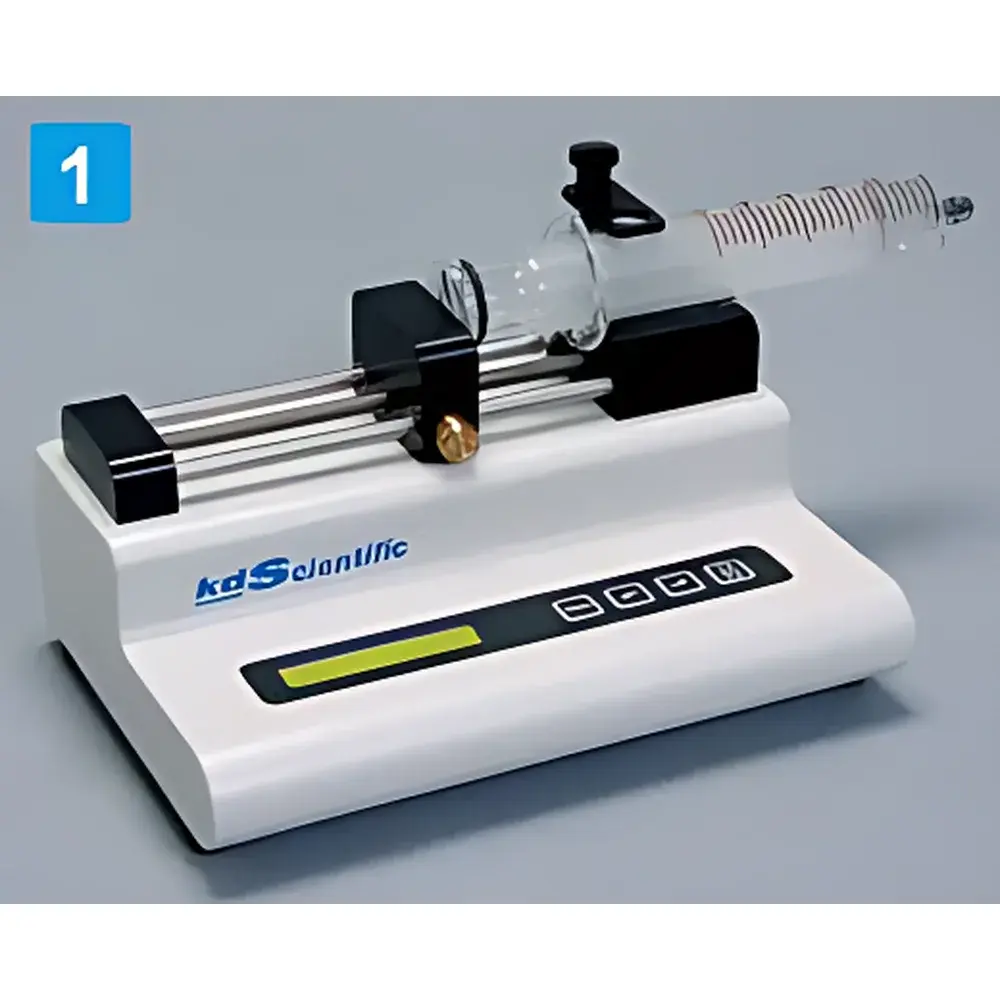
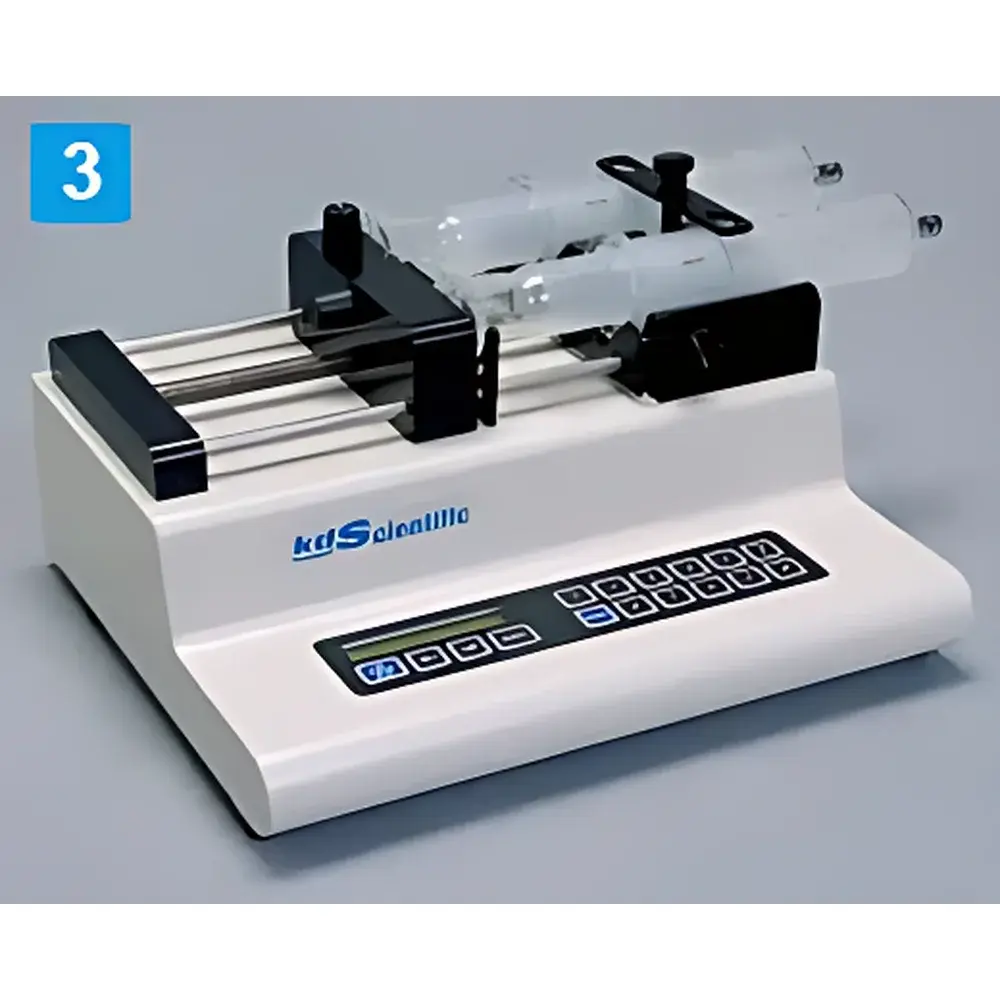
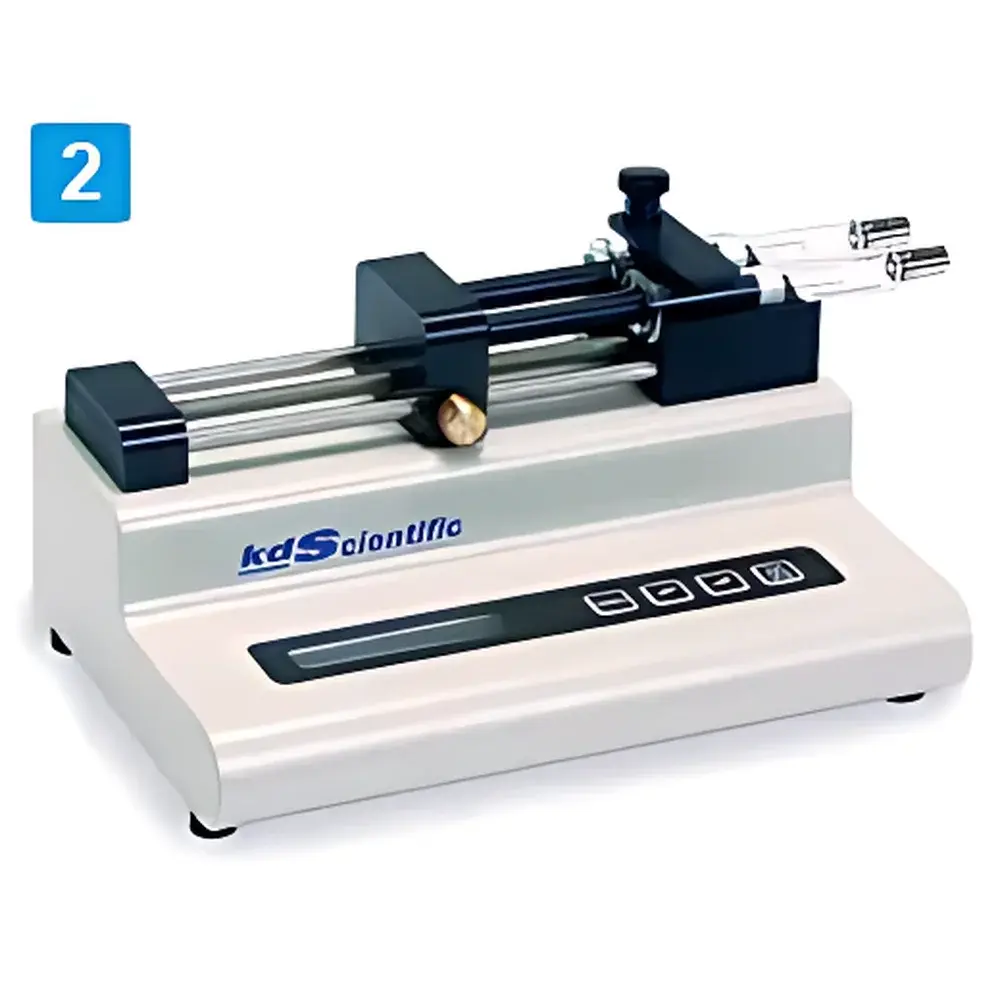
KDS100 Single-Channel Microinfusion Syringe Pump
| Origin | USA |
|---|---|
| Manufacturer Type | Authorized Distributor |
| Origin Category | Imported |
| Model | KDS100 |
| Instrument Type | Syringe Pump |
| Flow Rate Range | 0.1 µL/hr – 423 mL/hr (dependent on syringe size) |
| Stepper Motor Resolution | 0.529 µm per half-step |
| Maximum Linear Force | 9 kg |
| Accuracy | ±<1% |
| Repeatability | ±0.1% |
| Display | Real-time volume and flow rate |
| Control Interface | Menu-driven keypad |
| Memory | Non-volatile parameter retention |
| Optional Connectivity | RS-232 (KDS-200+ models only) |
| Syringe Capacity Range | 10 µL – 60 mL |
| Dimensions (W×D×H) | 23 × 15 × 13 cm |
| Weight | 2 kg |
Overview
The KDS100 is a precision single-channel microinfusion syringe pump engineered for high-accuracy, low-flow-rate delivery in life science, pharmacology, neuroscience, and analytical chemistry applications. Utilizing a high-torque stepper motor coupled with a calibrated lead-screw drive mechanism, the KDS100 delivers volumetrically precise fluid displacement based on syringe geometry and motor step resolution. Its core operating principle relies on direct linear actuation—where rotational motion of the motor is converted into axial movement of the syringe plunger—enabling deterministic control over infusion volume and rate without reliance on pressure feedback or flow sensors. Designed for benchtop use in regulated environments, the KDS100 supports traceable, repeatable dosing down to 0.1 µL/hr, making it suitable for chronic intracerebral, intravenous, or intrathecal infusions in rodent models, as well as micro-scale reagent delivery in HPLC sample introduction or electrophysiology rigs.
Key Features
- Single-channel architecture optimized for simplicity, reliability, and minimal footprint (23 × 15 × 13 cm; 2 kg)
- Wide syringe compatibility: accommodates glass or plastic syringes from 10 µL to 60 mL capacity
- Auto-scaling flow units: system dynamically selects µL/hr or mL/hr based on installed syringe dimensions
- Real-time digital display showing elapsed volume, remaining volume, current flow rate, and operational status
- Non-volatile memory retains all user-defined parameters—including target volume, flow rate, and direction—across power cycles
- High-resolution linear actuation: 0.529 µm per half-step ensures sub-microliter positional fidelity
- Consistent mechanical performance: ±<1% volumetric accuracy and ±0.1% repeatability under ISO 8536-4 test conditions
- Programmable auto-stop function triggers upon reaching preset infusion volume, preventing over-delivery
Sample Compatibility & Compliance
The KDS100 is compatible with standard Luer-lock and Luer-slip syringes compliant with ISO 8536-4 and ASTM D3720. It supports chemically resistant syringe barrels (e.g., borosilicate glass, polypropylene, PTFE-lined) for use with organic solvents, aqueous buffers, viscous peptides, or low-concentration neuroactive compounds. While the KDS100 itself does not carry FDA 510(k) clearance or CE IVD marking, its mechanical design and calibration traceability align with GLP documentation requirements for preclinical dosing studies. When integrated into validated workflows—for example, in USP compounding or ISO/IEC 17025-accredited laboratories—the device supports audit-ready operation through manual log entries and consistent parameter recall. Note: For GMP-regulated processes requiring electronic records and signature compliance (21 CFR Part 11), users should consider the KDS-200 series with RS-232 interface and validated third-party control software.
Software & Data Management
The KDS100 operates exclusively via front-panel keypad navigation using an intuitive menu structure—no external computer or driver installation required. All settings are stored in non-volatile EEPROM and persist after power loss. Although the KDS100 lacks built-in data logging or remote control capability, its parameter stability and deterministic behavior make it ideal for integration into manually documented SOPs. For laboratories requiring automated protocol execution or time-stamped event logging, the KDS-200 and KDS-300 series offer RS-232 serial communication (with optional cable and OEM-compatible ASCII command set), enabling integration with LabVIEW, MATLAB, or custom Python-based control platforms. Firmware updates and configuration backups are not supported on the KDS100 model due to its embedded fixed-function architecture.
Applications
- Chronic intracerebroventricular (ICV) or intraparenchymal drug infusion in murine and rat models
- Microdialysis probe perfusion at ultra-low flow rates (e.g., 0.5–5 µL/min) with minimal backpressure sensitivity
- Precise reagent addition in capillary electrophoresis, microfluidic chip priming, or patch-clamp perfusion systems
- Controlled delivery of radiolabeled tracers or fluorescent dyes during in vivo imaging experiments
- Calibration fluid dispensing in analytical instrument validation (e.g., GC autosampler testing)
- Gradual pH or ion concentration modulation in cell culture bioreactors or organ-on-chip platforms
FAQ
What syringe sizes are supported by the KDS100?
The KDS100 accepts standard Luer-fit syringes ranging from 10 µL to 60 mL capacity. Syringe barrel diameter and plunger length are automatically accounted for during flow rate calculation.
Does the KDS100 support bidirectional operation (infuse and withdraw)?
Yes—the KDS100 allows reversible plunger motion for both infusion and withdrawal modes, configurable via the front-panel menu.
Is the KDS100 compatible with corrosive or high-viscosity fluids?
Fluid compatibility depends on syringe material selection. Use glass or PTFE-lined syringes for aggressive solvents; avoid prolonged exposure to >100 cP fluids without verifying plunger seal integrity.
Can infusion parameters be exported or remotely controlled?
No—the KDS100 has no digital interface. Remote control and data export require upgrading to the KDS-200 series with RS-232 port.
How is calibration verified for regulatory submissions?
Users perform gravimetric or volumetric verification per ASTM E2797 or ISO 8655-7 using certified balance and Class A glassware; calibration certificates are maintained internally per laboratory quality system requirements.



