
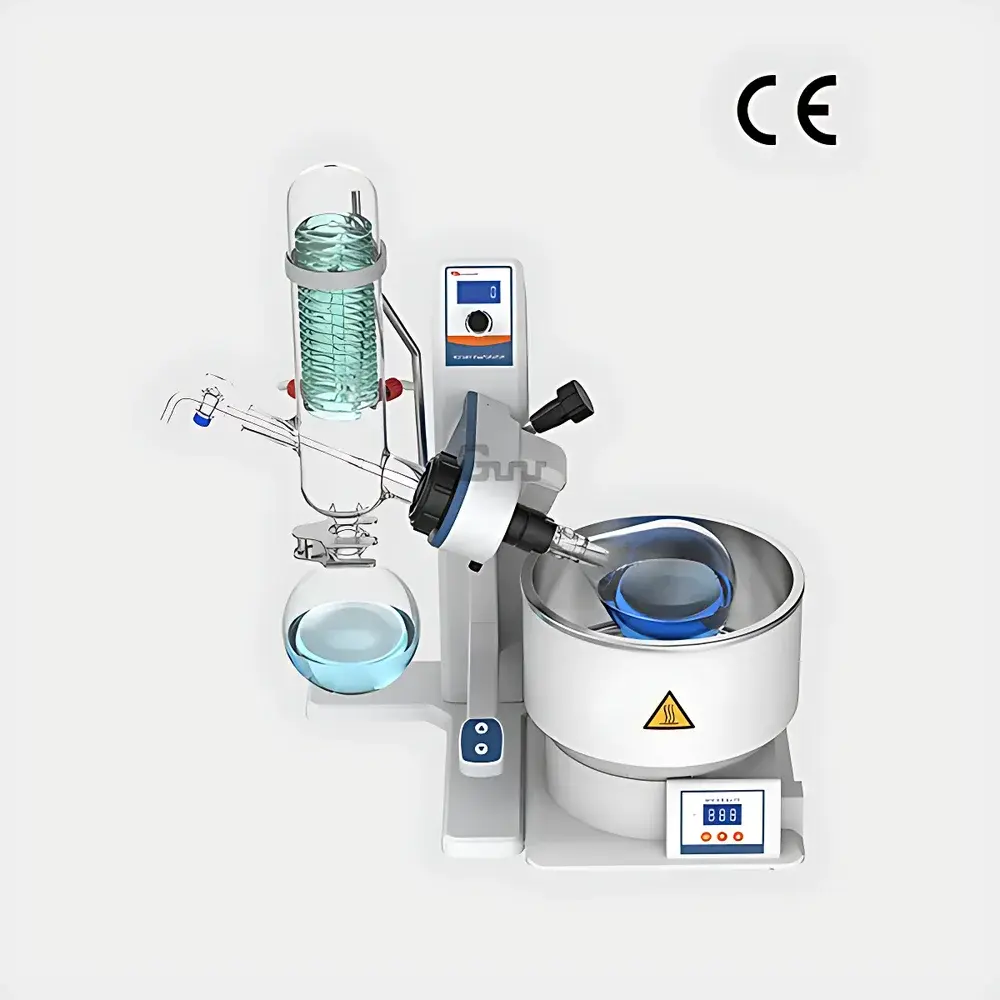
Truelab R-3001 Electrically Lifting Rotary Evaporator
| Brand | Truelab |
|---|---|
| Origin | Shanghai, China |
| Model | R-3001 |
| Capacity | 2 L |
| Ultimate Vacuum | 1 mbar |
| Rotation Speed | 10–280 rpm |
| Bath Temperature Range | 20–180 °C |
| Temperature Control Accuracy | ±1 °C |
| Condenser Cooling Area | 0.126 m² |
Overview
The Truelab R-3001 Electrically Lifting Rotary Evaporator is an engineered solution for efficient solvent removal, concentration, and purification of heat-sensitive compounds under reduced pressure. Based on the fundamental principle of rotary evaporation—where a rotating flask increases surface area and promotes uniform thin-film formation while simultaneous vacuum lowers boiling points—the R-3001 enables precise, repeatable, and scalable separation workflows in research laboratories, QC labs, and pilot-scale synthesis environments. Its modular architecture separates the heating bath from the main drive unit, allowing flexible integration with external chillers, vacuum controllers, and inert gas manifolds. Designed for compliance with general laboratory safety and electromagnetic compatibility requirements, the system carries CE marking per EU Directive 2014/30/EU (EMC) and 2014/35/EU (LVD), verified by TÜV Rheinland.
Key Features
- Electric lifting mechanism with smooth, stepless vertical travel (up to 150 mm stroke), enabling safe and reproducible immersion depth adjustment without manual cranking or mechanical strain.
- Dual-seal design using PTFE inner gasket and fluororubber outer O-ring at all critical joints, minimizing vapor leakage and ensuring long-term vacuum integrity (≤0.33 kPa/min leakage rate under test conditions).
- High-efficiency double-surface condenser with total cooling area of 0.126 m² (1260 cm²), optimized for rapid reflux and high recovery yield across volatile solvents including acetone, ethanol, ethyl acetate, and dichloromethane.
- PID-controlled heating bath (stainless steel 06Cr19Ni10, Φ254 × 130 mm) featuring PT100 two-wire temperature sensor, bottom-mounted 1300 W heater, dry-run protection, and easy-clean internal geometry.
- Brushless DC motor drive with synchronous belt transmission—ensuring low-noise operation (<55 dB(A)), minimal vibration, and stable rotational performance across full speed range (10–280 rpm, infinitely variable).
- Rotating flask inclination angle adjustable from 15° to 45° via ergonomic knob, facilitating optimal film formation for diverse viscosities and volumes.
- Liquid crystal display (LCD) interface showing real-time rotation speed and bath temperature, with intuitive navigation and parameter locking to prevent accidental changes during operation.
Sample Compatibility & Compliance
The R-3001 accommodates standard borosilicate glass 3.3 components—including 500 mL and 1000 mL round-bottom flasks (24/40 ground joints), 1000 mL collection flask (S35 spherical joint), and detachable bath shield—ensuring chemical resistance to acids, bases, and organic solvents. All wetted surfaces are constructed from either borosilicate glass 3.3 or PTFE, eliminating metal contact and supporting GLP-aligned documentation practices. While not certified to ISO/IEC 17025 or FDA 21 CFR Part 11 out-of-the-box, the instrument’s stable analog control architecture and non-networked design permit straightforward qualification (IQ/OQ/PQ) in regulated environments when paired with validated external vacuum and cooling systems.
Software & Data Management
The R-3001 operates as a standalone analog-electronic system with no embedded firmware or digital connectivity. Temperature and rotation setpoints are manually entered and maintained via front-panel controls; no data logging, remote access, or audit trail functionality is included. This architecture prioritizes operational robustness, electromagnetic immunity, and long-term serviceability—ideal for laboratories where deterministic behavior, minimal validation burden, and avoidance of cybersecurity vulnerabilities are primary concerns. For users requiring traceable records, external USB data loggers or PLC-integrated vacuum/temperature monitoring systems may be deployed in parallel.
Applications
- Solvent removal from natural product extracts (e.g., plant alkaloids, essential oils) without thermal degradation.
- Concentration of peptide solutions prior to lyophilization or HPLC analysis.
- Removal of low-boiling solvents (e.g., diethyl ether, pentane) following Grignard or lithium–halogen exchange reactions.
- Recovery and recycling of high-purity solvents in synthetic chemistry workflows.
- Preparative distillation of thermally labile intermediates under controlled vacuum gradients (1–100 mbar).
- Small-batch purification of pharmaceutical actives compliant with ICH Q5C stability guidelines.
FAQ
What is the maximum recommended operating altitude for the R-3001?
The system is rated for use up to 2000 meters above sea level. At higher elevations, vacuum pump performance and condensation efficiency may decrease due to lower atmospheric pressure and reduced heat transfer capacity.
Can the R-3001 be used with corrosive solvents such as concentrated HCl or HF?
No. Although the glass and PTFE components resist many organics and mild aqueous reagents, hydrofluoric acid and fuming hydrochloric acid will attack both borosilicate glass and fluororubber seals. Use only with solvents compatible with Class B glassware and FKM/PTFE materials.
Is the heating bath compatible with silicone oil or ethylene glycol-based heat transfer fluids?
Yes—the stainless steel bath is chemically inert to common high-temperature heat transfer media. However, maximum fluid temperature must remain within the specified 20–180 °C range and below the flash point of the selected medium.
Does the R-3001 support inert atmosphere operation (e.g., N₂ or Ar purging)?
Yes. The dual-seal joint design and optional gas inlet adapter (sold separately) allow continuous inert gas sparging into the evaporating flask, preventing oxidation of air-sensitive compounds.
What maintenance intervals are recommended for long-term reliability?
Inspect PTFE and fluororubber seals every 6 months or after 200 operational hours; replace if cracked or compressed beyond 20% of original thickness. Clean condenser coils quarterly with isopropanol and lint-free cloth; verify bath heater calibration annually using a traceable PT100 reference probe.



