
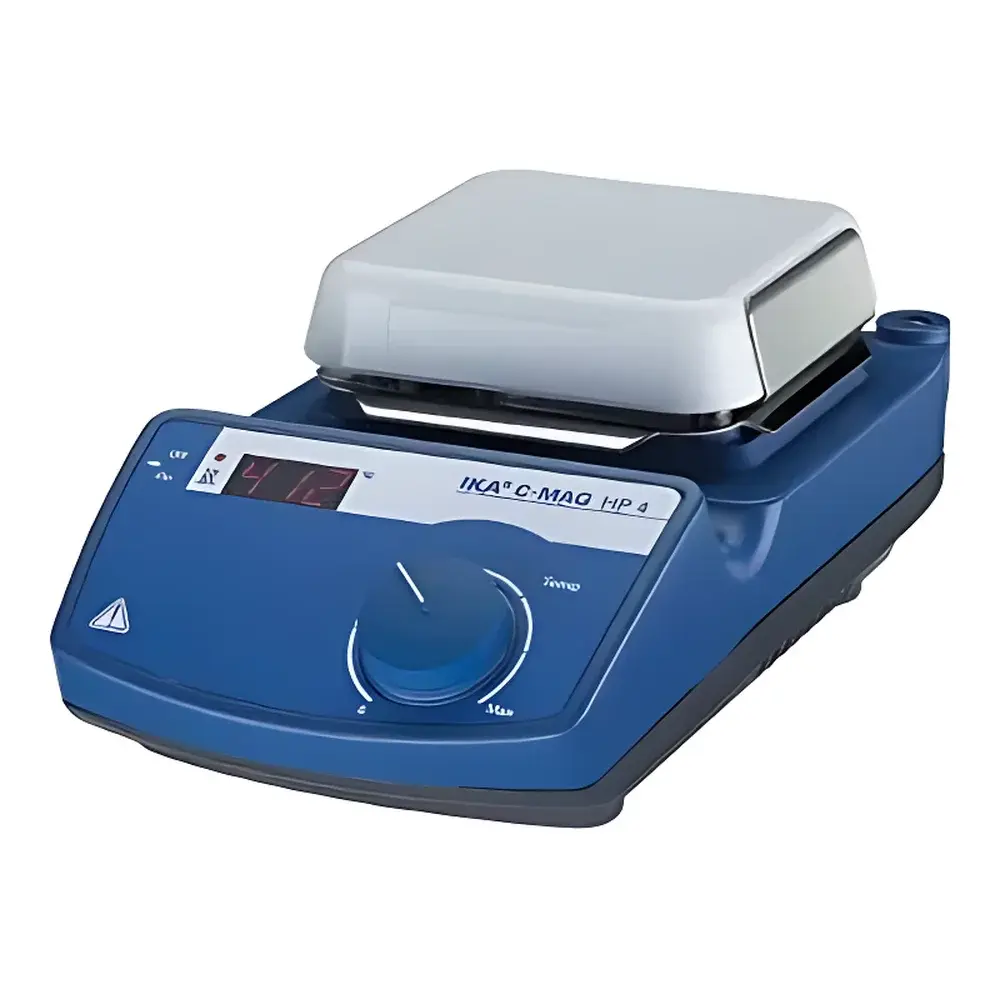
IKA HP4 Ceramic Electric Heating Plate
| Brand | IKA |
|---|---|
| Origin | Germany |
| Model | HP4 |
| Heating Power | 250 W |
| Max. Heating Temperature | 500 °C |
| Temperature Uniformity | ±3 °C |
| Heating Surface Dimensions | 100 × 100 mm |
| Display Type | Digital LED |
| Protection Class | IP21 |
| Safety Cut-off | 550 °C |
| Weight | 3 kg |
| External Dimensions | 150 × 105 × 260 mm |
| Material | Monolithic Ceramic Plate |
| Temp. Control Accuracy | ±10 K |
| Heating Rate (1 L H₂O) | 2.5 K/min |
Overview
The IKA HP4 Ceramic Electric Heating Plate is a compact, benchtop thermal platform engineered for reliable, repeatable heating in routine laboratory sample preparation and digestion workflows. Designed according to DIN EN 60529 standards, it operates on resistive heating principles, delivering controlled thermal energy across a monolithic ceramic surface without hotspots or thermal gradients beyond ±3 °C across its 100 × 100 mm active zone. Its 250 W power rating supports moderate-volume heating applications—including solvent evaporation, reagent warming, and pre-digestion stabilization—without excessive energy draw or thermal overshoot. The unit is not intended for magnetic stirring; it functions exclusively as a static heating surface, making it suitable for use with external stirrers, glassware requiring non-magnetic environments (e.g., HF-based digestions), or vessels incompatible with integrated stir motors. Its fixed safety cut-off at 550 °C complies with IEC 61000-4-2 ESD immunity requirements and prevents uncontrolled thermal escalation under fault conditions.
Key Features
- Monolithic ceramic heating surface: Chemically inert, seamless construction resists corrosion from acids (including concentrated HNO₃, HCl, and diluted HF), alkalis, and organic solvents—ideal for EPA Method 3050B/3052 sample digestion prep.
- Digital LED temperature display and control: Enables precise setpoint entry and real-time monitoring with ±10 K accuracy over the 50–500 °C operating range.
- Elevated control panel design: Minimizes risk of liquid ingress during accidental splashes while improving ergonomics for visual verification and tactile operation.
- Integrated thermal safety system: Automatic shutdown activates if internal sensor detects surface temperature exceeding 550 °C—providing hardware-level redundancy independent of microcontroller logic.
- IP21-rated enclosure: Protects against vertically falling drips and solid objects ≥12.5 mm, meeting minimum environmental robustness for general laboratory placement (non-fume hood, non-wet bench).
- Low-profile footprint (150 × 105 × 260 mm) and lightweight chassis (3 kg): Optimized for space-constrained workstations and modular lab furniture integration.
Sample Compatibility & Compliance
The HP4 accommodates standard borosilicate glassware (e.g., beakers, Erlenmeyer flasks, digestion tubes) up to 1 L volume, provided thermal expansion coefficients and mechanical stability are verified per ASTM E438 Class I/II specifications. It is compatible with PTFE, quartz, and ceramic crucibles but not recommended for direct contact with metal containers lacking thermal insulation layers due to localized heat concentration risks. While not certified for GLP/GMP environments out-of-the-box, its digital setpoint retention, stable thermal plateau behavior, and traceable calibration points support IQ/OQ documentation when paired with external NIST-traceable thermometers (e.g., calibrated Pt100 probes). It meets CE marking requirements under the Low Voltage Directive (2014/35/EU) and EMC Directive (2014/30/EU), and conforms to RoHS 2011/65/EU material restrictions.
Software & Data Management
The HP4 operates as a standalone analog-digital hybrid instrument with no embedded firmware update capability, USB interface, or data logging functionality. Temperature setpoints and status indicators are managed exclusively via front-panel controls and LED feedback. For laboratories requiring audit trails or electronic records under FDA 21 CFR Part 11, integration must occur externally—e.g., using a validated data acquisition system (DAQ) connected to a calibrated external temperature probe placed in the sample vessel. No proprietary software or driver installation is required or supported. All operational parameters remain accessible without firmware dependencies, ensuring long-term functional continuity across IT infrastructure upgrades.
Applications
- Controlled-temperature sample drying and solvent removal prior to gravimetric analysis (ASTM D2237, ISO 11357-4).
- Pre-heating of digestion vessels in closed-vessel microwave-assisted digestion workflows (EPA 3052).
- Stabilization of reaction mixtures during slow-addition synthesis protocols where magnetic interference must be avoided.
- Calibration bath support for thermometer verification (ISO/IEC 17025 Clause 6.4.10) using secondary reference standards.
- Heating of pH electrodes and conductivity cells during conditioning procedures per USP environmental controls.
FAQ
Can the HP4 be used inside a fume hood?
Yes—its IP21 rating and absence of moving parts or ventilation requirements make it suitable for fume hood installation, though airflow should not exceed 0.5 m/s directly over the surface to avoid convective cooling effects.
Is external temperature probe connectivity supported?
No—the HP4 lacks analog voltage output or RS232/USB ports; temperature feedback is internal only. For closed-loop control, an external PID controller with relay output must be interfaced via the unit’s mains supply line.
Does the ceramic surface require special cleaning agents?
Wipe with deionized water and lint-free cellulose cloth after cooling. Avoid abrasive pads or chlorine-based cleaners, which may degrade surface gloss over repeated use.
What is the typical warm-up time to reach 300 °C?
Approximately 18–22 minutes from ambient (23 °C), depending on ambient humidity and load mass—consistent with its 2.5 K/min heating rate in aqueous systems.
Is the HP4 compliant with ISO/IEC 17025 calibration requirements?
It is not supplied with a calibration certificate, but its temperature control circuitry permits third-party calibration using accredited thermometry equipment per ISO/IEC 17025 Clause 6.4.6.



