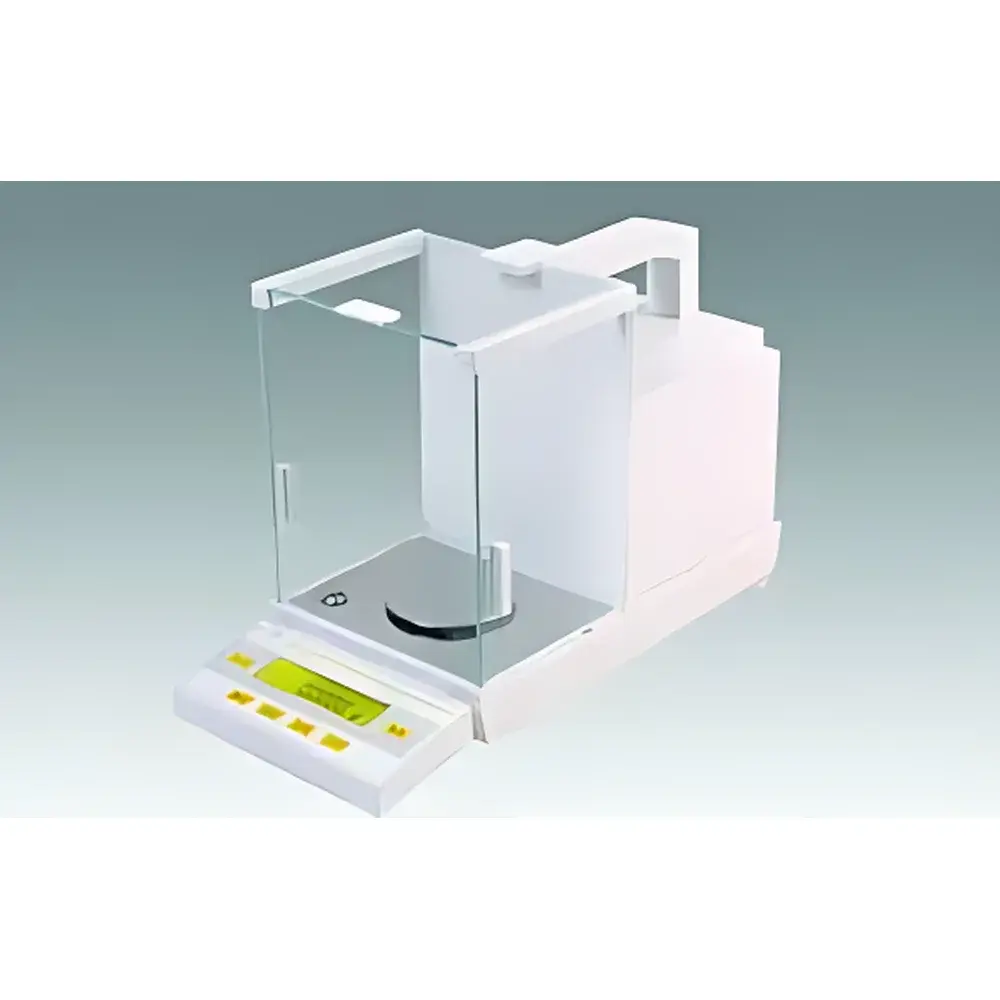
Shanghai Hengping FA2004 Precision Analytical Balance
| Brand | SOPTOP Hengping |
|---|---|
| Origin | Shanghai, China |
| Instrument Type | Analytical Balance |
| Maximum Capacity | 200 g |
| Readability | 0.1 mg |
| Repeatability | ±0.1 mg |
| Linearity | ±0.2 mg |
| Calibration | External |
| Pan Diameter | 90 mm |
| Dimensions (W×D×H) | 365 × 223 × 338 mm |
| Draft Shield Size | 150 × 165 × 200 mm |
| Interface | RS232 |
| Environmental Compensation | Dynamic Temperature Compensation |
| Protection | Overload & Shock Protection |
| Functions | Piece Counting, Percentage Weighing, Unit Conversion (g, oz, ct), Auto-Zero Tracking, Factory Reset, Linear Correction |
Overview
The Shanghai Hengping FA2004 Precision Analytical Balance is an entry-level yet rigorously engineered analytical balance designed for routine quantitative mass measurement in academic laboratories, quality control environments, and pharmaceutical production support settings. Operating on electromagnetic force compensation (EMFC) principle, the FA2004 delivers stable, drift-resistant measurements across its full 200 g capacity range with a nominal readability of 0.1 mg (100 µg). Its high-stability electromagnetic sensor—paired with dynamic temperature compensation—ensures consistent performance under ambient fluctuations typical in non-climate-controlled lab spaces. The balance conforms to fundamental metrological requirements for Class I analytical instrumentation per ISO 9001-aligned calibration practices and supports traceable external calibration using certified weights (e.g., ASTM E617 Class M2 or better). Designed for GLP-compliant workflows, it provides essential audit-ready functionality including auto-zero tracking, programmable stabilization time, and user-accessible linear correction parameters.
Key Features
- Electromagnetic force compensation sensor with enhanced thermal stability and low drift characteristics
- Adjustable weighing speed with four levels of damping control to optimize throughput vs. stability trade-offs
- RS232 serial interface compliant with standard SCPI command sets for integration into LIMS or custom data acquisition systems
- Four-stage mechanical shock absorption system mitigating floor-borne vibrations common in shared laboratory facilities
- Programmable auto-zero tracking with adjustable sensitivity threshold to maintain baseline integrity during extended idle periods
- Full-range tare function with memory retention across power cycles
- Overload protection circuitry with audible and visual alert upon exceeding 200 g limit
- Multi-unit display support: grams (g), ounces (oz), carats (ct), and percentage mode for relative mass analysis
- Backlit LCD with adjustable contrast and viewing angle for ergonomic operation under variable lighting conditions
- Factory reset capability and user-configurable linear correction coefficients for long-term accuracy maintenance
Sample Compatibility & Compliance
The FA2004 accommodates standard laboratory samples up to 200 g placed on its 90 mm diameter stainless-steel pan. Its integrated draft shield (150 × 165 × 200 mm) provides effective airflow isolation for low-mass measurements without requiring dedicated laminar flow enclosures. While not certified to OIML R76 or NIST Handbook 44 for legal-for-trade applications, the instrument meets functional performance criteria aligned with ISO/IEC 17025 preconditions for internal calibration and method validation. It supports compliance with USP and EP 2.1.6 guidelines for analytical balance qualification when operated within defined environmental limits (temperature: 10–30 °C; humidity: ≤80% RH non-condensing). Routine verification per ASTM E898–22 is recommended using calibrated reference masses before critical measurements.
Software & Data Management
Data output via RS232 follows ASCII-based protocol with configurable baud rate (9600 default), parity, and stop bits. Each measurement transmission includes timestamp (if enabled via external controller), net weight, unit code, and status flags (e.g., stable, overload, error). While the FA2004 lacks onboard data logging or FDA 21 CFR Part 11-compliant electronic signatures, its serial output is compatible with third-party software platforms—including LabArchives ELN, MATLAB Instrument Control Toolbox, and open-source Python libraries (pySerial)—for automated data capture, statistical process monitoring, and SPC chart generation. Audit trail integrity relies on external system configuration; users are advised to implement timestamped log files and access controls at the host level.
Applications
- Preparation of standard solutions and reagent aliquots in chemistry and biochemistry labs
- Weighing of active pharmaceutical ingredients (APIs) during formulation development
- Quality assurance testing of raw materials and finished products in food and cosmetics manufacturing
- Gravimetric analysis including ash content, moisture loss on drying (LOD), and residue on ignition (ROI)
- Piece counting for inventory management of uniform small parts (e.g., tablets, microcomponents)
- Educational demonstrations of mass conservation, stoichiometry, and uncertainty propagation
- Calibration verification of lower-precision balances and pipettes using mass comparison methods
FAQ
What calibration standards are required for external calibration of the FA2004?
Certified Class M2 or better weights per ASTM E617 are recommended; calibration should be performed at minimum two points (e.g., 0 g and 100 g) to verify linearity and repeatability.
Does the FA2004 support internal calibration?
No—it requires external calibration using traceable standard masses; no motorized internal weight mechanism is included.
Can the FA2004 be connected to a Windows PC for automated data export?
Yes, via RS232-to-USB adapter and terminal emulation software (e.g., Tera Term) or custom scripts using Python or LabVIEW.
Is the draft shield removable for cleaning or large-sample accommodation?
Yes—the acrylic draft shield is tool-free detachable and designed for easy wipe-down with ethanol or isopropanol.
What environmental conditions must be maintained for optimal performance?
Operate in a vibration-isolated location with stable ambient temperature (±2 °C/hour drift max) and relative humidity below 80% non-condensing; avoid direct sunlight and HVAC air streams.