
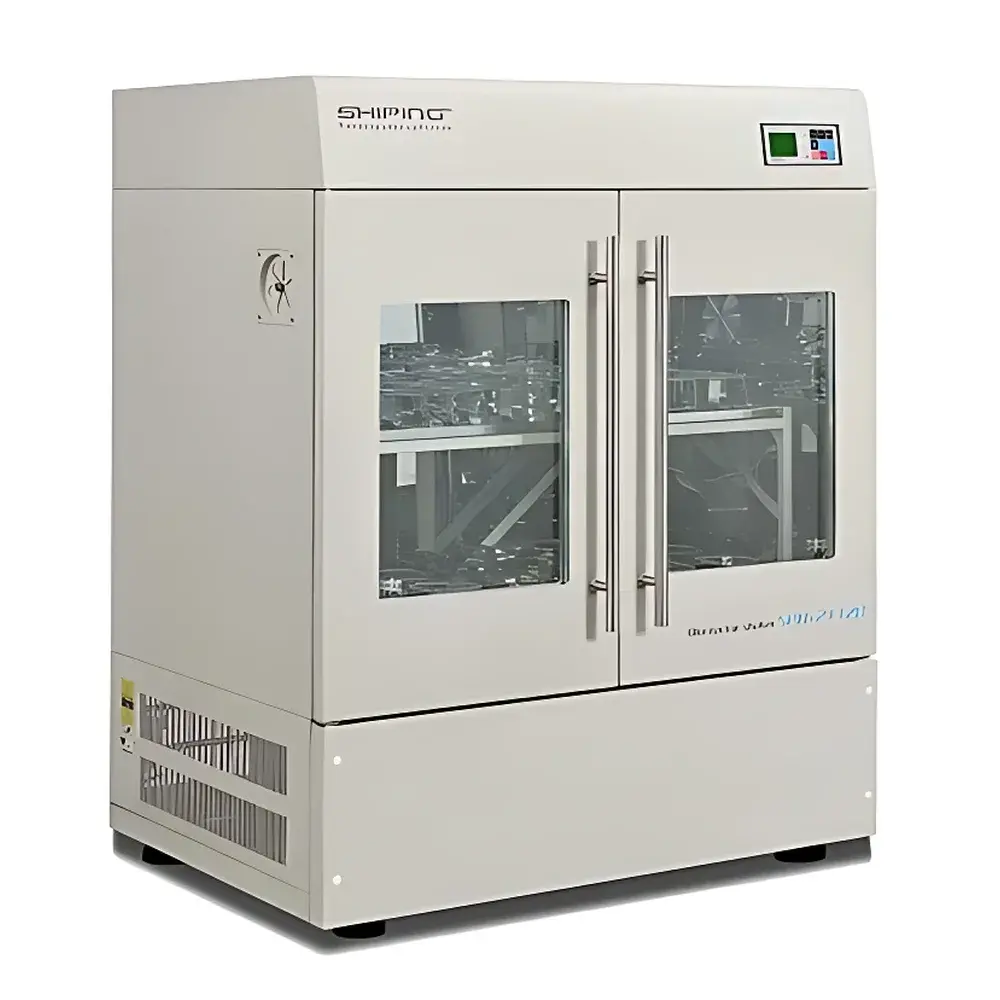
ShiPing ZPH-200B / ZPH-211B / ZPH-2013R / ZPH-2012R / ZPH-2102C / ZPH-2112B Multifunctional Intelligent Combination Incubator Shaker
| Brand | ShiPing |
|---|---|
| Origin | Shanghai, China |
| Model | ZPH-200B / ZPH-211B / ZPH-2013R / ZPH-2012R / ZPH-2102C / ZPH-2112B |
| Temperature Range | 4°C–60°C |
| Temperature Uniformity | ±0.5°C |
| Temperature Accuracy | ±0.1°C |
| Oscillation Frequency | 50–300 rpm |
| Speed Accuracy | ±1 rpm |
| Orbital Diameter | Φ25 mm |
| Timer Range | 0–500 h (or continuous) |
| Display | Full-color touchscreen |
| Control Algorithm | PID with environmental scanning microprocessor |
| Air Circulation | Forced convection |
| Oscillation Modes | Rotational or reciprocating (user-selectable) |
| Drive Mechanism | Single-axis balanced drive (Chinese patent) |
| Humidity Range (with external humidifier) | 45–90% RH |
| Cooling System | CFC-free R134a refrigerant |
| Heating Power | 400–800 W |
| Cooling Power | 118–230 W |
| Total Power Consumption | 580–1340 W |
| Chamber Volume | 80–640 L |
| Shelf Dimensions | 420×400 mm to 920×520 mm |
| Net Weight | 100–356 kg |
| Power Supply | AC 200–240 V, 50–60 Hz |
| Safety Features | Dual-limit temperature/speed alarm, independent overtemperature cutoff, door-open stop, leakage/overcurrent protection |
| Data Functions | Built-in thermal printer, wireless network connectivity (up to 20 units per PC), real-time data logging & curve visualization, clock display, dual-temperature view (setpoint vs. actual), parameter memory, power-failure recovery, speed/temperature calibration |
| Programming | 8-segment programmable curve, repeat/step mode, max segment duration: 999.99 min |
Overview
The ShiPing ZPH-Series Multifunctional Intelligent Combination Incubator Shaker integrates precise temperature control with programmable orbital or reciprocating agitation in a single platform engineered for reproducible cell culture, microbial growth, biochemical assays, and fermentation studies. Based on the Couette flow principle in orbital shakers and optimized laminar airflow design, the system maintains stable thermal homogeneity across the entire chamber while delivering consistent mechanical stimulation to samples. Each model employs a PID-controlled microprocessor with environmental scanning capability—continuously monitoring ambient conditions and dynamically adjusting heating, cooling, and motor output to compensate for load variation, door opening events, or ambient drift. The forced-convection air circulation ensures uniform temperature distribution (±0.5°C), critical for sensitive applications such as suspension cell expansion, enzyme kinetics, and recombinant protein expression where thermal gradients can significantly affect metabolic activity and yield.
Key Features
- Full-color capacitive touchscreen interface with intuitive navigation and multilingual support (English default)
- Dual-mode oscillation: user-selectable rotational (orbital) or reciprocating motion, enabling compatibility with flasks, tubes, microplates, and bioreactor vessels
- Single-axis balanced drive mechanism (Chinese patent ZL2018XXXXXXX)—minimizes vibration transmission to adjacent equipment and extends motor service life
- CFC-free R134a refrigeration system with variable-speed compressors; combined with high-efficiency PTC heaters for rapid temperature ramping and tight stability (±0.1°C setpoint accuracy)
- Comprehensive safety architecture: independent mechanical overtemperature cutoff, dual-limit audible/visual alarms for temperature and speed, automatic shutdown upon door opening, and Class I electrical protection per IEC 61010-1
- Embedded thermal printer for GLP-compliant hardcopy record generation of runtime parameters, including timestamped temperature and RPM traces
- Wireless LAN module supporting IEEE 802.11 b/g/n; compatible with Windows-based central monitoring software that manages up to 20 shakers simultaneously
Sample Compatibility & Compliance
The ZPH-Series accommodates standard laboratory vessels—from 50 mL conical tubes to 5 L baffled flasks—across its range of shelf configurations (e.g., ZPH-2112B supports up to six 2 L flasks per layer). All internal chambers are fabricated from electropolished 316L stainless steel, compliant with ISO 13485 surface finish requirements for cleanroom-compatible equipment. The system meets essential safety and electromagnetic compatibility standards including IEC 61326-1 (EMC for laboratory use) and IEC 61000-6-3 (emission limits). While not certified for GMP manufacturing environments out-of-the-box, its audit-trail-capable data logging, parameter lockout, and electronic signature-ready software options align with FDA 21 CFR Part 11 readiness when deployed with validated IT infrastructure.
Software & Data Management
The integrated PC software provides secure, role-based access control (administrator/operator modes), full audit trail logging of all parameter changes and operational events, and export of raw time-series data in CSV or Excel-compatible formats. Real-time graphs display synchronized temperature, speed, and humidity (when external humidifier is connected) with adjustable scaling and annotation tools. Historical data queries support date-range filtering, alarm event tagging, and comparative overlay of multiple runs—facilitating root-cause analysis in process optimization. All data files include embedded metadata (instrument ID, operator ID, protocol name, firmware version), satisfying traceability requirements under ISO/IEC 17025 and CLIA guidelines.
Applications
- Mammalian and insect cell suspension culture under controlled O2/CO2-compatible conditions (when used with gas-permeable closures)
- High-yield plasmid DNA amplification in E. coli using temperature-gradient-enabled auto-induction protocols
- Enzyme immobilization studies requiring simultaneous thermal activation and mechanical mixing
- Microbial stress response assays involving programmed thermal ramps coupled with dynamic shear exposure
- Antibiotic susceptibility testing via broth microdilution with automated agitation and incubation cycles
- Yeast two-hybrid screening workflows integrating timed shaking pulses with temperature-shift induction
FAQ
Is the ZPH-Series suitable for BSL-2 applications?
Yes—when equipped with HEPA-filtered air recirculation kits (optional accessory) and operated with sealed vessel configurations, it complies with CDC/NIH BSL-2 containment recommendations for non-aerosol-generating cultures.
Can the built-in printer generate ISO 17025-compliant calibration certificates?
The printer outputs raw operational logs; certified calibration reports require third-party metrology services using NIST-traceable reference standards.
What is the maximum allowable flask fill volume at 300 rpm?
For optimal oxygen transfer and minimal splashing, fill volume should not exceed 20% of nominal flask capacity (e.g., ≤1 L in a 5 L flask) at ≥250 rpm.
Does the wireless networking support TLS 1.2 encryption?
Yes—the embedded Wi-Fi module implements WPA2-Enterprise with configurable certificate-based authentication and TLS 1.2 for secure data transmission.
How is temperature uniformity verified during factory acceptance testing?
Using nine calibrated PT100 probes placed at ASTM E2251-defined locations (corners, center, mid-height), with results documented in the FAT report provided with each unit.



