
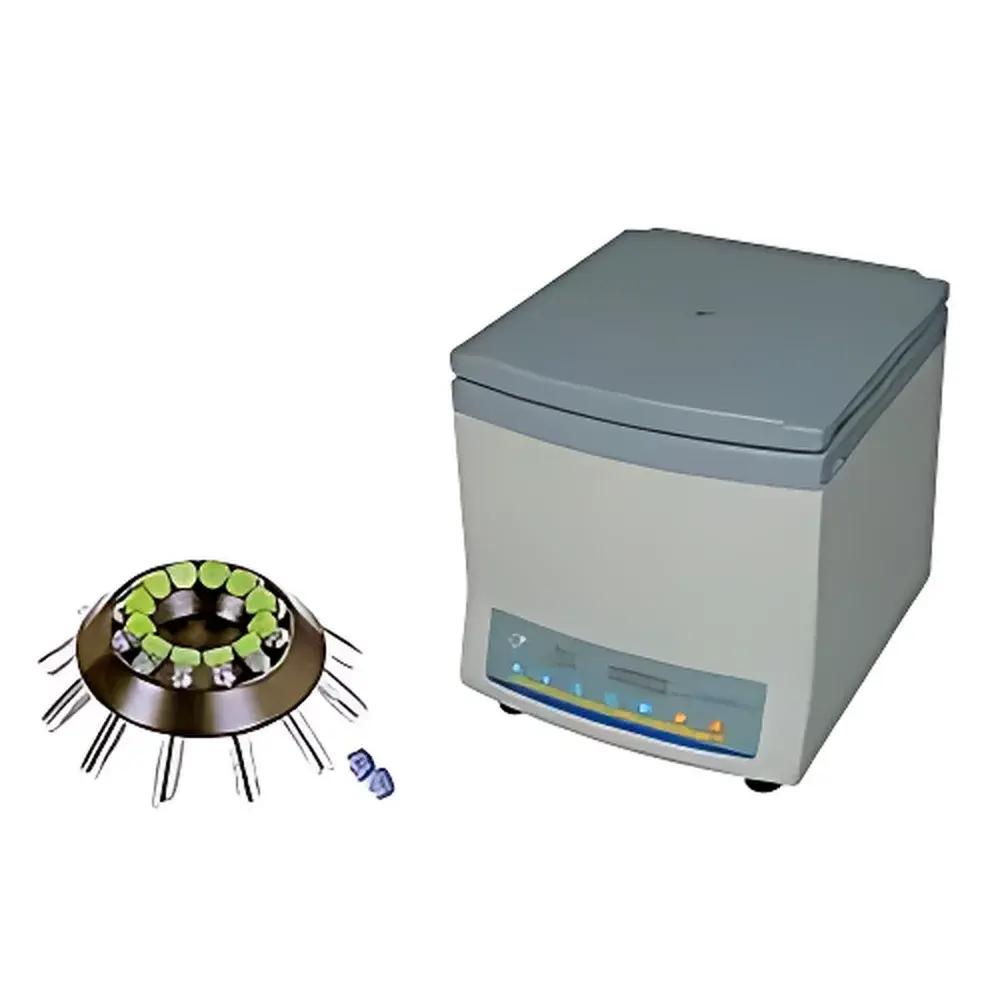
AnTing FeiGe TDL-60B Benchtop Low-Speed Centrifuge
| Brand | AnTing FeiGe |
|---|---|
| Origin | Shanghai, China |
| Instrument Type | Benchtop Centrifuge |
| Max Speed | 6000 rpm |
| Max RCF | 5200 ×g |
| Rotor Type | Fixed-Angle |
| Capacity | 12 × 20 mL |
| Timer Range | 0–60 min |
| Power Supply | 220 V, 50 Hz, 250 W |
| Dimensions (L×W×H) | 350 × 390 × 350 mm |
| Weight | 15 kg |
| Compliance | CE-marked for laboratory use under IEC 61010-1 |
Overview
The AnTing FeiGe TDL-60B is a robust, entry-level benchtop low-speed centrifuge engineered for routine separation tasks in clinical, diagnostic, and general life science laboratories. Operating on the principle of sedimentation under controlled rotational force, the TDL-60B generates a maximum relative centrifugal force (RCF) of 5200 ×g at 6000 rpm—sufficient to pellet whole blood components (e.g., erythrocytes, leukocytes), isolate serum or plasma from clotted samples, clarify cell lysates, and separate precipitates in biochemical assays. Its fixed-angle rotor configuration ensures rapid sedimentation with minimal sample resuspension, while the compact footprint (350 × 390 × 350 mm) allows seamless integration into standard biosafety cabinets or crowded benchtop environments. Designed for reliability over extended operational cycles, the unit features a high-strength polymer housing, precision-balanced drive assembly, and thermally stable brushless motor—enabling consistent performance across daily shifts without thermal drift or mechanical fatigue.
Key Features
- Fixed-angle rotor optimized for 12 × 20 mL conical tubes—compatible with common polypropylene and glass centrifuge tubes meeting ISO 8573-1 Class 4 purity standards.
- Microprocessor-controlled digital timer (0–60 min) with automatic brake and rotor stop detection, eliminating manual intervention post-run.
- Integrated electronic safety door lock that prevents lid opening during operation and enforces mandatory deceleration before release—compliant with IEC 61010-2-020 mechanical safety requirements.
- Low-noise operation (<65 dB(A) at 1 m) achieved via vibration-dampening feet and dynamically balanced rotor assembly—suitable for shared lab spaces and QA/QC environments.
- Over-speed and imbalance detection circuitry with immediate cut-off response, satisfying essential risk mitigation criteria outlined in ISO/IEC 17025 accredited testing laboratories.
Sample Compatibility & Compliance
The TDL-60B supports standard clinical and research sample formats including EDTA-, heparin-, and citrate-anticoagulated whole blood; urine supernatants; bacterial culture pellets; and clarified tissue homogenates. It meets key regulatory prerequisites for non-GMP clinical labs performing CLIA-waived tests, including USP sterility test support protocols and WHO TRS No. 961 Annex 5 guidance for centrifugation in diagnostic specimen preparation. While not validated for 21 CFR Part 11 electronic records, its analog timer and mechanical interlock design ensure audit-ready physical traceability for GLP-aligned workflows where paper-based run logs are maintained.
Software & Data Management
The TDL-60B operates as a standalone instrument with no embedded firmware or network interface. All operational parameters—including speed, time, and RCF—are set manually via front-panel controls and verified by dual-scale LED display (rpm and ×g). This architecture eliminates software validation overhead, making it suitable for laboratories operating under simplified quality systems (e.g., ISO 9001-certified facilities or teaching institutions). For traceability, users may document settings and run outcomes in external logbooks aligned with internal SOPs—consistent with FDA QSR §820.180 record retention practices for Class I medical device auxiliary equipment.
Applications
- Clinical diagnostics: Serum/plasma separation from venous blood specimens prior to ELISA, immunoassay, or clinical chemistry analysis.
- Blood banking: Processing donor units for component separation (e.g., platelet-poor plasma generation).
- Academic teaching labs: Demonstrating sedimentation kinetics, density gradient principles, and rotor geometry effects on pelleting efficiency.
- Biotechnology QC: Clarifying fermentation broths, recovering microbial cells, and preparing samples for downstream HPLC or spectrophotometric quantification.
- Veterinary pathology: Urine sediment concentration and synovial fluid analysis per CVMA guidelines.
FAQ
What is the maximum tube volume supported by the TDL-60B?
The unit accommodates twelve 20 mL conical centrifuge tubes in its standard fixed-angle rotor—no adapters or optional rotors are available.
Is the TDL-60B suitable for centrifuging infectious samples?
Yes, when used with sealed, biocontainment-certified tubes (e.g., ISO 13485-compliant screw-cap tubes), and operated inside a certified Class II biosafety cabinet per BMBL 6th edition recommendations.
Does the centrifuge include calibration documentation?
Factory calibration certificates for speed and timer accuracy are provided upon request; users should perform periodic verification using NIST-traceable tachometers per ISO/IEC 17025 Clause 6.5.
Can the rotor be autoclaved?
No—the aluminum rotor is anodized for corrosion resistance but is not rated for steam sterilization; wipe-down with 70% ethanol or 0.5% sodium hypochlorite is recommended between runs.
What maintenance is required for long-term reliability?
Annual inspection of carbon brushes, bearing lubrication status, and door latch integrity is advised; full service intervals align with IEC 61010-1 maintenance schedules for Class I electrical equipment.



