
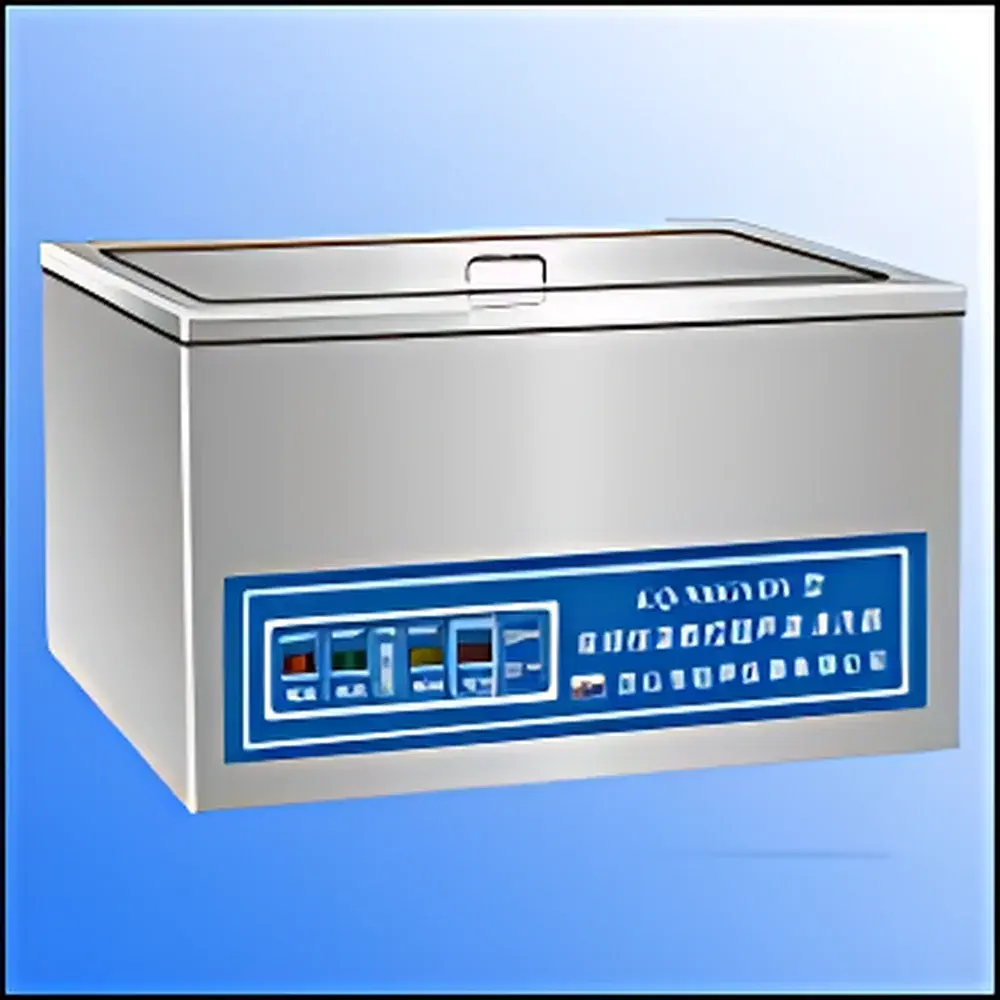
Shumei KQ-100B.E.V / KQ-250B.E.V / KQ-300B.E.V Benchtop Ultrasonic Cleaner
| Brand | Shumei |
|---|---|
| Origin | Jiangsu, China |
| Model | KQ-100B.E.V / KQ-250B.E.V / KQ-300B.E.V |
| Tank Capacity | 4 L / 10 L / 10 L |
| Ultrasonic Frequency | 40 kHz |
| Ultrasonic Power | 100 W / 250 W / 300 W |
| Adjustable Power | Yes |
| Heating Range | 0–80 °C |
| Timer Range | 1–20 min |
| Sound-Dampening Lid | Included |
| Manual Fill/Drain | Yes |
Overview
The Shumei KQ-100B.E.V, KQ-250B.E.V, and KQ-300B.E.V are benchtop ultrasonic cleaners engineered for precision cleaning, degassing, and sample preparation in regulated laboratory environments. These units operate on the principle of piezoelectric transduction at a fixed frequency of 40 kHz, generating cavitation bubbles within aqueous or compatible solvent media. When these microbubbles collapse near surfaces, they produce localized high-pressure shockwaves (up to ~1000 atm) and transient temperatures (~5000 K), enabling effective removal of particulate contaminants, organic residues, biofilms, and adsorbed ions from delicate instrumentation parts, glassware, surgical tools, semiconductor wafers, and analytical sample vessels. Designed with integrated ultrasonic generators and stainless-steel tanks (SUS304), each model features a robust mechanical control interface for time and temperature settings—optimized for GLP-compliant workflows where reproducibility, traceability, and operator safety are prioritized over digital complexity.
Key Features
- Stainless-steel tank construction (SUS304) ensures corrosion resistance, long-term chemical compatibility with common lab solvents (e.g., isopropanol, acetone, aqueous detergents), and ease of decontamination.
- Fixed-frequency 40 kHz transducer array delivers consistent cavitation intensity across the tank volume—ideal for routine cleaning of standard labware including volumetric flasks, cuvettes, pipette tips, HPLC vials, and microscope slides.
- Adjustable heating (0–80 °C) enhances cleaning efficacy for viscous or thermally responsive contaminants; temperature stability maintained within ±2 °C under load.
- Programmable timer (1–20 minutes) enables repeatable exposure duration—critical for method validation and inter-laboratory comparability.
- Integrated sound-dampening lid reduces ambient noise to <55 dB(A) at 1 m distance, meeting occupational health guidelines for continuous operation in shared lab spaces.
- Manual fill-and-drain system supports controlled solvent handling without external plumbing—compatible with waste segregation protocols and solvent recovery workflows.
- Compact benchtop footprint (KQ-100B.E.V: 320 × 174 × 260 mm; KQ-250B.E.V/KQ-300B.E.V: 320 × 264 × 320 mm) facilitates integration into fume hoods, cleanrooms, or QC/QA workstations.
Sample Compatibility & Compliance
These cleaners accommodate a wide range of sample types—including metal, glass, ceramic, and certain polymers—provided material compatibility with ultrasonic energy and process solvents is verified per ASTM D2603 and ISO 13898. The 40 kHz frequency balances penetration depth and surface shear stress, minimizing risk of pitting on soft metals (e.g., aluminum alloys) or delamination on coated optics. Units comply with IEC 61000-6-3 (EMC emissions) and IEC 61000-6-2 (immunity). While not certified to UL/CSA standards, they meet general electrical safety requirements for Class I equipment under GB 4706.1–2005 (Chinese national standard equivalent to IEC 60335-1). For GMP-regulated environments, mechanical controls provide deterministic operation—eliminating firmware-related validation overhead associated with microprocessor-based systems.
Software & Data Management
The KQ-B.E.V series operates without embedded software or network connectivity, relying exclusively on analog controls (rotary dials for time and temperature). This architecture eliminates cybersecurity risks, firmware update dependencies, and electronic data integrity concerns—making it inherently suitable for 21 CFR Part 11–aligned workflows where audit trails are generated externally (e.g., via lab notebook entries or LIMS logging). No calibration certificate is supplied by default; however, temperature accuracy can be verified using NIST-traceable RTD probes, and timer repeatability may be confirmed with stopwatch-grade metrology. Routine maintenance includes visual inspection of transducer adhesion, tank integrity checks, and periodic descaling using dilute citric acid solution.
Applications
- Routine cleaning of analytical glassware prior to trace-metal analysis (e.g., ICP-MS, AAS) to minimize blank contamination.
- Degassing of mobile phases and solvents in chromatography labs to prevent pump cavitation and baseline drift.
- Preparation of nanoparticle dispersions and colloidal suspensions requiring uniform deagglomeration.
- Cleaning of reusable surgical instruments and dental handpieces in research animal facilities.
- Removal of photoresist residues from silicon wafers during microfabrication prototyping.
- Extraction support for solid-phase samples (e.g., plant tissues, soil matrices) in environmental and pharmaceutical labs.
FAQ
What is the difference between the “B”, “E”, and “V” suffixes in the KQ model nomenclature?
The “B” denotes inclusion of heating (800 W heater); “E” adds a sound-dampening lid and drain valve; “V” indicates a larger vertical tank design with increased capacity and optional dual-frequency capability—none of which apply to the B.E.V configuration, which combines heating (“B”) and lid (“E”) but retains the standard tank geometry (“V” is omitted in this variant).
Can these units be used with flammable solvents such as acetone or ethanol?
No. These models lack explosion-proof certification and internal spark suppression. Only aqueous solutions or non-flammable, low-volatility solvents (e.g., 2% SDS, citric acid, or commercial ultrasonic cleaning concentrates) are permitted.
Is the ultrasonic power output adjustable per cycle?
Yes—mechanical power regulation is provided via front-panel potentiometer, allowing users to reduce nominal output (e.g., 50–100% of rated wattage) to accommodate sensitive substrates or optimize energy use.
Does the unit include a basket or mesh tray?
A stainless-steel wire mesh basket is included as standard equipment to suspend items above the tank bottom and ensure uniform acoustic exposure.
What maintenance intervals are recommended for sustained performance?
Transducer performance should be assessed quarterly via cavitation intensity test (using aluminum foil erosion or calorimetric methods); tank interior should be descaled every 50 operating hours when using hard water or heated cycles.



