
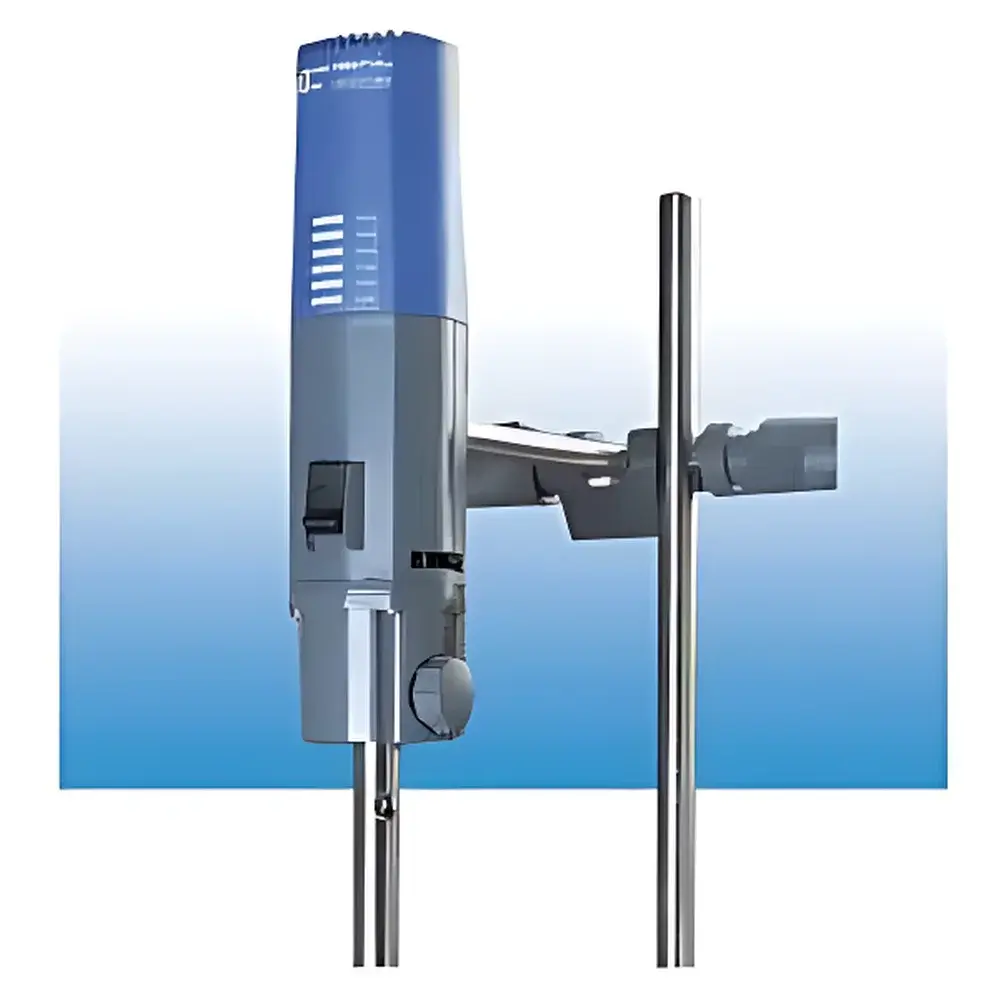
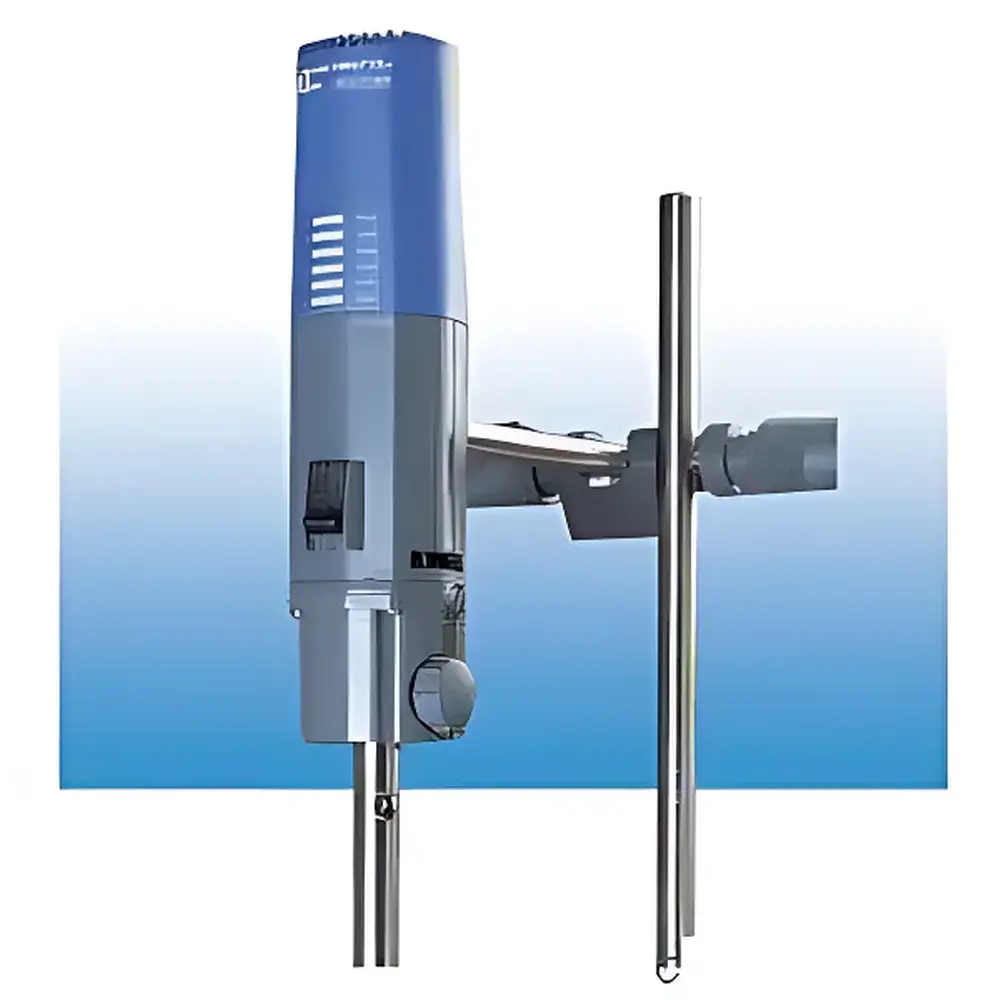
IKA T18 ULTRA-TURRAX High-Speed Homogenizer (Germany)
| Brand | IKA |
|---|---|
| Origin | Germany |
| Model | T18 ULTRA-TURRAX |
| Instrument Type | Probe-type rotor-stator homogenizer |
| Dimensions (W×D×H) | 65 × 80 × 240 mm |
| Processing Volume Range | 10–1500 mL |
| Motor Input Power | 500 W |
| Motor Output Power | 300 W |
| Max. Viscosity | 5,000 mPa·s |
| No-Load Noise Level | 73 dB(A) |
| Weight | 1.6 kg |
| Speed Range | 3,500–24,000 rpm (infinitely variable, calibrated scale) |
| Shaft Diameter/Length | 13 mm / 175 mm |
| Compatible Probes | S18N-10G (1–100 mL), S18N-19G (10–1500 mL) |
Overview
The IKA T18 ULTRA-TURRAX is a precision-engineered probe-type rotor-stator homogenizer designed for reproducible, high-shear dispersion, emulsification, and cell disruption in research and quality control laboratories. Based on the proven principle of high-speed mechanical shearing—where a rapidly rotating rotor draws sample material into a narrow stator gap and subjects it to intense hydraulic shear, cavitation, and turbulent mixing—the T18 delivers consistent particle size reduction and homogenization across diverse matrices. Its robust aluminum housing, thermally optimized motor design, and integrated electronic speed regulation ensure stable operation under variable load conditions. As a CE-marked instrument manufactured in Staufen, Germany, the T18 complies with IEC 61000-6-2 (EMC immunity) and IEC 61000-6-4 (EMC emission) standards, and its construction supports routine use in ISO/IEC 17025-accredited testing environments.
Key Features
- Infinitely variable speed control via calibrated analog dial (3,500–24,000 rpm), enabling precise adaptation to sample rheology and process requirements
- Electronic temperature monitoring with automatic thermal cut-off to prevent motor overload during extended operation
- Quick-lock probe mounting system (no tools required) for rapid interchange of standardized ULTRA-TURRAX dispersing elements
- Two validated probe configurations: S18N-10G (1–100 mL, ideal for small-volume tissue homogenization or nanoparticle dispersion) and S18N-19G (10–1500 mL, suited for batch emulsification or suspension stabilization)
- Low-noise enclosure design (73 dB(A) at no load) compatible with shared laboratory spaces and noise-sensitive applications
- Compact footprint (65 × 80 × 240 mm) and lightweight chassis (1.6 kg) facilitate benchtop integration and portability between workstations
- Stainless steel probe shaft (13 mm Ø, 175 mm length) with corrosion-resistant surface finish for compatibility with aqueous, organic, and mildly aggressive media
Sample Compatibility & Compliance
The T18 ULTRA-TURRAX accommodates a broad range of sample types—including biological tissues, plant extracts, polymer solutions, pharmaceutical suspensions, food emulsions, and ceramic slurries—within viscosity limits up to 5,000 mPa·s. Its performance aligns with common method validation frameworks: for food safety testing, it meets the mechanical homogenization requirements specified in ISO 6887-1:2017 (preparation of microbiological test samples); for pharmaceutical R&D, it supports USP dissolution media preparation and USP homogenization protocols. The device is suitable for GLP-compliant workflows when paired with documented operating procedures and maintenance logs. While not inherently 21 CFR Part 11 compliant (as it lacks audit-trail-capable software), its analog interface ensures deterministic, tamper-evident operation—valuable in regulated environments where simplicity and traceability are prioritized over digital complexity.
Software & Data Management
The T18 operates as a standalone analog instrument without embedded firmware or connectivity interfaces. All operational parameters—including speed setting, runtime, and probe type—are manually recorded by the user. This architecture eliminates software validation burdens and reduces failure modes associated with embedded electronics. For laboratories requiring digital documentation, the T18 integrates seamlessly with external timers, data loggers, or LIMS systems via manual entry or barcode-scanned protocol execution. Optional accessories—including adjustable lab stands (R1822), universal clamps (SRH3), and vessel holders—support repeatable positioning and ergonomic handling during extended processing cycles.
Applications
- Pre-analytical sample preparation for HPLC, GC-MS, and ICP-MS: homogenizing tissue biopsies, soil extracts, or composite food matrices to ensure representative sub-sampling
- Formulation development: stabilizing oil-in-water emulsions (e.g., cosmetic lotions, agrochemical concentrates) and dispersing nanomaterials in polymer matrices
- Microbiological testing: lysing Gram-negative bacteria and yeast cells for DNA/RNA extraction per ISO 11290-1 and EN ISO 13843 protocols
- Quality assurance in dairy and beverage production: verifying fat globule size distribution in milk homogenates and particle uniformity in fruit pulp suspensions
- Educational laboratories: demonstrating shear-dependent viscosity behavior, emulsion kinetics, and energy input–particle size correlations
FAQ
What is the maximum recommended continuous operating time for the T18 ULTRA-TURRAX?
For optimal thermal management, continuous operation should not exceed 60 seconds per cycle when processing viscous or heat-sensitive samples; allow ≥30 seconds cooling between cycles. At lower speeds (<10,000 rpm) and with low-viscosity media, duty cycles may extend to 120 seconds.
Can the T18 be used for sterile applications?
Yes—ULTRA-TURRAX probes are autoclavable at 121 °C for 20 minutes (standard cycle). Verify probe integrity post-sterilization; avoid repeated autoclaving of PTFE-coated variants.
Is the S18N-19G probe compatible with glass vessels?
It is designed for use with standard laboratory glassware (e.g., beakers, cylinders, centrifuge tubes). Ensure vessel walls are ≥1.5 mm thick and maintain ≥5 mm clearance between probe tip and vessel bottom/side to prevent breakage.
Does IKA provide calibration certificates for the T18?
IKA does not supply factory calibration certificates for analog speed-controlled units. Users may verify rotational speed using an external tachometer traceable to NIST or PTB standards as part of internal equipment qualification.
How does the T18 compare to the T25 or T50 models in terms of torque and scalability?
The T18 delivers peak torque of ~0.12 N·m at 10,000 rpm. The T25 (0.25 N·m) and T50 (0.5 N·m) offer higher torque and larger probe options for >2 L volumes and higher-viscosity applications—making them suitable for pilot-scale development, while the T18 remains optimal for analytical-scale reproducibility.



