
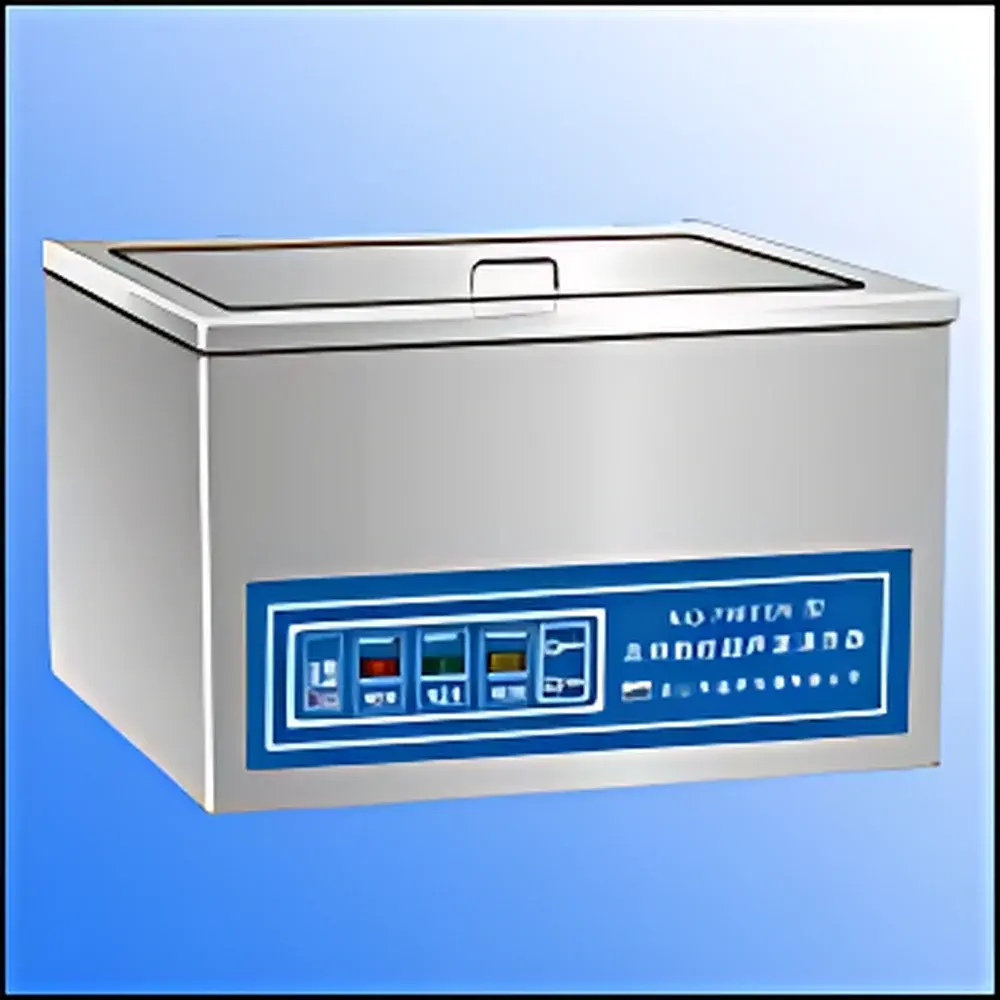
Shumei KQ-500B.E.V / KQ-600B.E.V / KQ-700B.E.V Benchtop Ultrasonic Cleaner
| Brand | Shumei |
|---|---|
| Origin | Jiangsu, China |
| Model | KQ-500B.E.V / KQ-600B.E.V / KQ-700B.E.V |
| Capacity | 22.5 L |
| Ultrasonic Frequency | 40 kHz |
| Ultrasonic Power | 500 W / 600 W / 700 W |
| Adjustable Power | Yes |
| Temperature Range | 0–80 °C |
| Timer Range | 1–20 min |
| Sound-Dampening Lid | Included |
| Manual Fill/Drain | Yes |
Overview
The Shumei KQ-500B.E.V, KQ-600B.E.V, and KQ-700B.E.V are benchtop ultrasonic cleaners engineered for reproducible, high-efficiency cleaning in academic laboratories, QC/QA environments, and R&D facilities. These units operate on the principle of cavitation—generated by piezoelectric transducers bonded to the stainless-steel tank bottom—which produces microscopic implosions in the cleaning solution. This mechanical energy effectively removes particulate contamination, organic residues, oxides, and biofilms from delicate components including glassware, surgical instruments, optical lenses, semiconductor wafers, and precision metal parts. Unlike immersion-only or agitation-based methods, ultrasonic cleaning ensures uniform treatment across complex geometries, blind holes, and micro-textured surfaces without mechanical abrasion. The integrated transducer–tank architecture minimizes acoustic coupling loss and supports stable, long-term operation under continuous duty cycles.
Key Features
- Stainless-steel tank construction (304 grade) with reinforced welded seams and corrosion-resistant finish—ensures durability against aqueous, alkaline, and mild solvent-based cleaning media.
- Adjustable analog controls for precise setting of ultrasonic duration (1–20 minutes) and heating temperature (0–80 °C), enabling method reproducibility without software dependency.
- Dual-function heating system (1000 W) maintains consistent bath temperature during extended cleaning cycles, critical for temperature-sensitive applications such as enzymatic residue removal or low-volatility solvent activation.
- Sound-dampening lid reduces ambient noise to ≤55 dB(A) at 1 m distance—compliant with ISO 7779 and OSHA workplace noise exposure guidelines for laboratory environments.
- Integrated safety circuitry includes over-temperature cutoff, dry-run protection, and automatic shutdown upon lid opening—meeting IEC 61010-1 requirements for laboratory electrical equipment.
- Modular transducer array (each rated at 50 W nominal output) delivers uniform energy distribution across the full tank volume, verified per ASTM E1727-22 (Standard Guide for Ultrasonic Cleaning Process Validation).
Sample Compatibility & Compliance
These cleaners accommodate standard laboratory ware (e.g., beakers, flasks, cuvettes, pipette tips) and industrial components up to 500 × 300 × 150 mm (L × W × H). The 22.5 L capacity supports batch processing of multiple items simultaneously while maintaining adequate solution depth for effective cavitation zone penetration. Units comply with CE marking directives (2014/30/EU EMC, 2014/35/EU LVD) and conform to ISO 13485-aligned manufacturing practices. While not certified for sterile processing per ISO 17664 or EN 285, they serve as validated pre-sterilization cleaning steps in GMP-compliant medical device manufacturing workflows when paired with documented cleaning validation protocols.
Software & Data Management
As analog-controlled instruments, the KQ-B.E.V series does not incorporate digital data logging or network connectivity. All operational parameters are set manually via calibrated rotary dials, eliminating firmware-related validation overhead. This design aligns with GLP environments where traceability is maintained through paper-based or LIMS-integrated SOPs—particularly advantageous for regulated labs requiring minimal computerized system validation (CSV) scope per FDA 21 CFR Part 11 Annex A. Optional accessories—including stainless-steel mesh baskets, beaker holders, and degassing trays—are available to extend functional versatility without compromising calibration integrity.
Applications
- Pre-analytical sample preparation: removal of residual solvents, salts, or proteins from HPLC vials, GC liners, and ICP-MS nebulizers.
- Microelectronics: particle-free cleaning of PCB stencils, solder paste dispensing nozzles, and MEMS substrates prior to thin-film deposition.
- Pharmaceutical manufacturing: cleaning of tablet punches, capsule fillers, and stainless-steel contact parts in accordance with USP cleaning validation guidance.
- Materials science: dispersion of nanomaterials (e.g., graphene oxide, TiO₂ nanoparticles) in aqueous or organic media for colloidal stability studies.
- Maintenance of analytical instrumentation: restoration of ultrasonic bath performance in sonicator probes, flow cell windows, and acoustic sensors.
FAQ
What is the recommended cleaning solution for general laboratory use?
Aqueous alkaline detergents (pH 9–11) are optimal for organic soil removal; deionized water alone suffices for particulate rinsing. Avoid halogenated solvents unless explicitly approved for use with stainless-steel tanks.
Can these units be used for sterilization?
No. Ultrasonic cleaning is a physical decontamination step—not a sterilization modality. Sterilization requires validated thermal (autoclaving), chemical (ethylene oxide), or radiation processes per ISO 14937.
Is degassing required before initiating ultrasonic cleaning?
Yes. Dissolved air inhibits cavitation efficiency. A 5–10 minute degas cycle (with heater off and ultrasonics active) is recommended prior to loading samples.
How often should the cleaning solution be replaced?
Solution change frequency depends on soil load and process validation data. As a baseline, replace after every 8 hours of cumulative operation or immediately upon visible turbidity or foam degradation.
Are replacement transducers available as spare parts?
Yes. Shumei supplies OEM-certified transducer modules with matched impedance and resonant frequency (40 ± 1 kHz), ensuring consistent power delivery and avoiding harmonic interference in multi-unit installations.



