
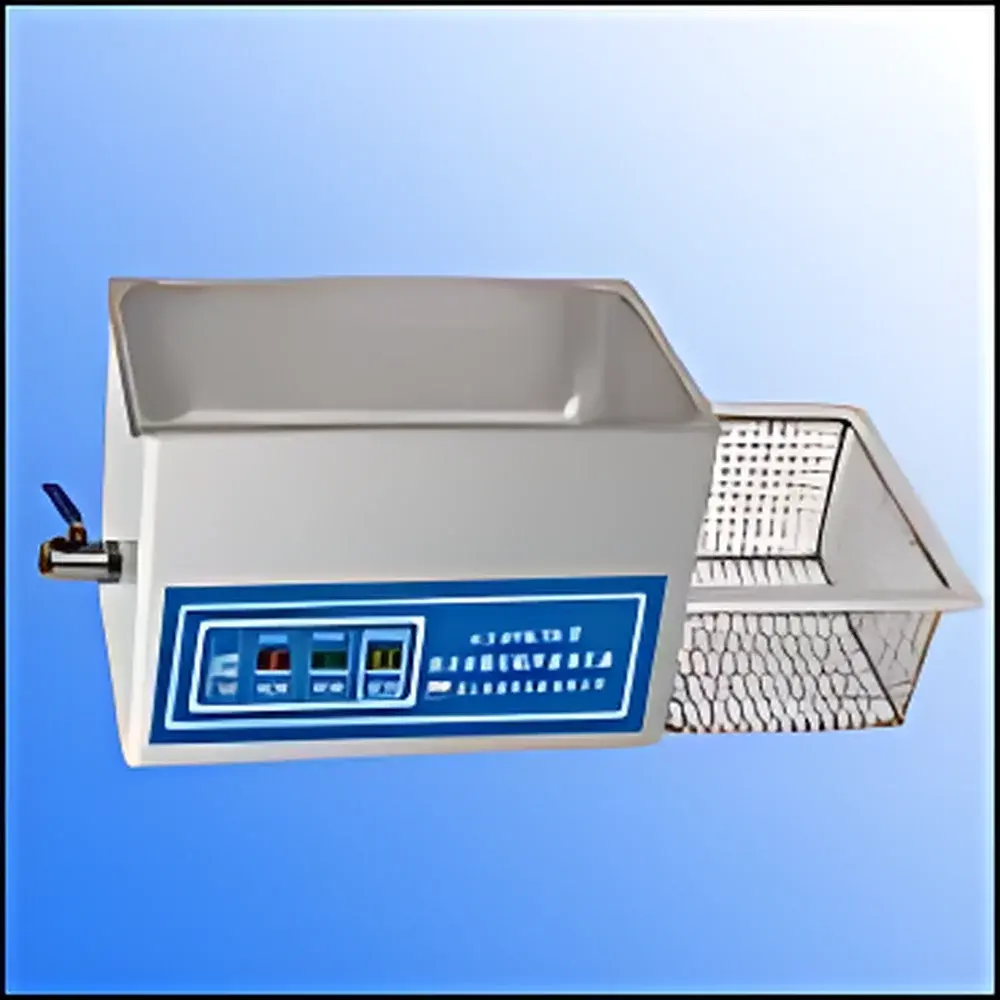
Shumei KQ-100KDE / KQ-200KDE / KQ-400KDE Ultrasonic Cleaner
| Brand | Shumei |
|---|---|
| Origin | Jiangsu, China |
| Model Series | KQ-100KDE / KQ-200KDE / KQ-400KDE |
| Tank Capacity | 2 L / 6 L / 10 L |
| Ultrasonic Frequency | 40 kHz |
| Ultrasonic Power | 100 W / 200 W / 400 W |
| Power Adjustment Range | 40–100% |
| Heating Temperature Range | 20–80 °C |
| Timer Range | 1–480 min |
| Sound-Dampening Lid | Yes |
| Manual Drain Valve | Yes |
| Tank Material | Stainless Steel (304) |
| Housing Material | Plastic (KQ-100KDE) or Stainless Steel (KQ-200KDE/KQ-400KDE) |
Overview
The Shumei KQ-100KDE, KQ-200KDE, and KQ-400KDE ultrasonic cleaners are benchtop laboratory instruments engineered for precision cleaning, degassing, dispersion, emulsification, and cell disruption applications. These units operate on the principle of high-frequency ultrasonic cavitation—generated at a fixed frequency of 40 kHz—where rapid pressure fluctuations in the cleaning solution produce microscopic vacuum bubbles that collapse with localized energy release. This physical mechanism enables effective removal of particulate contaminants, organic residues, and biofilms from delicate substrates such as glassware, metal parts, semiconductor wafers, optical components, and biological sample holders without mechanical abrasion. Designed for integration into quality control laboratories, R&D facilities, and academic research environments, the KQ series features an integrated ultrasonic generator and transducer assembly directly bonded to the stainless steel tank base, ensuring consistent energy transmission and long-term operational stability.
Key Features
- Three scalable models (KQ-100KDE: 2 L, KQ-200KDE: 6 L, KQ-400KDE: 10 L) accommodate diverse sample volumes and throughput requirements.
- Adjustable ultrasonic power output (40–100% of rated power) allows optimization for sensitive or heavily soiled samples.
- Digital temperature control (20–80 °C) enhances cleaning efficacy for temperature-dependent processes such as lipid dissolution or enzymatic residue removal.
- Precision digital timer (1–480 minutes) supports reproducible cycle execution; cumulative operating hour counter aids preventive maintenance scheduling.
- Integrated sound-dampening lid reduces ambient noise levels by up to 15 dB(A), improving laboratory ergonomics and compliance with occupational health guidelines.
- Stainless steel (304) tank construction ensures chemical resistance to common aqueous solvents, mild alkaline detergents, and ethanol-based solutions.
- Manual drain valve facilitates safe, controlled solution disposal—critical when handling hazardous or regulated waste streams.
- Standard mesh basket included for uniform part suspension and protection against direct tank contact during sonication.
Sample Compatibility & Compliance
The KQ series is compatible with a broad range of laboratory materials including borosilicate glass, fused silica, titanium alloys, aluminum, and polymer substrates (e.g., PTFE, polypropylene). It is routinely deployed in applications aligned with ASTM D2603 (Standard Test Method for Sonic Shear Stability of Lubricating Oils), ISO 13485 (medical device cleaning validation), and USP (Ultrasonic Cleaning of Pharmaceutical Equipment). While not certified to IEC 61000-6-3 (EMC) or UL 61010-1 out-of-the-box, the devices meet basic CE marking requirements for laboratory equipment under the Low Voltage Directive (2014/35/EU) and Electromagnetic Compatibility Directive (2014/30/EU) when operated within specified environmental conditions (ambient temperature 10–35 °C, relative humidity ≤80%). For GLP/GMP-regulated workflows, users may implement audit-ready documentation protocols—including calibration logs for temperature and timer functions—and integrate the units into validated cleaning SOPs.
Software & Data Management
These models operate via embedded microcontroller-based digital controls with LED display interface—no external PC software or proprietary drivers required. All operational parameters (time, temperature, power level) are stored in non-volatile memory and retained after power cycling. The system supports manual data recording for traceability; for automated data capture, integration with third-party lab information management systems (LIMS) is achievable via optional RS-232 or USB-to-serial adapters (sold separately). Time-stamped operation logs can be exported for inclusion in FDA 21 CFR Part 11-compliant electronic records when paired with appropriate validation packages and user access controls.
Applications
- Cleaning of HPLC vials, pipette tips, syringe filters, and chromatography columns prior to analysis.
- Degassing of solvents and mobile phases to eliminate air bubbles affecting detector baseline stability.
- Dispersion of nanomaterials (e.g., carbon nanotubes, metal oxides) in aqueous or organic suspensions.
- Cell lysis and nucleic acid extraction in molecular biology workflows, particularly for Gram-negative bacteria and yeast.
- Removal of flux residues from printed circuit boards (PCBs) and microelectronic components.
- Preparation of reference standards and calibration samples requiring particle-free surfaces.
- Supporting ASTM E1667 (Standard Practice for Ultrasonic Cleaning of Medical Devices) in pre-sterilization processing.
FAQ
What is the recommended cleaning solution for use with the KQ series?
Deionized water is suitable for general cleaning; for enhanced performance, low-foaming, non-corrosive ultrasonic detergents (e.g., Alconox® Liquinox® or Elma Clean®) are recommended. Avoid halogenated solvents unless verified compatible with stainless steel and sealed electronics.
Can the unit be operated without the mesh basket?
Yes, but direct placement of items on the tank bottom may reduce cavitation efficiency and risk surface scratching. Use of the included basket is strongly advised for uniform energy distribution and sample protection.
Is the heating function independent of ultrasonic activation?
No—the heater operates only when ultrasonic power is enabled. This design prevents thermal degradation of cleaning solutions during idle heating cycles.
How often should the transducer bonding integrity be verified?
Visual inspection for delamination or corrosion at the tank-transducer interface is recommended every 6 months; acoustic output verification using calibrated hydrophones is advised annually in high-use environments.
Does the KQ-200KDE/KQ-400KDE support continuous operation beyond 480 minutes?
No—the maximum programmable cycle is 480 minutes. For extended processes, manual restart or external timer relay integration is required.



