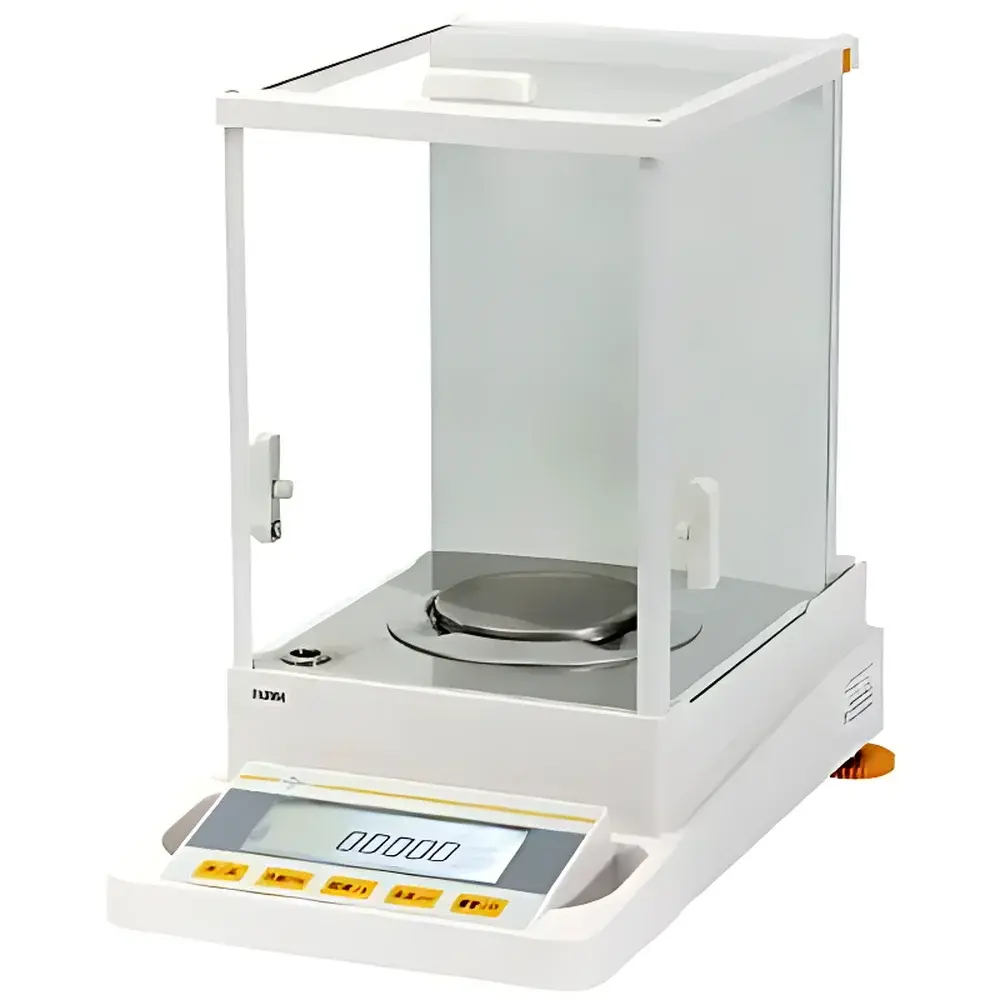
SOPOTOP FA1004 Analytical Balance (0.1 mg Readability)
| Brand | SOPOTOP |
|---|---|
| Origin | Shanghai, China |
| Model | FA1004 |
| Maximum Capacity | 100 g |
| Readability | 0.1 mg |
| Repeatability | ±0.1 mg |
| Linearity | ±0.2 mg |
| Pan Diameter | 90 mm |
| Draft Shield Dimensions | 190 × 155 × 235 mm |
| Overall Dimensions | 200 × 440 × 290 mm |
| Calibration | External |
| Sensor Type | Electromagnetic Force Compensation |
| Interface | RS232 |
| Functions | Counting, Percentage Weighing, Unit Conversion (g, oz, ct), Auto-zero Tracking, Overload Protection, Self-diagnosis, Linear Correction, Factory Reset |
Overview
The SOPOTOP FA1004 Analytical Balance is a precision laboratory instrument engineered for high-reproducibility mass measurement in research, quality control, and routine analytical workflows. Operating on the principle of electromagnetic force compensation—where sample weight is counterbalanced by a precisely regulated current through a coil suspended in a permanent magnetic field—the FA1004 delivers stable, drift-resistant readings with 0.1 mg readability across its full 100 g capacity range. Designed to meet the fundamental metrological requirements of ISO/IEC 17025-accredited laboratories, it supports traceable weighing under controlled environmental conditions (temperature stability ±2 °C, low air currents). Its robust mechanical architecture—including a rigid base, optimized draft shield geometry, and vibration-damping foot design—ensures operational reliability in shared lab environments without dedicated anti-vibration tables.
Key Features
- Electromagnetic force compensation sensor with rear-mounted configuration for enhanced thermal stability and reduced mechanical hysteresis
- Four-level shock absorption system mitigating floor-borne vibrations from adjacent equipment or foot traffic
- Dynamic temperature compensation algorithm continuously adjusts zero and sensitivity based on internal thermal gradient monitoring
- Full-range tare functionality enabling subtraction of container mass at any point within the 0–100 g span without recalibration
- Adjustable auto-zero tracking threshold and programmable weighing speed (fast/standard/slow) to balance throughput and stability
- Integrated overload protection with audible and visual alert upon exceeding 105% of maximum capacity
- Multi-function operation modes: piece counting, percentage weighing relative to reference mass, and unit conversion among grams, ounces, carats, and milligrams
- Backlit LCD display with adjustable contrast and character height for ergonomic viewing under varied ambient lighting
- RS232 serial interface compliant with standard ASCII protocol for seamless integration with LIMS, ELN, or custom data acquisition software
Sample Compatibility & Compliance
The FA1004 accommodates standard laboratory samples in crucibles, weighing boats, vials, and filter papers—compatible with both dry and low-moisture solids typical in pharmaceutical assay prep, chemical synthesis quantification, and materials characterization. Its 90 mm stainless-steel weighing pan and removable acrylic draft shield (190 × 155 × 235 mm) provide adequate containment for volatile solvents and fine powders while permitting easy cleaning. The balance conforms to international regulatory expectations for analytical instrumentation: its external calibration protocol aligns with ASTM E898–22 guidelines for verification of readability and repeatability; its linearity performance (±0.2 mg) satisfies USP criteria for Class I analytical balances used in dosage uniformity testing; and its audit-ready operation—including user-accessible calibration logs and error-code diagnostics—supports GLP/GMP documentation practices where electronic records are subject to review.
Software & Data Management
Data output via the built-in RS232 port follows standard NIST-traceable formatting (e.g., “S 000000.123 g” for stable reading), enabling direct ingestion into Excel, LabArchives, or proprietary QC databases without middleware. While the FA1004 does not include onboard data storage or touchscreen GUI, its command-set supports automated triggering (via DTR handshake) and timestamped output when paired with host software that implements ANSI X3.27–1989 framing. All calibration events—date, operator ID (if entered manually), standard mass value, and deviation—are recorded in non-volatile memory and retrievable via serial query, fulfilling basic FDA 21 CFR Part 11 record-keeping prerequisites for environments requiring audit trails.
Applications
- Quantitative preparation of reference standards and working solutions in pharmaceutical QC labs
- Weighing catalysts, reagents, and intermediates in synthetic organic chemistry workflows
- Gravimetric analysis of ash content, moisture loss on drying (LOD), and residue after ignition (RAI)
- Piece counting for small hardware components, tablets, or microelectronics packaging validation
- Calibration verification of pipettes and volumetric glassware using water density-based mass-to-volume conversion
- Teaching laboratories requiring ISO-compliant instrumentation for undergraduate analytical chemistry instruction
FAQ
What calibration standards are required for routine verification?
A Class M2 or better certified weight (e.g., 10 g or 100 g) traceable to NIST or BIPM is recommended for daily checks per ISO 17025 clause 6.5.2.
Is internal calibration available on the FA1004?
No—the FA1004 relies exclusively on external calibration using certified weights; no motorized internal mass or self-calibration mechanism is integrated.
Can the balance be operated inside a fume hood?
Not recommended—draft shields are not rated for corrosive vapor exposure, and airflow disrupts electromagnetic force equilibrium; use only in still-air benchtop environments.
Does the RS232 interface support bi-directional communication?
Yes—commands such as “CAL” (initiate calibration), “TARE”, and “PRINT” are supported per the SOPOTOP communication protocol manual v3.1.
How is temperature drift compensated during extended weighing sessions?
The internal thermistor network feeds real-time ambient and sensor housing temperature data to the microcontroller, which applies pre-characterized gain and offset corrections derived from factory thermal mapping.