
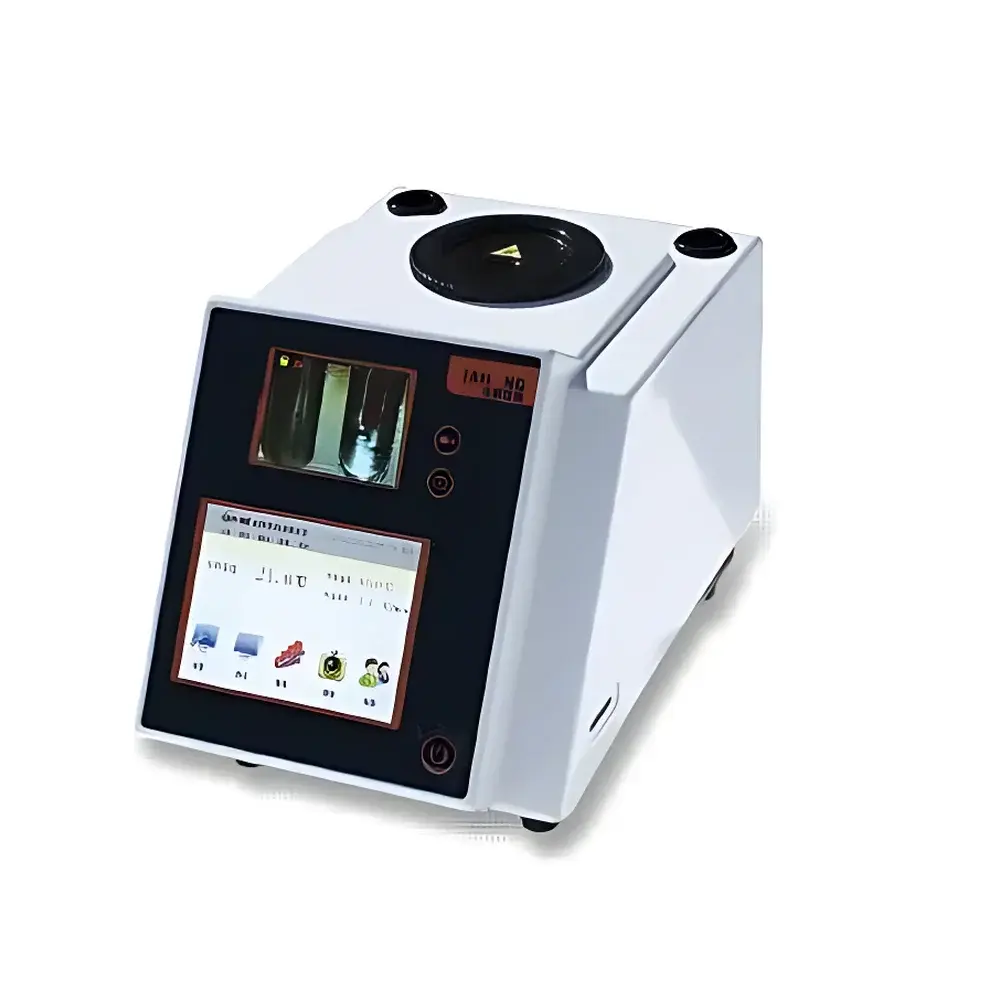
Y30 Fully Automated Video-Based Fat Melting Point Analyzer
| Origin | Shanghai, China |
|---|---|
| Manufacturer Type | Authorized Distributor |
| Origin Category | Domestic (China) |
| Model | Y30 |
| Price Range | USD 7,000–14,000 |
| Temperature Range | 0–100 °C |
| Heating Rate | 0.1–10 °C/min |
| Temperature Repeatability | ±0.1 °C (at 0.1 °C/min heating rate) |
| Temperature Accuracy | ±0.3 °C (up to 100 °C) |
| Capillary Dimensions | OD 1.4 mm, ID 1.0 mm, L 100 mm (dual-open) |
| Sample Capacity | 2 samples per run |
| Temperature Resolution | 0.1 °C |
Overview
The Y30 Fully Automated Video-Based Fat Melting Point Analyzer is a precision thermal analysis instrument engineered for the objective, reproducible determination of melting onset and clear point temperatures in edible fats, waxes, cocoa butter equivalents, margarines, and other lipid-based materials. Unlike traditional capillary tube methods relying on visual endpoint detection, the Y30 integrates high-resolution real-time video imaging with synchronized digital temperature acquisition to capture phase transition dynamics—solid-to-paste-to-liquid—across two parallel samples simultaneously. Its measurement principle is based on optical transmittance and morphological change detection under controlled linear heating, conforming to fundamental thermodynamic definitions of melting behavior in semi-crystalline lipid matrices. The system employs a Pt100 platinum resistance thermometer (PRT) sensor with fast thermal response (<1.5 s time constant) and active PID feedback control to maintain programmed heating profiles within specification across the full 0–100 °C operating range. Designed for routine QC laboratories in food manufacturing, ingredient suppliers, and regulatory testing facilities, the Y30 delivers traceable, audit-ready results aligned with international standard methodologies.
Key Features
- Fully automated video capture and melting point recognition: High-frame-rate CMOS camera records sample evolution at 30 fps; proprietary image-processing algorithms detect first visible melt (onset), complete clearing (clear point), and intermediate stages (e.g., “slip melting”) without operator intervention.
- Dual-sample independent analysis: Two identical capillary channels operate under identical thermal conditions but allow separate timing and endpoint determination—enabling intra-batch comparison or reference vs. test sample evaluation.
- PID-driven thermal control architecture: Ensures stable, linear heating rates from 0.1 to 10 °C/min with <±0.05 °C deviation over 10-minute intervals; cooling via forced-air convection enables rapid return to ambient between runs.
- High-fidelity data traceability: Each assay generates a time-stamped video file (.AVI), synchronized temperature log (.CSV), and annotated melting report (.PDF); all stored with metadata including operator ID, calibration timestamp, and environmental conditions.
- Compliance-ready hardware interface: RS232, USB 2.0, and 10/100 Mbps Ethernet ports support integration into LIMS environments and enable remote monitoring and firmware updates.
Sample Compatibility & Compliance
The Y30 accommodates standard dual-opening capillaries (1.4 mm OD × 1.0 mm ID × 100 mm L), compatible with ASTM D3104, ISO 6321:2018, GB/T 24892–2010, GB/T 12766–2008, and SN/T 0801.5–1999. It supports both anhydrous and low-moisture fat samples—including hydrogenated vegetable oils, palm oil fractions, lard, tallow, and synthetic wax blends—provided they exhibit distinct optical transitions within the 0–100 °C window. No solvent pre-treatment or derivatization is required. Instrument validation follows IQ/OQ protocols per ISO/IEC 17025:2017; temperature accuracy and repeatability are verified using NIST-traceable reference standards (e.g., indium, tin, and diphenylamine mixtures). The system meets GLP documentation requirements and supports 21 CFR Part 11-compliant electronic signatures when deployed with validated software modules.
Software & Data Management
The embedded Y30 Control Suite (v4.2+) runs on a dedicated ARM-based processor and features a 7-inch TFT color touchscreen with intuitive icon-driven navigation. All video recordings and thermal logs are saved locally to an 8 GB industrial-grade eMMC storage module, supporting ≥200 full assay archives. Export options include CSV (temperature/time), AVI (H.264-encoded), PNG (key-frame snapshots), and PDF (formatted compliance reports with pass/fail flags against user-defined spec limits). Optional PC software enables batch analysis, statistical trending (X-bar/R charts), method library management, and audit trail review with immutable timestamps and user-action logging. Data integrity safeguards include write-once archive mode, automatic checksum verification, and password-protected administrator access levels.
Applications
- Quality control of edible oils and shortenings in food processing plants
- Characterization of cocoa butter polymorphism and tempering behavior
- Stability assessment of fat-based pharmaceutical excipients (e.g., suppository bases)
- Raw material qualification for confectionery and dairy analogs
- Research into crystallization kinetics and polymorphic transitions in lipid systems
- Regulatory submission support for FDA, EFSA, and CFDA dossiers requiring documented melting behavior
FAQ
Does the Y30 comply with ISO 6321:2018 for fat melting point determination?
Yes—the optical detection methodology, capillary specifications, heating rate tolerances, and reporting structure fully satisfy Clause 5 (Apparatus) and Clause 7 (Procedure) of ISO 6321:2018.
Can the instrument be calibrated in-house using certified reference materials?
Yes—calibration routines support multi-point verification (e.g., 0 °C ice bath, 50 °C certified liquid bath, 100 °C boiling water) with automated offset correction and certificate generation.
Is video playback synchronized with temperature data during review?
Yes—playback includes a superimposed real-time temperature graph and cursor-linked frame indexing, enabling precise correlation of morphological change with thermal events.
What maintenance is required for long-term reliability?
Annual verification of PRT sensor drift and optical path cleanliness; no consumables beyond standard capillaries and calibration standards.
Can the Y30 be integrated into a networked laboratory environment?
Yes—via Ethernet port with static IP or DHCP configuration; supports SNMP monitoring and scheduled data export to shared network drives or cloud-based repositories.



