
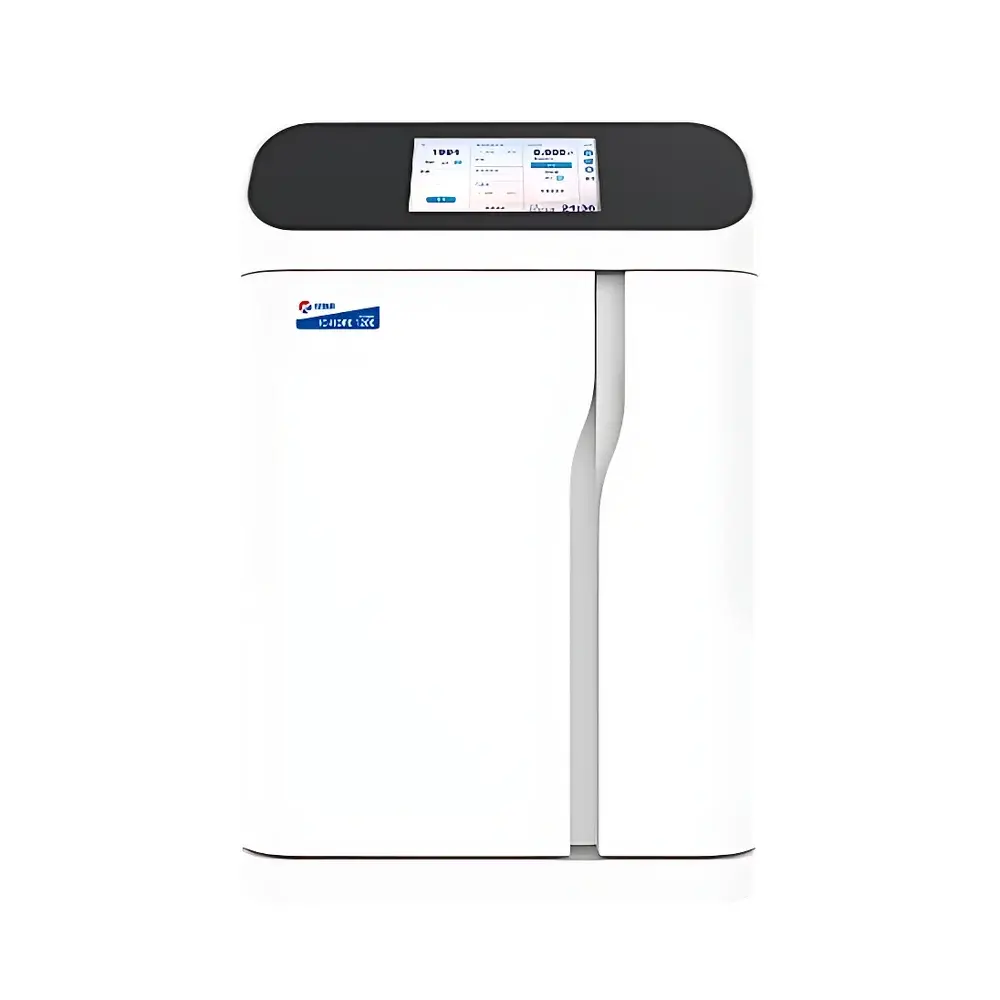
Yoke IC-hope1800S Dual-Channel Ion Chromatograph
| Brand | Yoke |
|---|---|
| Origin | Shanghai, China |
| Manufacturer Type | Direct Manufacturer |
| Instrument Type | Laboratory Benchtop Ion Chromatograph |
| Configuration | Dual-Channel (Simultaneous Anion & Cation Analysis) |
| Pump Pressure Range | 0–35 MPa |
| Flow Rate Range | 0.001–10.000 mL/min |
| Eluent Flow Rate | 0.1–5 mL/min |
| Max Operating Pressure | 35 MPa |
| Column Oven Temperature Range | 5–65 °C |
| Temperature Stability | ≤ 0.1 °C |
| Eluent Concentration Range | 0.1–100 mM |
Overview
The Yoke IC-hope1800S Dual-Channel Ion Chromatograph is a benchtop analytical instrument engineered for high-reproducibility, simultaneous anion and cation separation and quantification using suppressed conductivity detection. It operates on the fundamental principles of ion-exchange chromatography, where analyte ions are separated on dedicated anion- or cation-selective stationary phases under precisely controlled eluent composition, flow rate, and column temperature. The system integrates two independent chromatographic channels—each with dedicated pumps, injectors, columns, suppressors, and detectors—enabling true parallel analysis without cross-contamination or method compromise. Designed for routine QC, environmental monitoring, pharmaceutical impurity profiling, and food safety testing, the IC-hope1800S supports both manually prepared eluents and optional external electrolytic eluent generators, ensuring flexibility across regulatory and research-driven workflows.
Key Features
- Dual-channel architecture with fully independent fluidic paths for concurrent anion and cation analysis—eliminating sequential run delays and preserving method integrity.
- Full-plastic, low-extractable fluidic path constructed from chemically inert PEEK and polyetheretherketone (PEEK), compatible with strong acids (e.g., HNO₃, H₂SO₄), strong bases (e.g., KOH, NaOH), and organic modifiers (e.g., methanol, acetonitrile) up to 30% v/v.
- High-pressure binary gradient pump capable of stable operation up to 35 MPa, with flow precision ≤ 0.1% RSD and programmable flow rates from 0.001 to 10.000 mL/min.
- Integrated column oven with PID-controlled heating/cooling, maintaining temperature stability ≤ ±0.1 °C across 5–65 °C—critical for retention time reproducibility and column longevity.
- 10.0-inch capacitive touchscreen interface running embedded real-time control software, displaying live parameters including conductivity, current, pressure, flow rate, suppressor status, six-port valve position, and eluent generator output.
- One-touch system flush function with pre-programmed solvent sequences to clear salt crystallization, regenerate suppressors, and prepare for next-run equilibration.
- Automatic component recognition and synchronization: the main controller detects valve switching events and triggers corresponding data acquisition windows, minimizing manual intervention and timing-related integration errors.
- Self-maintenance protocol: scheduled automatic flushing of pump heads, injection loops, and suppressor membranes at user-defined intervals to prevent precipitate buildup and extend service life.
Sample Compatibility & Compliance
The IC-hope1800S accommodates aqueous samples containing inorganic anions (F⁻, Cl⁻, NO₂⁻, Br⁻, NO₃⁻, PO₄³⁻, SO₄²⁻), organic acids (acetate, formate, oxalate), cations (Li⁺, Na⁺, NH₄⁺, K⁺, Mg²⁺, Ca²⁺), and transition metal complexes. Its modular design allows integration with UV/Vis absorbance detectors (190–800 nm) or pH/cond conductivity modules for orthogonal detection—supporting USP , ASTM D4327, ISO 14911, and EPA Methods 300.0, 317.0, and 321.8. All firmware and software modules comply with ALCOA+ data integrity principles; audit trails, electronic signatures, and user-access-level controls meet FDA 21 CFR Part 11 requirements when deployed in validated GxP environments.
Software & Data Management
The Yoke ChromoLink™ acquisition and processing software provides full instrument control via touchscreen or PC interface (Windows 10/11, 64-bit). It supports real-time chromatogram visualization with adjustable sampling frequency (1–10 Hz), peak integration using tangent skim or valley-to-valley algorithms, baseline correction, and customizable report templates compliant with ISO/IEC 17025. Raw data files (.ycd) are stored with embedded metadata—including method version, operator ID, instrument serial number, and environmental logs—ensuring full traceability. Data export options include CSV, PDF, and XML formats compatible with LIMS integration. Software updates are delivered via secure HTTPS with SHA-256 signature verification.
Applications
- Environmental water analysis: quantification of regulated anions and cations in drinking water, wastewater, and surface water per EU Directive 2020/2184 and WHO guidelines.
- Pharmaceutical excipient testing: residual chloride, sulfate, and sodium in APIs and sterile formulations per ICH Q5C and USP /.
- Fertilizer and soil extract analysis: simultaneous determination of NO₃⁻, PO₄³⁻, K⁺, Ca²⁺, and Mg²⁺ for nutrient balance assessment.
- Battery electrolyte characterization: Li⁺, PF₆⁻, and HF quantification in lithium-ion cell formulations.
- Food and beverage quality control: detection of preservatives (benzoate, sorbate), sweeteners (acesulfame-K), and counter-ions in dairy, beverages, and infant formula.
FAQ
Can the IC-hope1800S operate without an eluent generator?
Yes—the system supports both manually prepared eluents and external electrolytic eluent generators. Manual preparation is suitable for standardized methods requiring fixed concentrations (e.g., 3.2 mM Na₂CO₃/1.0 mM NaHCO₃), while the generator enables gradient elution and ultra-low background conductivity for trace-level analysis.
Is the instrument compatible with third-party chromatography data systems (CDS)?
The IC-hope1800S exports standardized .csv and .xml files and supports OLE DB connectivity for integration with Thermo Chromeleon, Agilent OpenLab, and Waters Empower via custom API configuration.
What maintenance intervals are recommended for long-term reliability?
Daily: system flush post-analysis. Weekly: suppressor regeneration and filter inspection. Quarterly: pump seal replacement and detector cell cleaning. Annual: full calibration verification against NIST-traceable standards.
Does the software support audit trail review and electronic signature capture?
Yes—ChromoLink™ records all parameter changes, method executions, and report generations with timestamps, user IDs, and IP addresses. Electronic signatures are enforced during report finalization and method validation steps.
How does the dual-channel design impact method development time?
Independent channel control allows concurrent optimization of anion and cation methods—including different column chemistries, eluent compositions, and detector settings—reducing total development cycle by approximately 40% compared to single-channel sequential approaches.




