
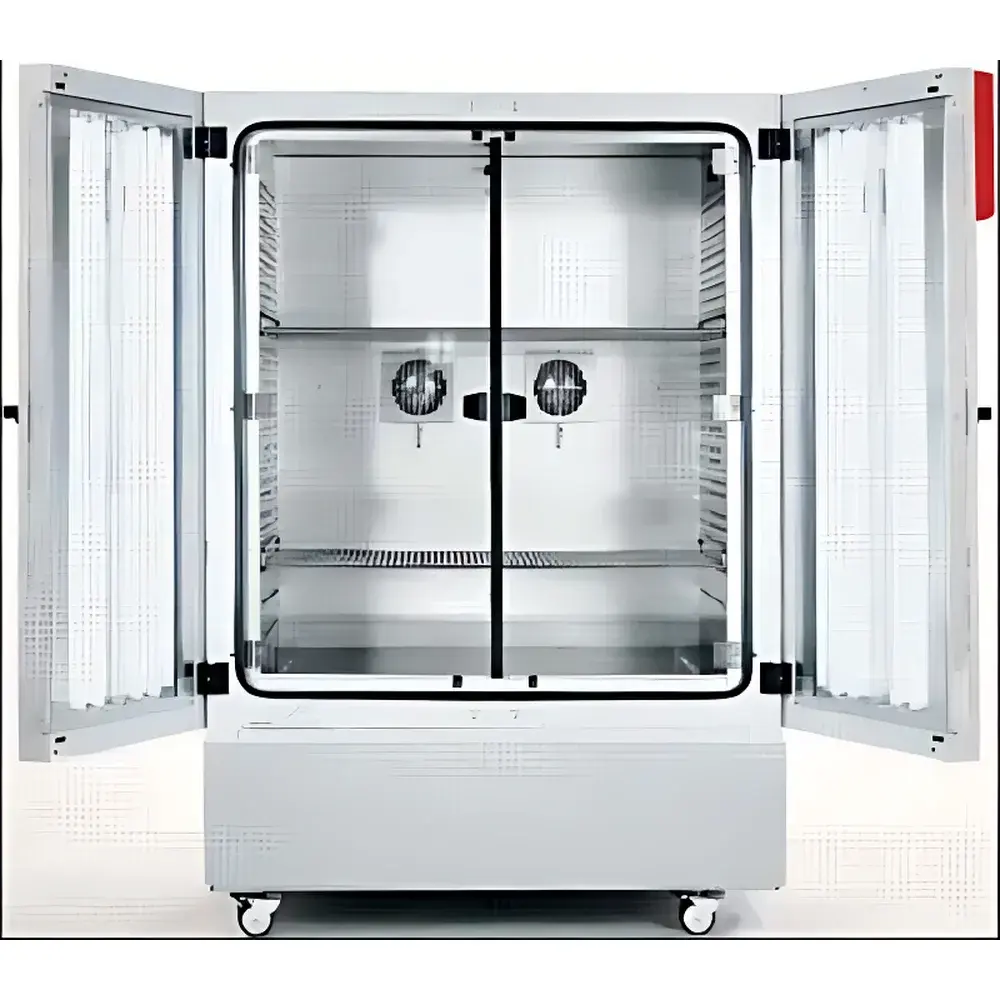
BINDER KB115 Biochemical Incubator with Low-Temperature Capability
| Brand | BINDER |
|---|---|
| Origin | Germany |
| Model | KB 115 |
| Temperature Range | –10 °C to 100 °C |
| Internal Volume | 115 L |
| External Dimensions (W×H×D) | 834×1022×646 mm |
| Interior Dimensions (W×H×D) | 600×480×400 mm |
| Temperature Uniformity @ 5 °C | ±0.4 °C |
| @ 25 °C | ±0.1 °C |
| @ 40 °C | ±0.2 °C |
| Temperature Fluctuation @ 5 °C | ±0.1 °C |
| @ 40 °C | ±0.1 °C |
| Heating Time to 40 °C | 9 min |
| Cooling Time from 40 °C to 5 °C | 83 min |
| Recovery Time (30-s door opening) to 5 °C | 5 min |
| to 40 °C | 1 min |
| Power Supply | 230 V, 0.46 kW |
| Net Weight | 105 kg |
| Refrigerant | R134a |
| Shelf Load Capacity | 20 kg per shelf / 50 kg total |
| Shelves | 2 stainless steel standard shelves (up to 5 optional) |
| Door | 1 external door + 1 internal tempered glass door |
| Controller | MP programmable controller (2×10 or 1×20 segments), ramp function, timer functions (delay start/stop, temperature-dependent stop) |
| Fan Speed | 0–100% adjustable |
| Safety Device | Independent Class 3.1 overtemperature protection (DIN 12880) with visual and audible alarm |
| Interface | RS422 for APT-COM® software integration |
Overview
The BINDER KB115 Biochemical Incubator is a precision-engineered, low-temperature-capable environmental chamber designed for demanding life science applications requiring stable thermal control across an extended range of –10 °C to 100 °C. Unlike standard incubators limited to ambient or mild refrigeration, the KB115 integrates a high-efficiency direct-cooling technology (DCT®) with BINDER’s proprietary APT.line® preheating chamber system—ensuring rapid, uniform temperature distribution and exceptional recovery performance after door openings. Its construction adheres to DIN 12880 Class 3.1 safety standards, incorporating redundant thermal monitoring and independent overtemperature protection. The unit is certified for laboratory use in accordance with IEC 61010-1 and complies with EU Directive 2014/30/EU (EMC) and 2014/35/EU (LVD). Designed for reproducible microbiological growth, enzyme kinetics, cold-adapted cell culture, and long-term stability testing, the KB115 delivers metrological reliability essential for GLP-compliant workflows and regulated environments.
Key Features
- APT.line® preheating chamber technology ensures homogeneous temperature distribution and minimizes thermal gradients across the 115 L interior
- DCT® (Direct Cooling Technology) enables precise sub-ambient operation down to –10 °C with reduced condensation risk and improved energy efficiency
- MP programmable controller supporting up to two independent 10-segment programs—or one consolidated 20-segment program—with fully configurable ramp rates, dwell times (up to 999:59 h per segment), and conditional logic (e.g., temperature-dependent termination)
- Adjustable fan speed (0–100%) allows optimization of air circulation for sensitive samples or low-evaporation protocols
- Class 3.1 independent safety thermostat (DIN 12880) with dual-stage visual and audible alarm provides fail-safe thermal oversight
- Tempered internal glass door reduces external heat exchange and enables non-intrusive sample observation without compromising chamber stability
- RS422 interface compatible with BINDER’s APT-COM® software for remote monitoring, data logging, audit trail generation, and 21 CFR Part 11–compliant electronic records
- Environmentally optimized refrigerant R134a (GWP = 1430) aligned with F-Gas Regulation (EU) No 517/2014 phase-down requirements
Sample Compatibility & Compliance
The KB115 accommodates standard ISO/IEC 80000-compliant labware—including Petri dishes, multiwell plates, flasks, and test tubes—on two included stainless-steel shelves (load capacity: 20 kg each; max 5 shelves optional). Its interior chamber is electropolished stainless steel (AISI 304), resistant to corrosion from common biological reagents and decontamination agents (e.g., 70% ethanol, hydrogen peroxide vapor). The unit meets ISO 14644-1 Class 5 cleanroom compatibility when operated under controlled ambient conditions and supports validation per IQ/OQ/PQ protocols. It is routinely deployed in applications governed by USP , ISO 20387 (biobanking), and CLSI M22-A3 (microbial growth requirements), and its temperature stability profile satisfies ASTM E145-22 Annex A3 for forced-air incubators.
Software & Data Management
APT-COM® software provides full bidirectional communication via RS422, enabling real-time parameter adjustment, continuous temperature logging at user-defined intervals (1 s to 24 h), and export of timestamped CSV or PDF reports. Audit trails record all operator actions—including setpoint changes, program starts/stops, alarm events, and calibration interventions—with user authentication and electronic signature support. Data integrity conforms to FDA 21 CFR Part 11 requirements when used with validated system configurations and appropriate access controls. Optional printer integration (via RS232/RS422 converter) supports on-demand hardcopy output with configurable print intervals and event-triggered printing.
Applications
- Cold-adapted bacterial and fungal cultivation (e.g., Pseudomonas fluorescens, Yarrowia lipolytica)
- Enzyme activity assays requiring sub-zero stabilization or cryoenzymology
- Long-term stability studies of biologics, vaccines, and nucleic acid preparations per ICH Q5C
- Controlled-temperature storage of primary cells, stem cell derivatives, and tissue explants prior to processing
- Environmental simulation for ecological microbiology and soil respiration studies
- Quality control of diagnostic reagents and ELISA kits under defined thermal stress profiles
FAQ
What is the minimum operating temperature of the KB115, and how is sub-ambient stability achieved?
The KB115 achieves –10 °C using DCT® direct cooling architecture with optimized evaporator placement and APT.line® thermal buffering—eliminating cold spots and ensuring ±0.4 °C uniformity even at low setpoints.
Does the KB115 support regulatory compliance for pharmaceutical QC labs?
Yes: its programmable controller, independent safety circuit, RS422 data interface, and APT-COM® audit trail functionality are designed to support 21 CFR Part 11, EU Annex 11, and GMP-aligned validation processes.
Can the internal glass door be removed for cleaning or sterilization?
The tempered glass door is fixed and not removable; however, it is chemically resistant and compatible with standard laboratory disinfectants and validated VHP decontamination cycles.
Is the KB115 suitable for CO₂-sensitive applications?
No—the KB115 is a temperature-controlled incubator only; for CO₂-regulated environments, BINDER’s CB series is recommended.
What maintenance intervals are recommended for optimal performance?
BINDER recommends annual preventive maintenance including refrigerant pressure verification, fan calibration, sensor validation, and safety thermostat functional testing—documentation templates are provided in the service manual.




