
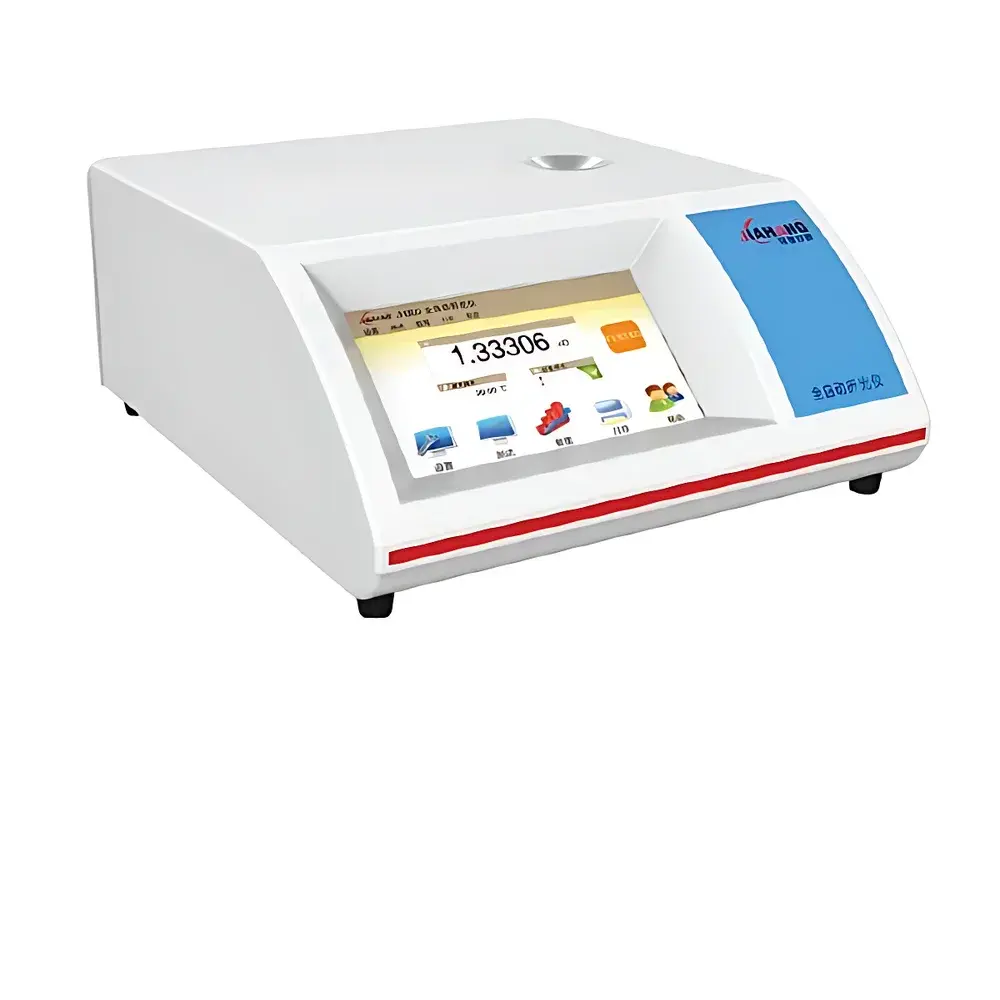
J200 Automatic Digital Refractometer
| Origin | Shanghai, China |
|---|---|
| Manufacturer Type | Authorized Distributor |
| Origin Category | Domestic (PRC) |
| Model | J200 |
| Price Range | USD 2,100–7,000 |
| Instrument Type | Benchtop Refractometer |
| Temperature Control | Peltier-based |
| Digital Display | Yes |
| Refractive Index Range | 1.3000–1.7000 (nD) |
| Accuracy | ±0.0002 (nD) |
| Brix Range | 0–100% |
| Brix Accuracy | ±0.1% |
| Light Source | LED @ 589 nm |
| Prism Material | Sapphire-grade |
| Sample Cell | Stainless Steel |
| Detection Method | Linear CCD Array |
| Display | 7-inch TFT Color Touchscreen |
| Interface | USB & RS-232 |
| Power Supply | 220 VAC / 50 Hz |
Overview
The J200 Automatic Digital Refractometer is a precision benchtop optical instrument engineered for high-reproducibility measurement of refractive index (nD) and mass fraction of aqueous sugar solutions (Brix %) in liquid and semi-liquid samples. It operates on the principle of total internal reflection at the prism-sample interface, with angular detection of the critical angle via a high-resolution linear CCD array. Calibrated to the sodium D-line (589 nm), the system delivers traceable nD values compliant with ISO 21640:2022 and ASTM D1218–20 standards for refractometric analysis. Its integrated Peltier temperature control ensures thermal stabilization within ±0.1 °C across ambient conditions, eliminating manual water-bath dependency and enabling ISO/IEC 17025-compliant calibration workflows. Designed for routine QC laboratories and R&D environments, the J200 meets functional requirements for GLP documentation integrity and supports audit-ready data capture.
Key Features
- 7-inch full-color capacitive touchscreen interface with intuitive icon-driven navigation and multilingual UI support (English, German, French, Spanish, Chinese)
- Sapphire-grade prism surface offering exceptional scratch resistance, chemical inertness, and long-term optical stability—critical for aggressive solvents and viscous samples
- High-sensitivity linear CCD sensor (2048-pixel resolution) enabling sub-millidegree angular resolution and real-time critical angle fitting with least-squares algorithm
- Peltier-based thermoregulation system with active cooling/heating capability, maintaining sample temperature at user-set points from 10 °C to 40 °C (±0.1 °C stability)
- Stainless-steel sample well with optimized geometry for minimal volume (0.5 mL typical), rapid cleaning, and bubble-free loading—even for dark, turbid, or high-viscosity fluids
- Built-in validation routines including factory-calibrated sucrose standard verification and prism surface contamination diagnostics
Sample Compatibility & Compliance
The J200 accommodates transparent, translucent, deeply colored, and moderately viscous liquids without dilution or filtration—including crude oils, polymer solutions, pharmaceutical syrups, fruit concentrates, essential oils, and glycerol-water mixtures. Its optical design mitigates scattering artifacts common in particulate-laden or emulsified systems. The instrument conforms to key regulatory frameworks: it supports 21 CFR Part 11-compliant electronic records when paired with validated LIMS integration; meets ISO 17025 method validation prerequisites for refractometry; and satisfies USP and Ph. Eur. 2.2.21 requirements for Brix and nD determination in excipient and dosage form testing. CE marking confirms compliance with EU Directive 2014/30/EU (EMC) and 2014/35/EU (LVD).
Software & Data Management
Embedded firmware enables direct data logging to internal memory (≥10,000 results) with timestamp, operator ID, temperature, and measurement mode metadata. USB and RS-232 interfaces support bidirectional communication with third-party laboratory software (e.g., LabWare LIMS, Thermo Fisher SampleManager). Optional PC software provides advanced features: customizable report templates (PDF/CSV), statistical process control (SPC) charting, multi-instrument fleet monitoring, and automated calibration certificate generation aligned with ISO/IEC 17025 Annex A.3. All data modifications are logged with immutable audit trails—including user, action, timestamp, and pre-/post-values—ensuring full ALCOA+ (Attributable, Legible, Contemporaneous, Original, Accurate, Complete, Consistent, Enduring, Available) compliance.
Applications
- Petroleum & Lubricants: nD-based hydrocarbon classification, additive concentration verification, and base oil purity screening
- Pharmaceuticals: Excipient identity confirmation (e.g., propylene glycol, glycerin), syrup concentration control, and stability-indicating assay support
- Food & Beverage: Real-time Brix monitoring in juice processing, honey adulteration screening, jam/sauce solids content, and dairy product consistency grading
- Chemicals & Cosmetics: Surfactant solution strength, fragrance oil dilution verification, and polymer solution concentration tracking
- Academic Research: Teaching optics principles (Snell’s law, dispersion), material characterization of biofluids, and method development for novel refractive media
FAQ
What is the minimum sample volume required for accurate measurement?
Typical volume is 0.5 mL; however, reliable results can be obtained with as little as 0.3 mL when using the optional micro-volume capillary adapter.
Does the J200 support automatic temperature compensation (ATC) for non-standard measurement temperatures?
Yes—the instrument applies built-in nD correction algorithms per ISO 17025 Annex C, referencing published temperature dispersion coefficients for water, sucrose, ethanol, and common solvents.
Can the J200 be validated for GMP-regulated environments?
Yes—full IQ/OQ/PQ protocols are available, including traceable NIST-traceable reference standards (certified sucrose solutions), performance verification checklists, and electronic signature-enabled calibration logs.
Is the sapphire prism replaceable by the end user?
No—prism replacement requires factory recalibration and optical alignment; however, routine cleaning with lint-free wipes and isopropanol is sufficient for >5 years of continuous operation.
How frequently must the instrument be recalibrated?
Daily verification with certified sucrose standards is recommended; full recalibration is required every 6 months or after 1,000 measurements—whichever occurs first—as defined in the instrument’s SOP template.




