
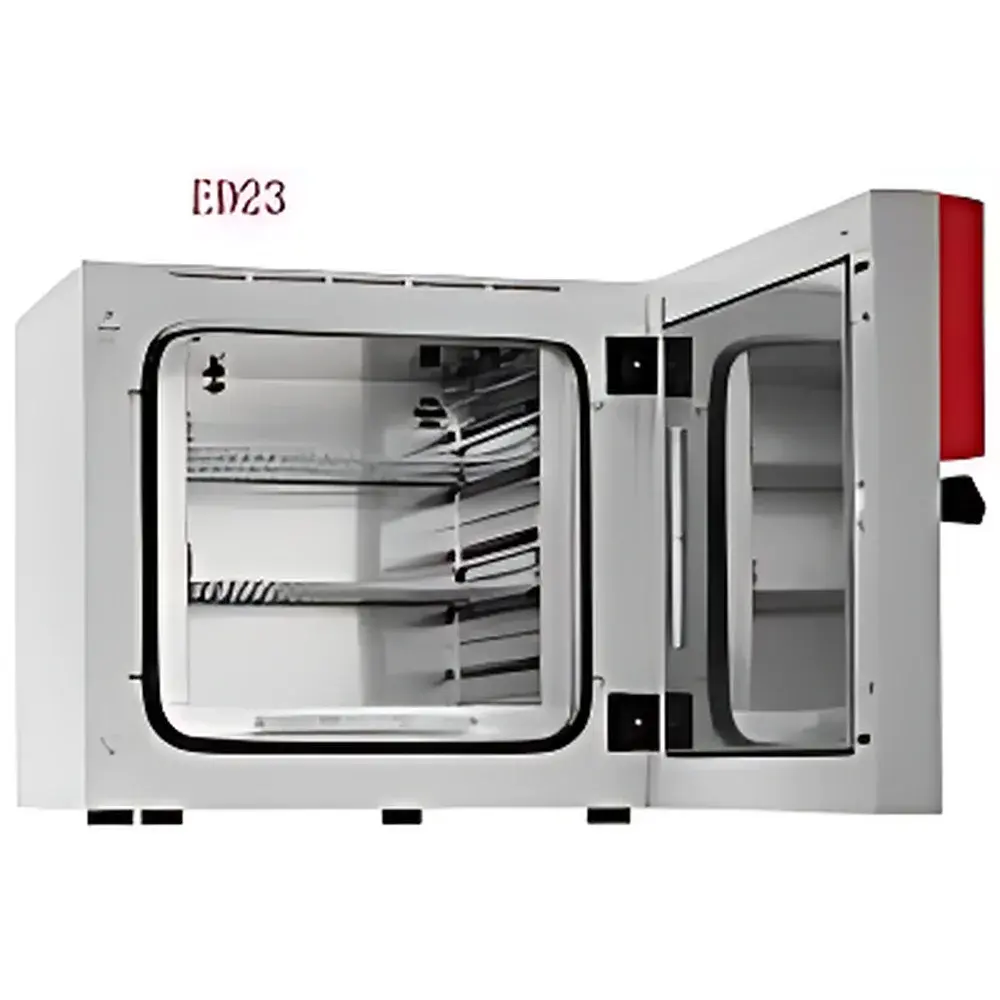
BINDER ED115 Natural Convection Drying Oven
| Brand | BINDER |
|---|---|
| Origin | Germany |
| Model | ED115 |
| Temperature Range | Ambient +5 °C to 300 °C |
| Temperature Uniformity | ±1.5 °C at 70 °C, ±2.5 °C at 150 °C, ±4.5 °C at 300 °C |
| Temperature Fluctuation | ±0.3 °C |
| Chamber Volume | 115 L |
| Internal Dimensions (W×H×D) | 600 × 480 × 400 mm |
| External Dimensions (W×H×D) | 834 × 702 × 645 mm |
| Interior Material | Stainless Steel (AISI 304) |
| Heating Method | Electric Resistive Heating |
| Air Exchange Rate | 12 h⁻¹ at 70 °C, 10 h⁻¹ at 150 °C and 300 °C |
| Recovery Time (after 30-sec door opening) | 2 min to 70 °C, 9 min to 150 °C, 14 min to 300 °C |
| Power Supply | 230 V, 50/60 Hz, 1.6 kW |
| Net Weight | 57 kg |
| Standard Shelving | 2 stainless steel shelves (load capacity: 20 kg per shelf, total 50 kg) |
| Controller | Microprocessor-based with LED display, programmable timer (0–99 h 59 min or continuous), APT.Line™ preheating chamber technology |
| Safety | Dual independent temperature safety devices (TWB), overtemperature protection |
| Interface | RS422 for optional APT-COM software integration |
Overview
The BINDER ED115 Natural Convection Drying Oven is a precision-engineered laboratory oven designed for applications requiring stable, repeatable thermal environments without forced air circulation. Unlike fan-assisted (forced convection) ovens, the ED115 relies on natural convection—heat-driven buoyancy-driven airflow—to maintain uniform temperature distribution across its 115-liter stainless steel chamber. This design eliminates turbulence-induced sample disturbance, making it particularly suitable for drying heat-sensitive powders, curing coatings, aging polymer specimens, and conditioning reference materials where mechanical airflow could compromise integrity or homogeneity. The oven incorporates BINDER’s proprietary APT.Line™ preheating chamber technology, which thermally isolates the main chamber from external ambient fluctuations and significantly improves thermal stability—especially under full-load conditions. Its microprocessor-based controller ensures precise setpoint execution, digital LED readout, and programmable timing (0–99 h 59 min or continuous operation), meeting routine operational demands in QC labs, R&D facilities, and GLP-compliant environments.
Key Features
- APT.Line™ preheating chamber architecture for enhanced thermal stability and minimized temperature overshoot during ramp-up
- Natural convection design eliminates fan-induced vibration and airflow interference—ideal for delicate samples and gravimetric drying procedures
- Stainless steel interior (AISI 304) with seamless welded corners for corrosion resistance, easy cleaning, and long-term hygiene compliance
- Dual independent temperature safety devices (TWB) compliant with EN 61010-1, providing redundant overtemperature protection
- Adjustable heating power and optional variable air exchange control via integrated damper settings (factory-configurable)
- RS422 serial interface supporting integration with BINDER’s APT-COM software suite for remote monitoring, data logging, and audit-trail generation
- Calibration-ready design: factory-calibrated with documented traceability to national standards; supports user-performed verification per ISO/IEC 17025 requirements
Sample Compatibility & Compliance
The ED115 accommodates standard laboratory glassware, ceramic crucibles, metal trays, and polymer molds within its 600 × 480 × 400 mm chamber. Its natural convection profile ensures minimal convective shear stress—critical for ASTM D2244 (color difference), ISO 5630-3 (paper aging), and USP (plastic container testing). The oven meets IEC 61010-1 for electrical safety and conforms to CE marking requirements. When operated with APT-COM software and enabled audit trail functionality, it supports FDA 21 CFR Part 11 compliance for electronic records and signatures—enabling use in regulated pharmaceutical and medical device manufacturing environments. Temperature uniformity and recovery performance are validated per VDI/VDE 2655 Sheet 1 (German guideline for drying and heating equipment) and align with ISO 17025 clause 6.4.10 for equipment suitability assessment.
Software & Data Management
The optional APT-COM software provides comprehensive control and documentation capabilities via RS422 connection. Users can define multi-step temperature profiles, monitor real-time chamber conditions (including internal sensor readings and safety status), and export timestamped CSV logs with metadata (operator ID, method name, calibration status). Audit trails record all parameter changes, start/stop events, and alarm activations—including timestamps with millisecond resolution and user authentication. Data files are digitally signed and tamper-evident, satisfying ALCOA+ principles (Attributable, Legible, Contemporaneous, Original, Accurate, Complete, Consistent, Enduring, Available) for regulatory submissions. Integration with LIMS systems is supported through OPC UA or custom API extensions.
Applications
- Gravimetric moisture content determination per ISO 540, ASTM D2231, and AOAC 950.46
- Thermal aging of elastomers and plastics per ISO 188 and ASTM D573
- Curing of adhesives, coatings, and composite pre-pregs under controlled low-airflow conditions
- Conditioning of reference standards and hygroscopic materials prior to analytical weighing
- Residue drying in environmental testing (e.g., TSS, TDS, suspended solids per EPA 160.2)
- Pre-heating of substrates in surface science and thin-film deposition workflows
FAQ
What distinguishes natural convection from forced convection in drying ovens?
Natural convection relies solely on thermal buoyancy for air movement, eliminating fan noise, vibration, and non-uniform airflow—making it preferable for sensitive materials and standardized drying protocols.
Is the ED115 suitable for GLP or GMP environments?
Yes—when equipped with APT-COM software and configured with audit trail, electronic signature, and calibration management modules, it fulfills core requirements of GLP (OECD 1998) and GMP (EU Annex 11, FDA Part 11).
Can temperature uniformity be verified independently?
Yes—the chamber includes two calibrated PT100 sensors (working and reference), and the unit ships with a validation certificate referencing DIN EN ISO/IEC 17025-accredited calibration.
Does the oven support multi-point temperature mapping?
While not built-in, the RS422 interface enables third-party validation systems (e.g., Ellab, QualiTrak) to acquire real-time sensor data for IQ/OQ/PQ studies.
What maintenance is required for long-term accuracy?
Annual verification of temperature sensors and safety cutouts is recommended; stainless steel chamber surfaces require only periodic wiping with ethanol or mild detergent—no lubrication or fan servicing needed.
Related Products



