
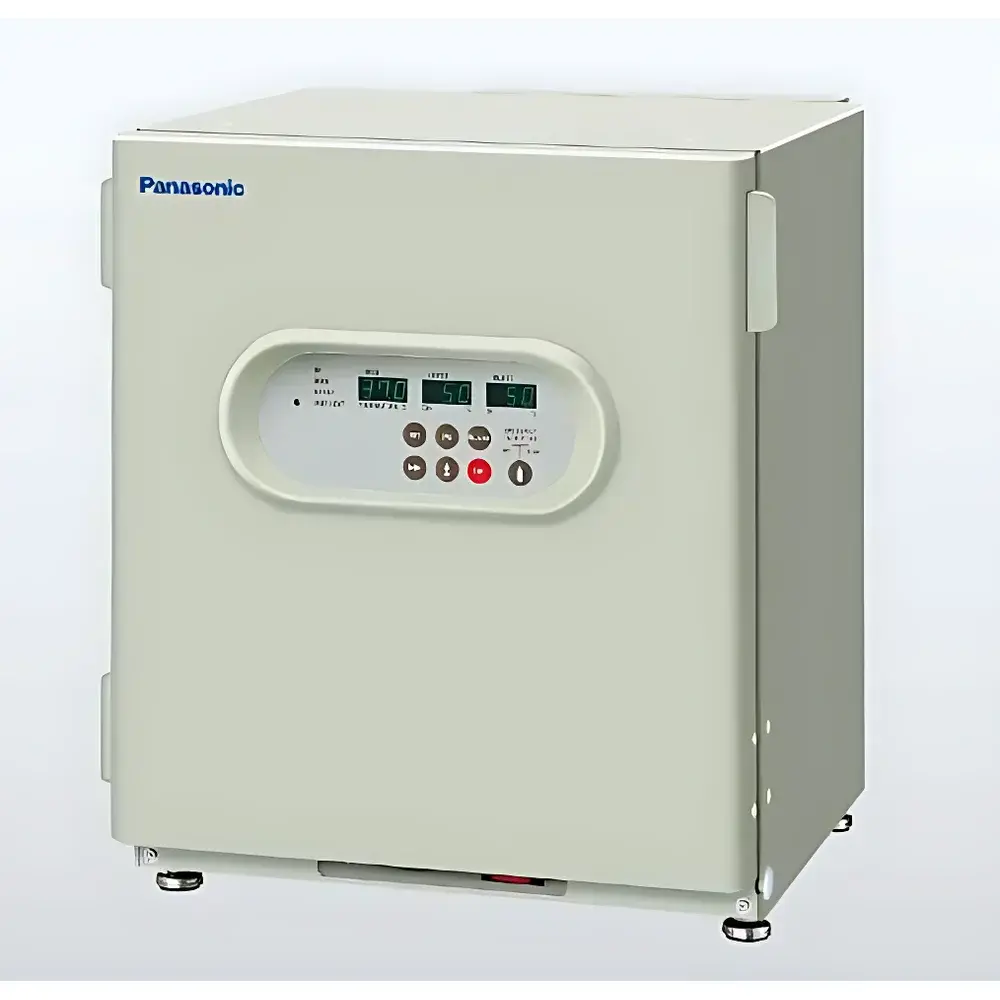
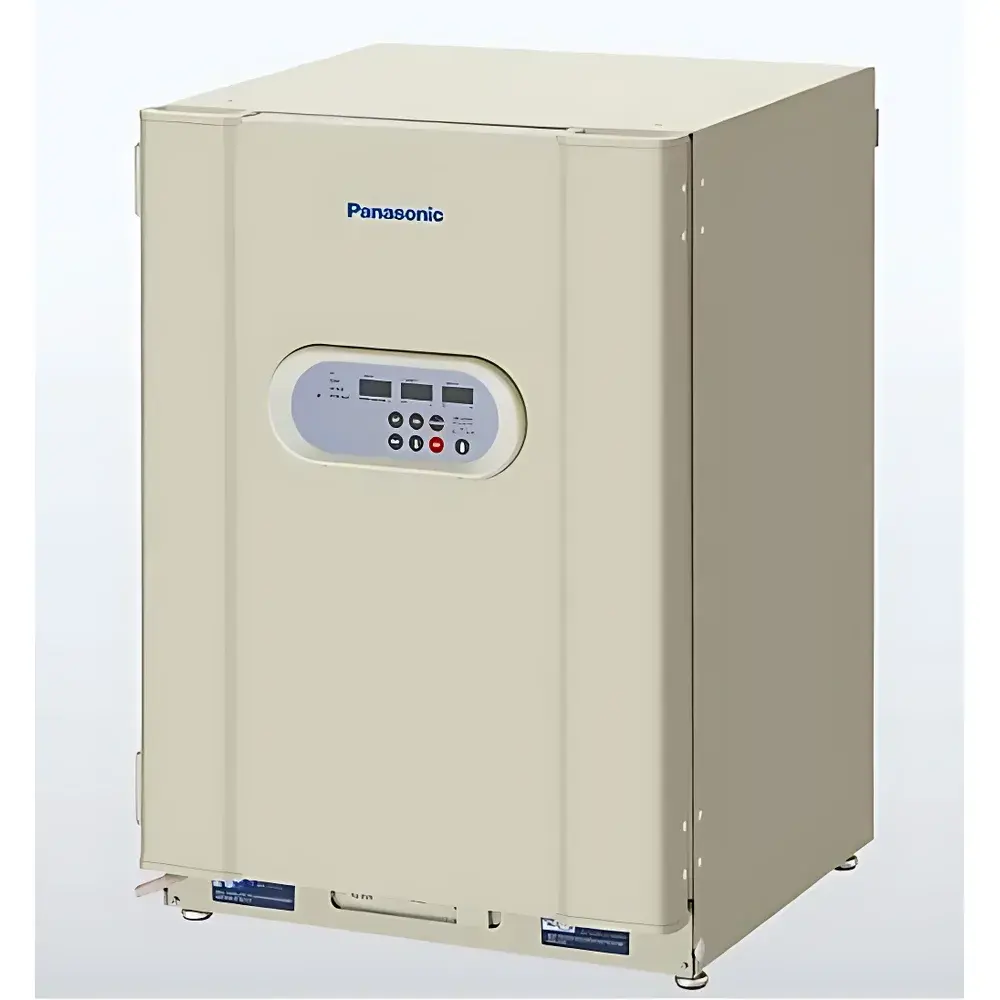
Panasonic MCO-5M and MCO-18M Multi-Gas Incubators
| Brand | Panasonic (Sanyo) |
|---|---|
| Origin | Japan |
| Model | MCO-5M, MCO-18M |
| Temperature Range & Accuracy | +5°C to 50°C (ambient: 5–35°C) |
| Temperature Uniformity | ±0.25°C (at 25°C ambient, 37°C setpoint, 5% CO₂, 5% O₂, no load) |
| Temperature Stability | ±0.1°C |
| CO₂ Control Range | 0–20% |
| CO₂ Control Accuracy | ±0.15% |
| O₂ Control Range | 1–18%, 22–80% |
| O₂ Control Accuracy | ±0.2% |
| Humidity Method | Natural evaporation via stainless steel humidification pan |
| Relative Humidity | 95 ± 5% RH |
| Internal Volume | 49 L (MCO-5M), 170 L (MCO-18M) |
| External Dimensions (W×D×H) | 480 × 548 × 575 mm (MCO-5M), 620 × 710 × 900 mm (MCO-18M) |
| Net Weight | 50 kg (MCO-5M), 97 kg (MCO-18M) |
| Power Consumption | 205 W (MCO-5M), 330 W (MCO-18M) |
| Heating System | DHA (Direct Heating Air-jacket) with triple independent heating units (MCO-18M only) |
| Sensor Types | Thermal Conductivity (CO₂, MCO-5M), IR (CO₂, MCO-18M), Long-life electrochemical (O₂) |
| Interior Material | Antimicrobial copper-alloy stainless steel |
| UV Lamp | 4 W ozone-free (optional) |
| Filtration | 0.3 µm HEPA-grade gas filter (99.97% efficiency for CO₂/O₂ or CO₂/N₂ lines) |
| Alarm Functions | High/low temperature, CO₂/O₂ deviation, door open, UV lamp fault, independent overheat protection |
Overview
The Panasonic MCO-5M and MCO-18M Multi-Gas Incubators are precision-engineered environmental control systems designed for advanced cell culture applications requiring strict regulation of CO₂, O₂, and temperature—particularly in assisted reproductive technology (ART), induced pluripotent stem cell (iPSC) maintenance, hypoxia research, and donor-specific sample isolation. Both models employ a Direct Heating Air-jacket (DHA) system to minimize thermal gradients and eliminate condensation-prone water jackets. The MCO-5M serves as a compact, single-donor incubator ideal for IVF laboratories implementing patient-dedicated workflows, while the MCO-18M delivers enhanced stability through three independently controlled heating zones and high-fidelity IR-based CO₂ sensing—critical for long-term, low-passage primary culture and GMP-aligned bioprocessing environments.
Key Features
- DHA architecture ensures rapid temperature recovery (<6 min from 25°C to 37°C after door opening) and eliminates cold spots via uniform air-jacket heating—no water bath maintenance or microbial risk from standing water.
- Antimicrobial copper-alloy stainless steel interior (inCu saFe™) provides continuous, non-leaching surface disinfection validated per ISO 22196; seamless, fully rounded corners prevent biofilm accumulation and simplify cleaning validation.
- Optimized gas control: MCO-5M utilizes long-life thermal conductivity (TC) CO₂ sensors and electrochemical O₂ sensors; MCO-18M upgrades to non-dispersive infrared (NDIR) CO₂ detection and dual-range O₂ sensing (1–18% and 22–80%), enabling precise normoxic, physioxic, and hyperoxic studies.
- Integrated ozone-free 4 W UV-C lamp (optional) irradiates recirculated air and humidification pan vapor path, reducing airborne and aerosolized microbial load—validated for ≥3-log reduction of E. coli, S. aureus, and C. albicans per IEC 62471.
- Three-point independent temperature monitoring (top/mid/base) with PID feedback enables real-time spatial compensation; humidity maintained at 95 ± 5% RH via passive stainless steel pan evaporation—no ultrasonic misting to avoid mineral deposition or cross-contamination.
- Stackable configuration (up to three units vertically) with reinforced slide-out casters (MCO-18RB option) optimizes footprint in space-constrained cleanrooms without compromising airflow integrity or service access.
Sample Compatibility & Compliance
These incubators support adherence to ISO 13485, ISO 5 cleanroom classifications (when installed with appropriate HVAC), and FDA 21 CFR Part 11 requirements when paired with compliant data logging software (e.g., Panasonic’s optional MCO Data Logger). The copper-alloy chamber meets ASTM E2149-20 for antimicrobial surface efficacy. Gas filtration (0.3 µm, 99.97% efficient) complies with USP and standards for sterile compounding and hazardous drug handling. All alarm events—including temperature excursion, gas deviation (>±0.3% CO₂ or >±0.5% O₂), door-open duration (>30 s), and UV lamp failure—are timestamped and stored locally with configurable relay outputs for integration into facility-wide BMS systems.
Software & Data Management
While standalone operation requires no PC, optional Ethernet-enabled data loggers provide GLP-compliant audit trails: 16,000-point internal memory (expandable via SD card), CSV export, and password-protected user roles (operator, supervisor, administrator). Calibration logs, sensor drift history, and alarm summaries are exportable for regulatory submissions. Firmware supports traceable calibration certificate import (NIST-traceable reference gases required), and all parameter changes generate immutable entries including operator ID, timestamp, and pre/post values—fully satisfying ALCOA+ principles (Attributable, Legible, Contemporaneous, Original, Accurate, Complete, Consistent, Enduring, Available).
Applications
- Assisted Reproductive Technology (ART): Patient-dedicated culture in MCO-5M prevents cross-donor contamination during oocyte maturation, fertilization, and blastocyst development under 5% O₂/5% CO₂—aligned with ESHRE guidelines on physioxic embryo culture.
- Hypoxia & Normoxia Modeling: MCO-18M’s dual O₂ range enables stable 1% O₂ for cancer stem cell expansion or 80% O₂ for oxidative stress assays, with <±0.2% stability critical for HIF-1α pathway fidelity.
- Stem Cell Biomanufacturing: DHA-driven thermal uniformity (±0.25°C) and CO₂ stability (±0.15%) reduce spontaneous differentiation in hESC and iPSC cultures across 170 L working volume.
- GMP-Compliant QC Testing: Validated performance supports USP ancillary materials testing and EP 2.6.27 cell-based assay environments where environmental consistency directly impacts potency assay reproducibility.
FAQ
What gas supply configurations are supported?
Both models accept CO₂/N₂ or CO₂/O₂ mixed gas inputs via 4–6 mm ID tubing; optional MCO-21GC auto-switching manifold enables uninterrupted operation during cylinder changeover.
Is humidity actively controlled or passively maintained?
Humidity is maintained passively via stainless steel humidification pans using natural evaporation—eliminating ultrasonic components that introduce particulates or require demineralized water.
Can the incubators be integrated into a centralized laboratory monitoring system?
Yes—RS-485 Modbus RTU and optional Ethernet interfaces allow real-time parameter streaming and alarm forwarding to LabVantage, Thermo Fisher SampleManager, or custom SCADA platforms.
What validation documentation is provided?
Each unit ships with Factory Acceptance Test (FAT) report, IQ/OQ templates aligned with ISO 14644-3, and sensor calibration certificates traceable to NIST standards.
Are replacement parts and service support available globally?
Panasonic Life Sciences maintains certified service centers in North America, EMEA, and APAC; copper-alloy chamber panels, IR sensors, and DHA heating elements are stocked with ≤5-business-day lead time.
Related Products



