
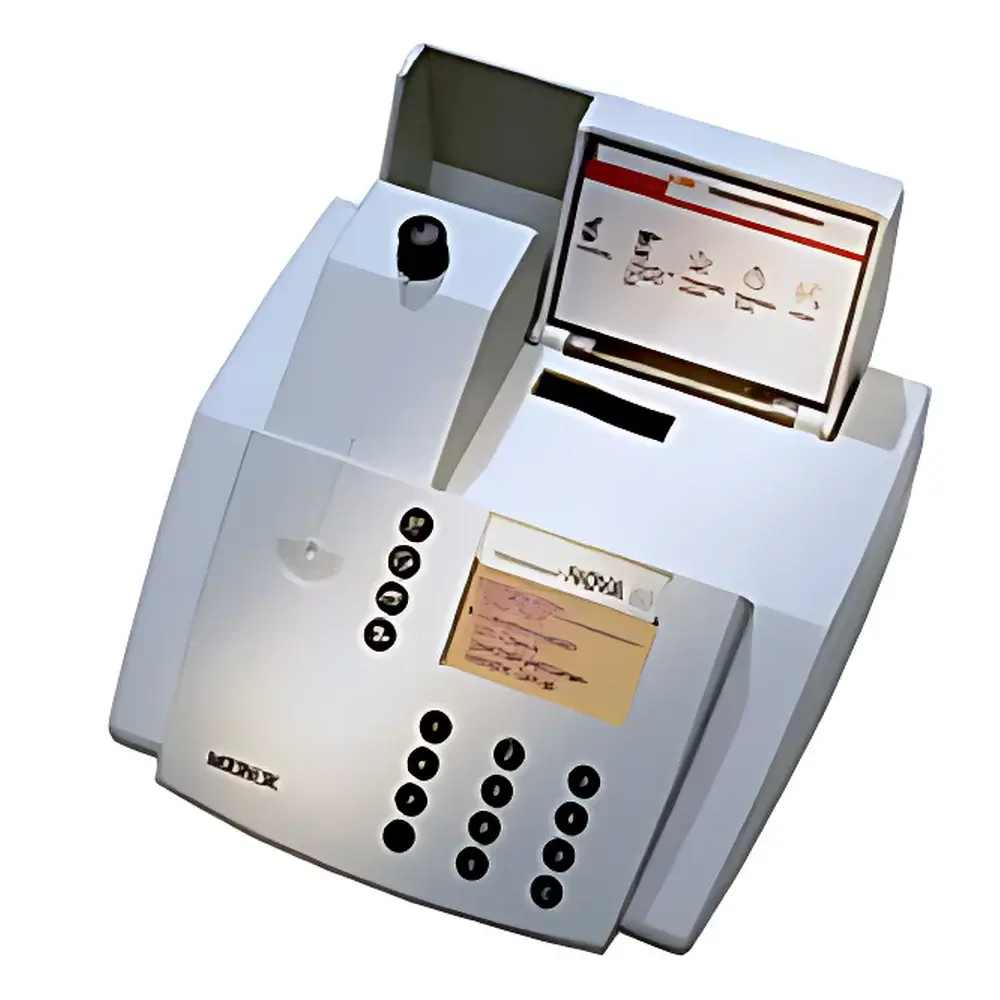
Merck Spectroquant® Pharo 100 Visible-Spectrum Multi-Parameter Water Quality Analyzer
| Brand | Merck |
|---|---|
| Origin | Germany |
| Model | Pharo 100 |
| Instrument Type | Laboratory Water Quality Analyzer |
| Detection Capability | Multi-Parameter (≥50 parameters) |
| Wavelength Range | 320–1100 nm |
| Light Source | Tungsten Halogen Lamp |
| Optical System | Stabilized Single-Beam |
| Spectral Bandwidth | 4 nm |
| Wavelength Accuracy | ±1 nm |
| Absorbance Range | ±3.3 A |
| Absorbance Resolution | 0.001 A |
| Absorbance Accuracy | ±0.003 A (A < 0.600) |
| Cuvette Compatibility | 16 mm round, 10/20/50 mm square (auto-recognized) |
| Data Storage | 1000 test results + 4 MB for spectral/dynamic data (e.g., 100 scans, 400 kinetics curves) |
| Interfaces | 1× USB-A, 1× USB-B, 1× RS232 |
| Compliance | DIN, US EPA certified methods |
| Power | 100–240 V~, 50–60 Hz |
| Operating Temperature | +10 °C to +35 °C |
| Dimensions | 404 × 197 × 314 mm |
| Weight | ~3.7 kg (without battery) |
Overview
The Merck Spectroquant® Pharo 100 is a laboratory-grade visible-spectrum multi-parameter water quality analyzer engineered for precision, traceability, and regulatory compliance in environmental testing laboratories. Based on stabilized single-beam spectrophotometric principles, the Pharo 100 quantifies analyte concentrations in water and wastewater via absorbance measurements across 320–1100 nm—covering standard colorimetric methods for nutrients (e.g., nitrate, phosphate), metals (e.g., iron, copper), oxidants (e.g., chlorine, permanganate), and organic load indicators (e.g., COD, TOC proxies). Its optical architecture integrates a tungsten halogen lamp with 1 nm wavelength resolution and 4 nm spectral bandwidth, ensuring reproducible photometric performance under ISO/IEC 17025-aligned operating conditions. Unlike generic spectrophotometers, the Pharo 100 embeds method-specific calibration logic—including automatic blank subtraction, cuvette geometry recognition, and pre-validated curve interpolation—eliminating manual intervention that introduces variability in routine QC/QA workflows.
Key Features
- Automated barcode recognition for Spectroquant® pre-filled test vials and economical reagent kits—enabling zero-config method selection and eliminating manual parameter entry errors.
- Intelligent cuvette detection system: automatically identifies 16 mm round or 10/20/50 mm square cells and selects optimal pathlength-dependent measurement ranges without user input.
- Integrated Analytical Quality Assurance (AQA) framework with three hierarchical levels: AQA 1 (wavelength verification via PhotoCheck or CertiPUR® standards), AQA 2 (system performance validation using CombiCheck solutions), and AQA 3 (matrix interference screening via MatrixCheck algorithm).
- Built-in library of >170 pre-programmed calibration curves covering >50 water quality parameters, all validated against DIN 38404 and US EPA-approved methodologies.
- GLP-compliant data handling: full electronic audit trail, user access control, timestamped result logs, and immutable storage of raw spectra, kinetic traces, and calibration history.
- Expandable functionality via USB-A/B and RS232 interfaces—supports firmware updates, method downloads, and external peripheral integration (e.g., barcode scanners, thermal printers) without service intervention.
Sample Compatibility & Compliance
The Pharo 100 accepts standard cuvette formats used across accredited environmental labs: disposable 16 mm round vials for rapid field-compatible assays, and reusable quartz/glass 10 mm, 20 mm, and 50 mm square cells for high-precision, low-concentration analysis. All optical components meet IP31 ingress protection requirements, and internal spill containment channels mitigate risks from accidental overflow or cuvette breakage. Method validation aligns with internationally recognized standards—including DIN EN ISO 15586 (phosphate), DIN 38405-27 (ammonium), and US EPA Methods 365.3 (phosphate), 365.4 (nitrate), and 334.0 (chlorine)—ensuring data defensibility during regulatory audits. The instrument’s firmware implements 21 CFR Part 11–compatible electronic signatures and audit logging when operated with Merck-certified software modules.
Software & Data Management
Data integrity is enforced through dual-layer storage architecture: 1,000 test records reside in non-volatile internal memory with full metadata (operator ID, date/time, method version, cuvette ID, raw absorbance values), while 4 MB of dedicated flash memory archives graphical outputs—including up to 100 full-spectrum scans (300–900 nm at 1 nm increments) and 400 kinetic profiles (150 data points each). Export options include CSV, PDF, and XML formats compatible with LIMS platforms. USB mass storage mode allows direct transfer to PCs or network drives; no proprietary drivers are required. User-defined methods (up to 100 custom programs and 20 scan/kinetic protocols) are stored with version control and checksum validation to prevent unauthorized modification.
Applications
- Drinking water compliance monitoring (e.g., residual chlorine, nitrate, fluoride per WHO/EPA MCLs)
- Wastewater treatment plant influent/effluent profiling (COD, BOD surrogates, total phosphorus, ammonia-N)
- Surface and groundwater quality assessment (iron, manganese, sulfate, silica)
- Educational and research laboratories requiring traceable, method-locked photometric analysis
- Third-party environmental testing labs maintaining ISO/IEC 17025 accreditation
- Industrial process water control (cooling tower chemistry, boiler feedwater purity)
FAQ
Does the Pharo 100 support UV-range measurements?
No—the Pharo 100 operates exclusively in the visible spectrum (320–1100 nm). For UV/Vis capability (190–1100 nm), the Spectroquant® Pharo 300 model—equipped with a xenon flash lamp—is required.
Can I import custom calibration curves from external sources?
Yes. Up to 100 user-defined calibration functions (linear, quadratic, polynomial, or point-table) can be loaded via USB, provided they conform to the instrument’s syntax and unit conventions (e.g., mg/L, µmol/L, NTU).
Is GLP compliance hardware-enforced or software-configurable?
GLP features—including electronic signatures, audit trail activation, and result immutability—are firmware-embedded and activated by administrator-level credentials; configuration cannot be disabled without physical service access.
What happens if a barcode on a Spectroquant® vial is unreadable?
The instrument defaults to manual method selection from its internal library, preserving full functionality. Operator-entered method IDs are logged alongside scanned attempts for traceability.
How often must AQA checks be performed?
AQA Level 1 (wavelength verification) is recommended before each analytical session; AQA Level 2 (system verification) prior to batch analysis; AQA Level 3 (matrix check) is applied automatically per sample when enabled in method settings.







