
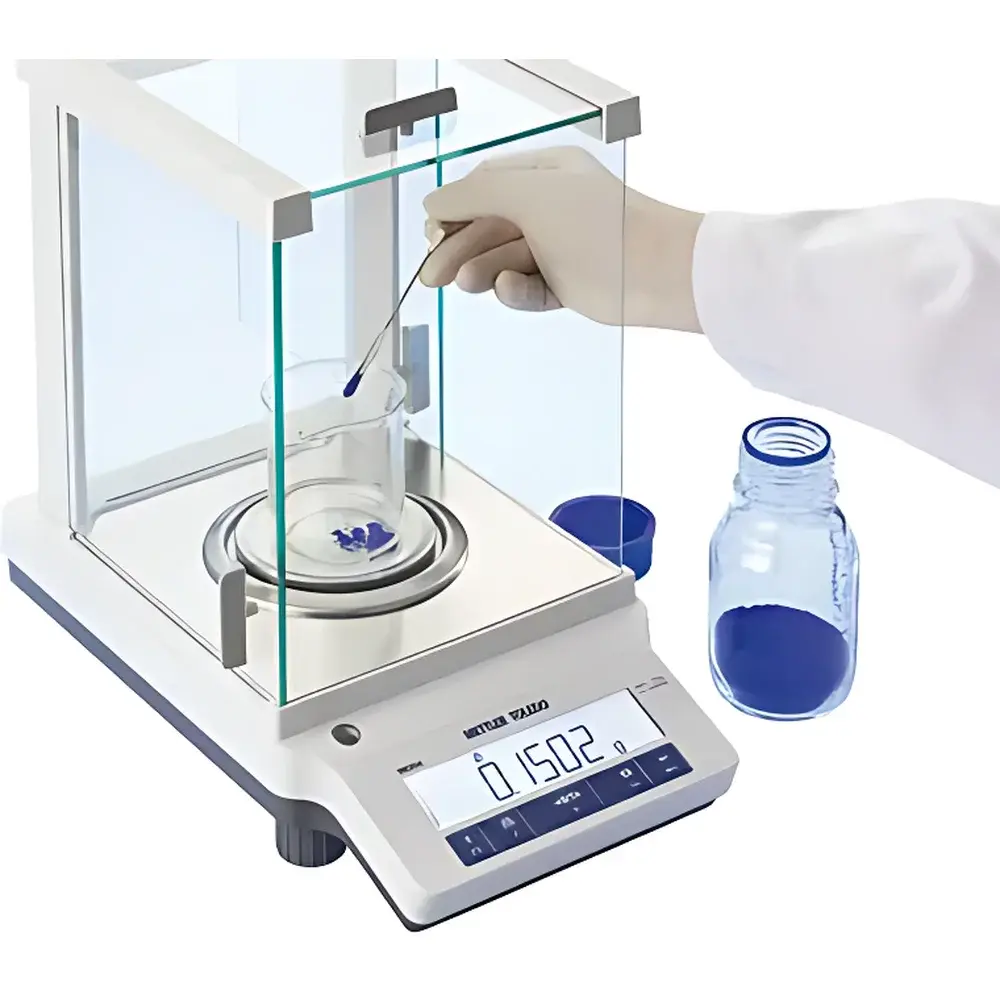
METTLER TOLEDO ME104 Advanced Analytical Balance with Automatic Internal Calibration
| Brand | METTLER TOLEDO |
|---|---|
| Origin | Shanghai, China |
| Model | ME104 |
| Readability | 0.1 mg |
| Max Capacity | 120 g |
| Pan Diameter | Ø90 mm |
| Repeatability | 0.1 mg |
| Linearity | ±0.2 mg |
| Stabilization Time (typical) | 2 s |
| Sensitivity to Temperature Drift | 2.0 ppm/°C |
| Net Weight | 4.5–4.7 kg |
| Calibration | Fully Automatic Internal Calibration |
| Compliance | ISO/GLP-compliant data logging (date/time stamp), supports audit-ready workflows |
Overview
The METTLER TOLEDO ME104 Advanced Analytical Balance is a precision laboratory instrument engineered for routine analytical weighing tasks requiring high reproducibility and long-term stability. Based on electromagnetic force compensation (EMFC) technology, the ME104 delivers consistent 0.1 mg readability across its 120 g maximum capacity, with intrinsic thermal drift compensation (2.0 ppm/°C) and robust mechanical design ensuring metrological integrity under variable ambient conditions. Designed as a direct successor to the AL104-IC series, the ME104 integrates fully automatic internal calibration—activated via single-button operation—eliminating manual weight handling and reducing operator-induced variability. Its compact footprint, reinforced metal chassis, and overload protection rated to 100 kg support reliable deployment in QC labs, university teaching facilities, and regulated production environments where traceable, repeatable mass measurement is foundational.
Key Features
- Automatic internal calibration (IntCal) with real-time verification and user-initiated recalibration at any time
- Electromagnetic force compensation (EMFC) sensor architecture delivering 0.1 mg readability and ≤0.1 mg repeatability
- ISO/GLP-compliant data management: integrated date/time stamping, user ID assignment, and event logging for audit readiness
- Ergonomic front-panel interface with intuitive icon-based navigation and tactile feedback keys
- Seamless cleaning design: rounded edges, smooth surfaces, and removable draft shield components (compatible with ME104 standard shield)
- Front-accessible leveling feet with bubble level indicator for rapid mechanical alignment
- Dual-range stabilization algorithm achieving typical settling time of 2 seconds under standard lab conditions (20–25°C, <60% RH)
- Robust construction: die-cast aluminum base, stainless-steel pan support, and shock-absorbing foot pads
Sample Compatibility & Compliance
The ME104 accommodates samples up to 120 g on its Ø90 mm stainless-steel weighing pan, suitable for powders, granules, liquids in tared vessels, and small solid specimens. It complies with international metrological standards including OIML R 76-1 (Class I), EN 45501, and ASTM E898–22 for analytical balance performance verification. For regulated environments, the balance supports 21 CFR Part 11–compliant workflows when paired with METTLER TOLEDO LabX software (optional), enabling electronic signatures, role-based access control, and full audit trail generation. All internal calibration events are automatically recorded with timestamp, operator ID (if configured), and deviation status—meeting GLP and GMP documentation requirements for method validation and equipment qualification.
Software & Data Management
While the ME104 operates autonomously via its built-in firmware, it natively supports RS232 and optional USB interfaces for seamless integration into laboratory information systems (LIS) or enterprise quality management systems (QMS). Data export includes CSV-formatted weighing records with embedded metadata: net/gross/tare values, units, timestamps, calibration status flags, and environmental condition tags (when connected to optional temperature/humidity sensors). When used with METTLER TOLEDO’s free MT-SICS protocol or LabX Lite software, users gain automated report generation, statistical process control (SPC) charting, and batch-level traceability—critical for pharmaceutical compounding, raw material release testing, and ISO 17025-accredited calibration labs.
Applications
- Formulation and recipe preparation in R&D and pilot-scale manufacturing
- Quantitative gravimetric analysis (e.g., ash content, moisture loss on drying)
- Sample preparation for HPLC, GC, and ICP-MS—where sub-milligram accuracy directly impacts detection limits
- Quality control of active pharmaceutical ingredients (APIs) per USP & Ph. Eur. general chapters <41> and <1251>
- Teaching laboratories: student exercises in stoichiometry, molar mass determination, and error propagation analysis
- Statistical process monitoring using built-in statistics mode (mean, SD, CV%, min/max)
- Density determination via sinker method (with optional density kit)
- Checkweighing and piece counting for component verification in electronics and medical device assembly
FAQ
Does the ME104 require external calibration weights?
No—the ME104 performs fully automatic internal calibration using an integrated motor-driven calibration mass. External weights are only required for periodic verification or regulatory audits.
Is the ME104 compatible with draft shields from older AL-series balances?
Yes, the standard ME104 draft shield (P/N 11121469) is mechanically and dimensionally compatible with AL104-IC mounts. However, optimal airflow dynamics are ensured when using the original ME-series shield assembly.
Can the ME104 be connected to a networked LIMS environment?
Yes—via RS232-to-Ethernet gateways or USB-to-serial adapters, the balance supports ASCII-based data streaming compliant with ASTM E1382 and CLSI GP26-A3 standards for instrument interfacing.
What is the recommended warm-up time before first use?
A minimum 30-minute stabilization period at constant ambient temperature (±2°C variation) is advised to achieve thermal equilibrium of the EMFC sensor and minimize drift-related uncertainty.
How frequently should internal calibration be performed?
METTLER TOLEDO recommends initiating IntCal at power-on, after significant ambient temperature shifts (>2°C), following mechanical disturbance, and prior to critical measurements—though the balance continuously monitors sensor stability and may prompt recalibration automatically.
Related Products



