
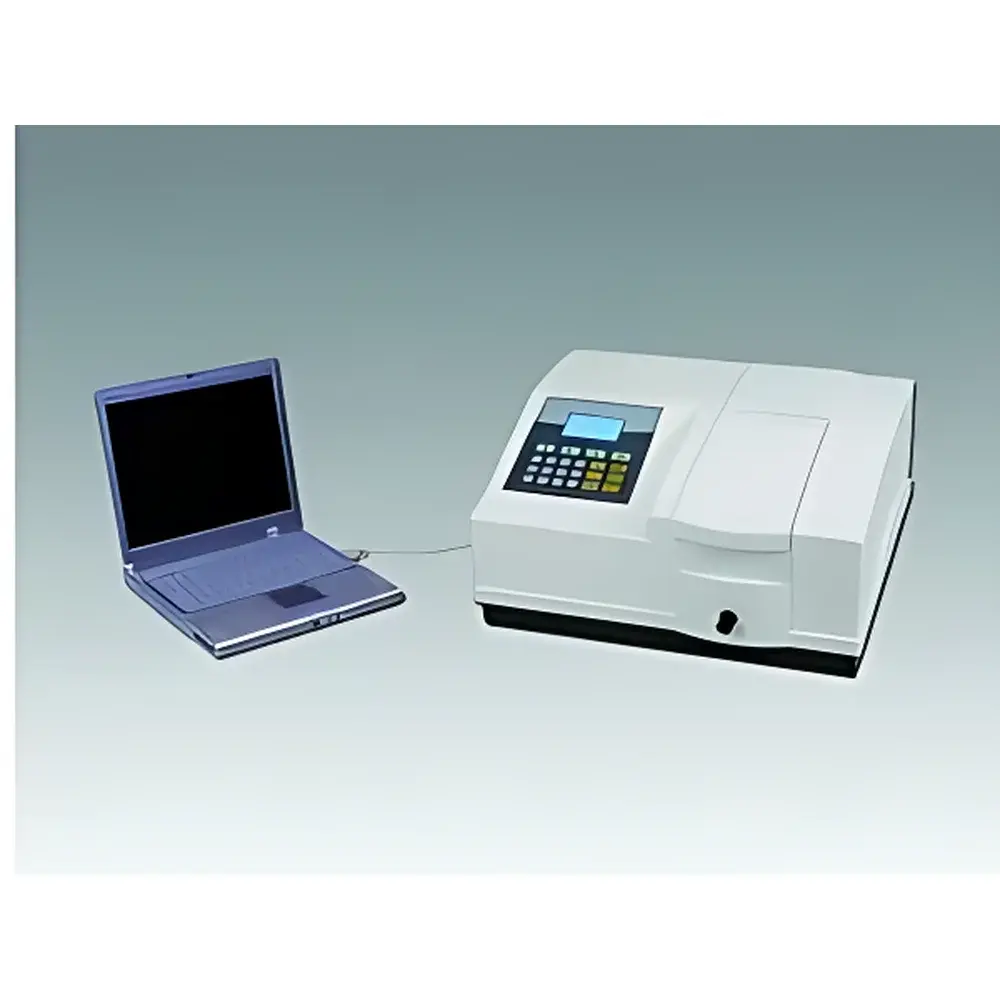
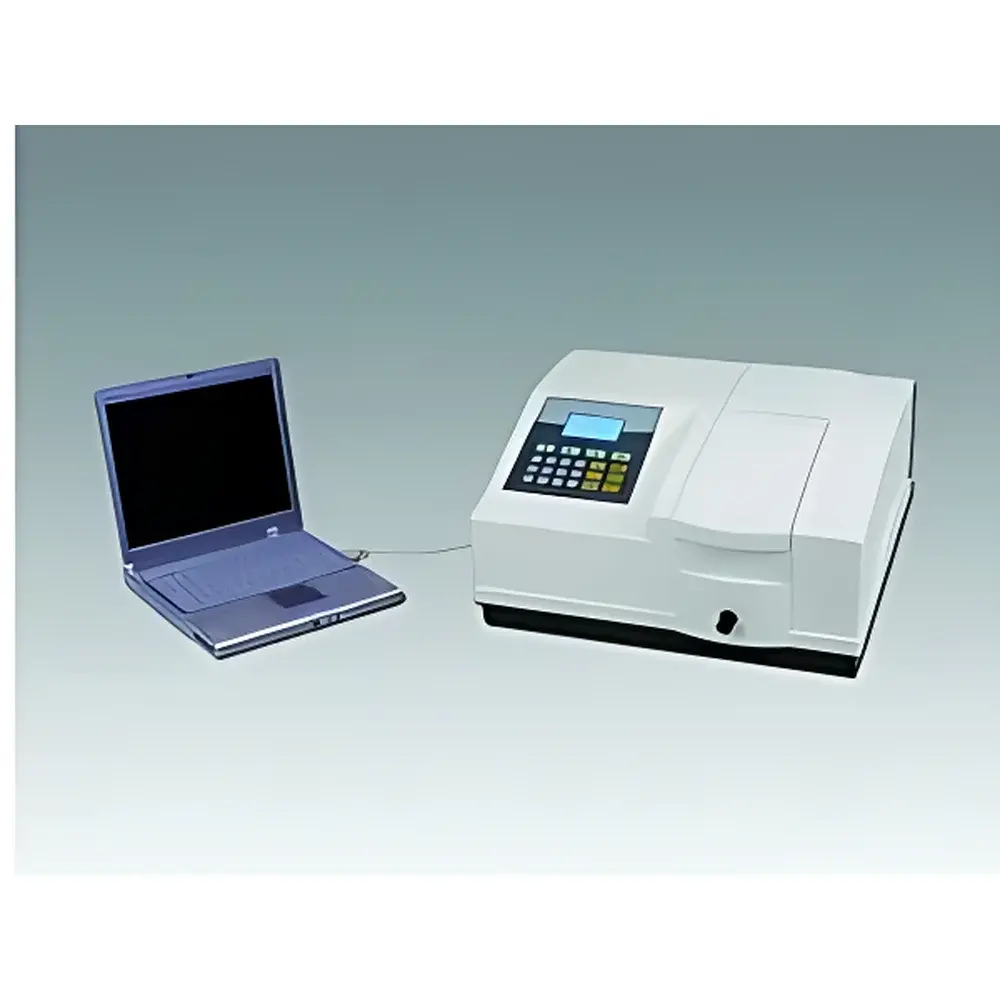
Truelab UV-752 Dual-Beam Ultraviolet-Visible Spectrophotometer
| Brand | Truelab |
|---|---|
| Origin | Shanghai, China |
| Model | UV-752 |
| Wavelength Range | 200–1000 nm |
| Spectral Bandwidth | 4 nm |
| Wavelength Accuracy | ±2.0 nm |
| Wavelength Repeatability | ±1.0 nm |
| Stray Light | ≤0.5% T (at 220 nm and 340 nm) |
| Photometric Accuracy | ±0.5% T |
| Photometric Repeatability | ±0.2% T |
| Baseline Drift | ±0.003 A/h |
| Detector | Photodiode Array |
| Optical Design | Dual-Beam |
| Wavelength Resolution | 0.1 nm step |
| Display | 128×64 LCD |
| Dimensions | 456 × 375 × 220 mm |
| Data Interface | USB |
| Software | UV-Solution Workstation |
Overview
The Truelab UV-752 is a dual-beam ultraviolet-visible (UV-Vis) spectrophotometer engineered for precision quantitative analysis across the 200–1000 nm spectral range. Based on classical Beer–Lambert law principles, it measures absorbance (A), transmittance (%T), and concentration (C) by comparing sample and reference beam intensities in real time—eliminating errors from source instability or detector drift. Its fixed 4 nm spectral bandwidth ensures optimal balance between resolution and signal-to-noise ratio for routine laboratory applications. Designed for robustness and operational consistency, the UV-752 employs a photodiode array detector for rapid spectral acquisition and stable photometric performance. The instrument features automatic wavelength calibration at startup, internal dark-current correction, and programmable lamp switching logic to optimize deuterium and tungsten lamp usage across UV and visible regions.
Key Features
- Dual-beam optical architecture with real-time reference compensation for enhanced baseline stability and long-term measurement reproducibility
- Photodiode array detection enabling fast, noise-resistant spectral acquisition without mechanical scanning
- Automatic wavelength initialization and calibration upon power-on, ensuring traceable alignment to NIST-traceable standards
- High-resolution 0.1 nm wavelength stepping capability within the full 200–1000 nm range
- Integrated 128×64 dot-matrix LCD display with intuitive menu navigation and real-time parameter feedback
- Onboard data storage supporting up to 200 test records and 50 user-defined calibration curves
- Up to 12-point standard curve generation with linear, polynomial, and logarithmic fitting algorithms
- USB interface compliant with USB 2.0 specifications for direct connection to Windows-based PCs
- Comprehensive lamp management system with automatic switching at user-configurable crossover wavelengths (e.g., 340 nm)
Sample Compatibility & Compliance
The UV-752 accommodates standard 10 mm pathlength quartz or glass cuvettes (including matched pairs for high-precision work), as well as optional micro-volume adapters and flow cells for specialized applications. It supports both liquid and semi-transparent solid samples when used with appropriate holders. The instrument meets core requirements of ISO 9001 quality management systems and complies with relevant sections of ASTM E275 (Standard Practices for Describing and Measuring Performance of UV-Vis Spectrophotometers) and ISO/IEC 17025 for testing laboratories. While not inherently 21 CFR Part 11 compliant out-of-the-box, its UV-Solution software architecture allows integration into validated environments through documented configuration controls and audit trail extensions.
Software & Data Management
The UV-Solution workstation software provides a comprehensive platform for instrument control, spectral scanning, kinetic assays, multi-wavelength quantitation, and derivative spectroscopy. It supports raw absorbance and transmittance export in CSV and ASCII formats compatible with third-party statistical packages (e.g., OriginLab, JMP, R). All calibration parameters—including curve coefficients, date/time stamps, operator ID fields, and instrument serial number—are embedded in saved files to support GLP/GMP documentation practices. Audit trail functionality can be enabled via configurable logging of method changes, calibration events, and result modifications—essential for regulated QC/QA workflows in pharmaceutical, food safety, and environmental testing labs.
Applications
The UV-752 serves as a foundational analytical tool in diverse settings: quantification of nucleic acids and proteins (e.g., A260/A280 ratios), determination of heavy metal ions via colorimetric chelation assays (e.g., Fe²⁺ with 1,10-phenanthroline), evaluation of dye concentrations in textile effluents, verification of active pharmaceutical ingredient (API) purity in raw materials, monitoring enzymatic reaction kinetics, and validation of disinfectant concentrations in healthcare facilities. Its broad spectral coverage also enables characterization of semiconductor thin films, photocatalytic nanomaterials, and natural pigment extracts in agricultural and botanical research.
FAQ
What is the maximum pathlength supported for standard cuvette measurements?
The UV-752 is optimized for 10 mm square cuvettes; custom holders for 5 mm, 20 mm, or 50 mm pathlengths are available as optional accessories.
Does the instrument support compliance with USP or EP 2.2.25?
Yes—the UV-752’s photometric accuracy (±0.5% T), stray light performance (≤0.5% T), and wavelength repeatability (±1.0 nm) meet the minimum acceptance criteria defined in these pharmacopeial chapters for routine identity and assay procedures.
Can the UV-Solution software generate electronic signatures for audit-ready reports?
Electronic signature capability requires supplemental validation of the host PC environment and integration with enterprise-level document management systems; the software provides all necessary metadata fields and export hooks for such implementation.
Is wavelength recalibration required after lamp replacement?
Yes—automatic recalibration is triggered during startup, but manual verification using holmium oxide or didymium filters is recommended per ISO/IEC 17025 internal quality control protocols.
What maintenance intervals are recommended for optimal photometric stability?
Daily: Cuvette holder cleaning and blank verification; Quarterly: Lamp intensity check and alignment verification; Annually: Full optical path inspection and detector gain calibration by authorized service personnel.






