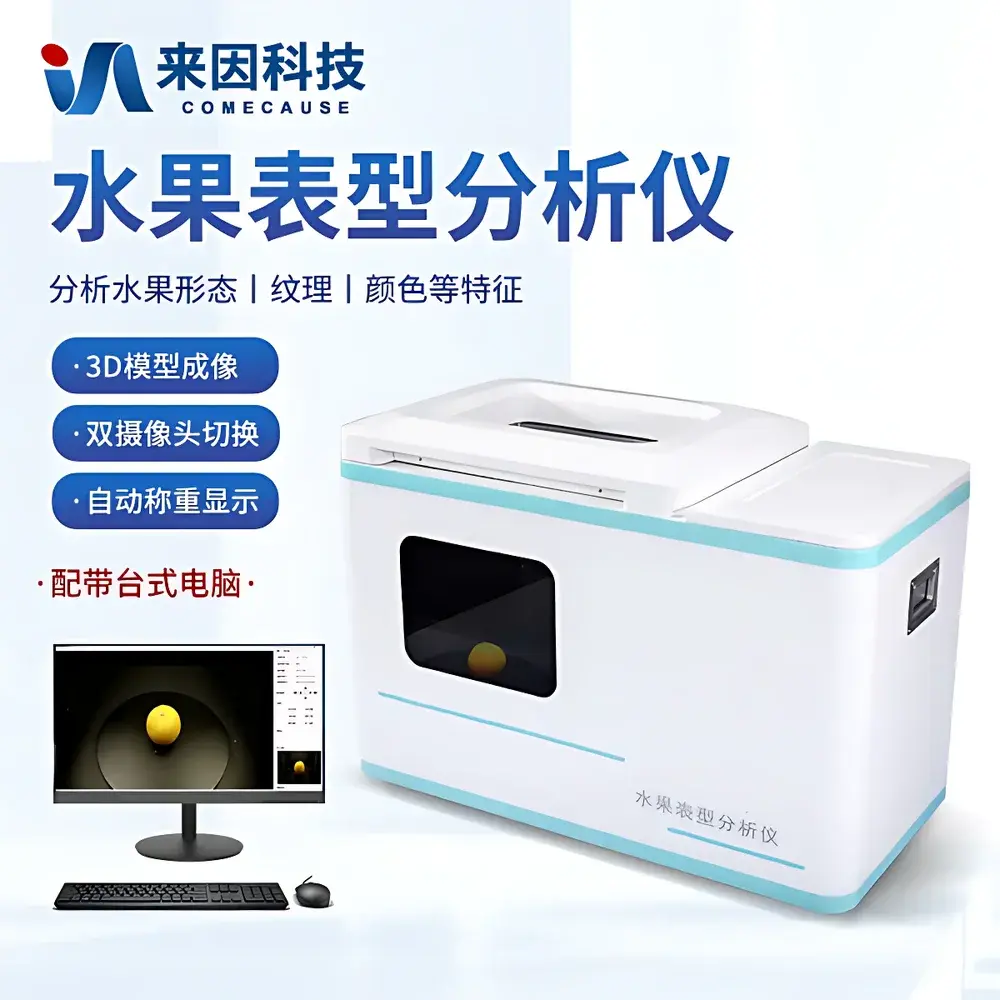
COMECAUSE IN*VistaFruit Digital Apple Phenotyping & Quality Analysis System
| Brand | COMECAUSE |
|---|---|
| Origin | Shandong, China |
| Manufacturer Type | Direct Manufacturer |
| Country of Origin | China |
| Model | IN*VistaFruit |
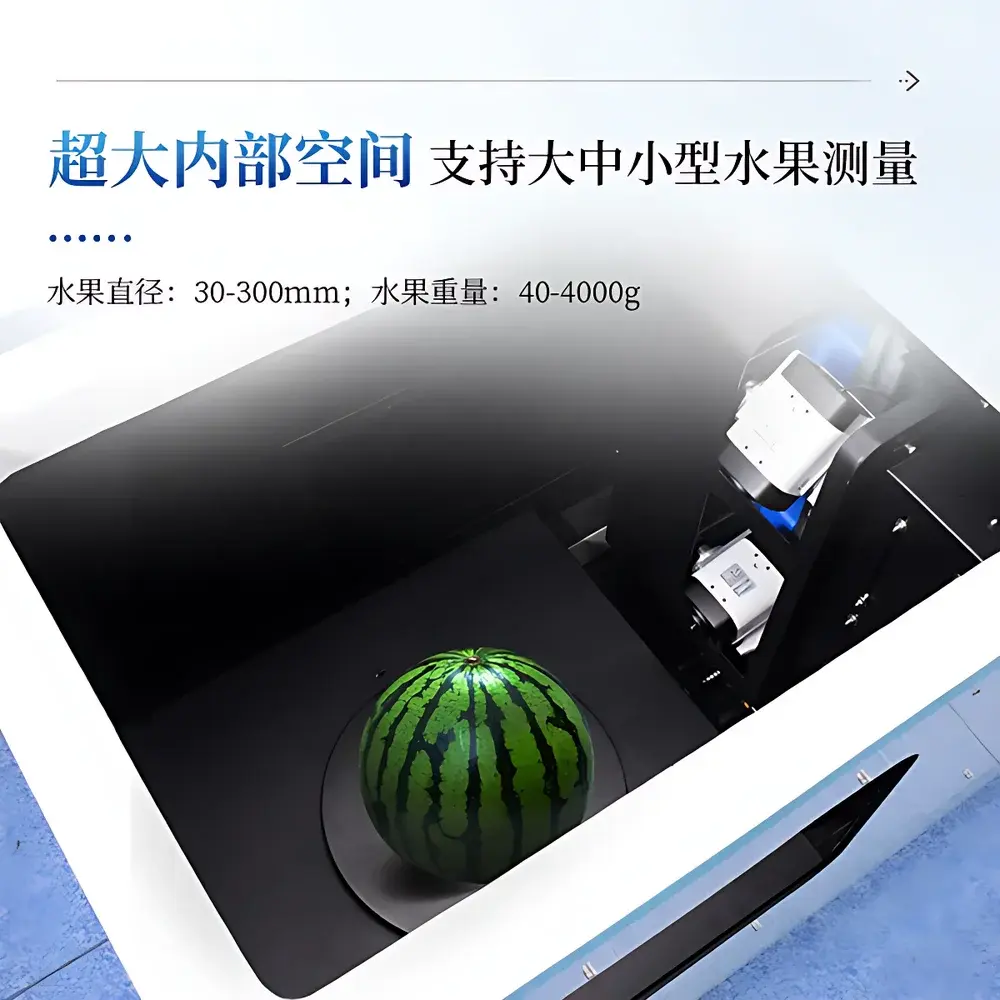
| Weight Range | 40–4000 g |
| Fruit Diameter Range | 30–300 mm |
| Integrated Precision Scale | Yes |
| Imaging | Multi-view RGB + Structured Light |
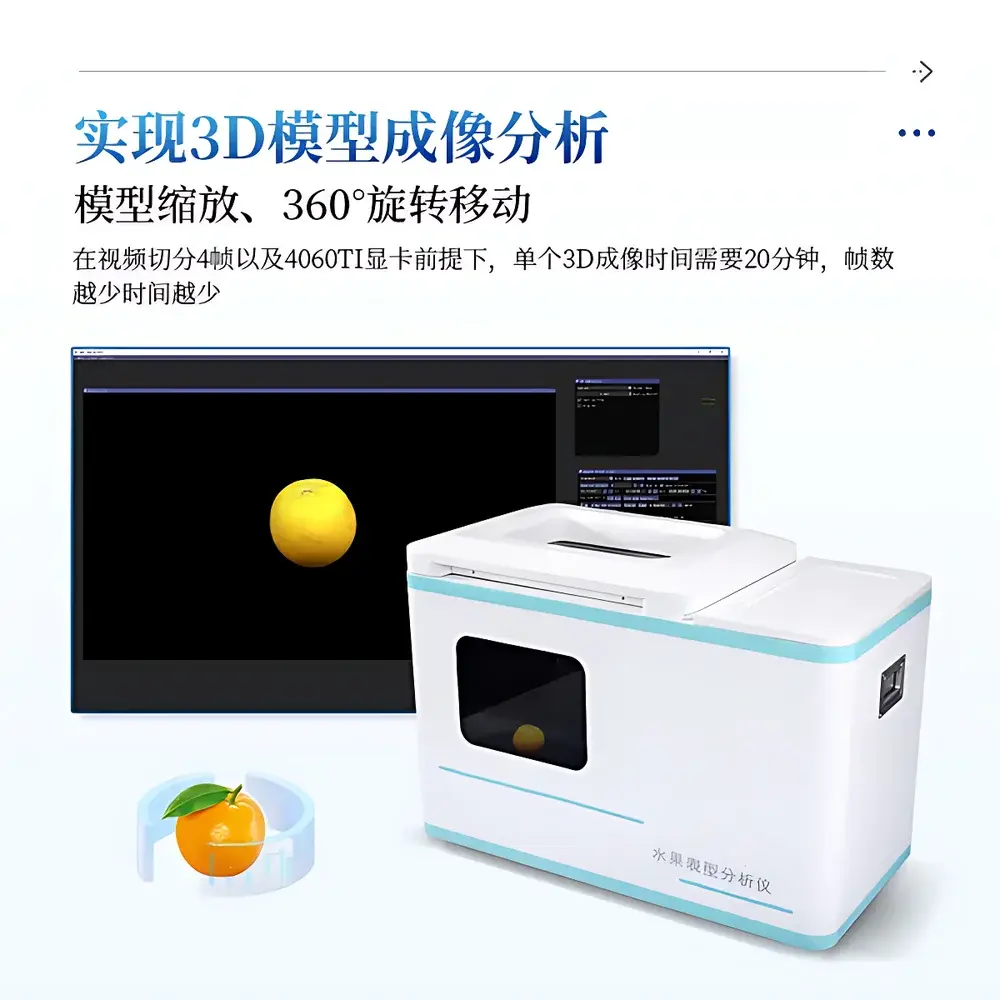
| 3D Reconstruction Method | AI-optimized Gaussian Splatting & Point Cloud Fusion |
| 2D Throughput | ≤1 sample/min |
| 3D Modeling Time (RTX 4060 Ti, 4-frame input) | ~20 min/sample |
| Software | Dual-language (EN/CN), Cloud Sync Enabled, GLP-compliant Audit Trail, FDA 21 CFR Part 11–ready Export Mode |
| Dimensions (W×D×H) | 1006 × 506 × 718 mm |
| Net Weight | 62 kg |
Overview
The COMECAUSE IN*VistaFruit Digital Apple Phenotyping & Quality Analysis System is a non-destructive, high-throughput imaging and metrology platform engineered for objective quantification of morphological, chromatic, and textural traits in pome and drupe fruits—primarily apples, but also extending to pears, citrus, melons, and stone fruits. It operates on the principle of multi-angle photogrammetric acquisition combined with structured-light-assisted depth mapping, followed by AI-accelerated 3D Gaussian Splatting reconstruction. This architecture enables sub-millimeter geometric fidelity and pixel-level spectral registration across the entire fruit surface. Unlike conventional grading tools that rely on single-axis dimensioning or spot-color sampling, IN*VistaFruit captures holistic surface geometry and reflectance distribution—transforming subjective visual assessment into traceable, repeatable, and statistically robust phenotypic descriptors. Its design adheres to core metrological principles: measurement traceability to SI units (e.g., grams, millimeters, CIELAB ΔE), spatial calibration via embedded reference targets, and temporal stability validated under controlled ambient lighting conditions (ISO 9001-aligned environmental monitoring protocol).
Key Features
- Integrated precision scale (40–4000 g range) with real-time software synchronization—no external weighing hardware required.
- Multi-spectral, multi-view imaging station with synchronized RGB capture and structured-light projection for accurate surface normal estimation.
- AI-driven 3D reconstruction pipeline leveraging Gaussian Splatting for efficient point cloud generation and texture mapping—optimized for fruit surface topology including calyx cavity, stem cavity, and micro-roughness features.
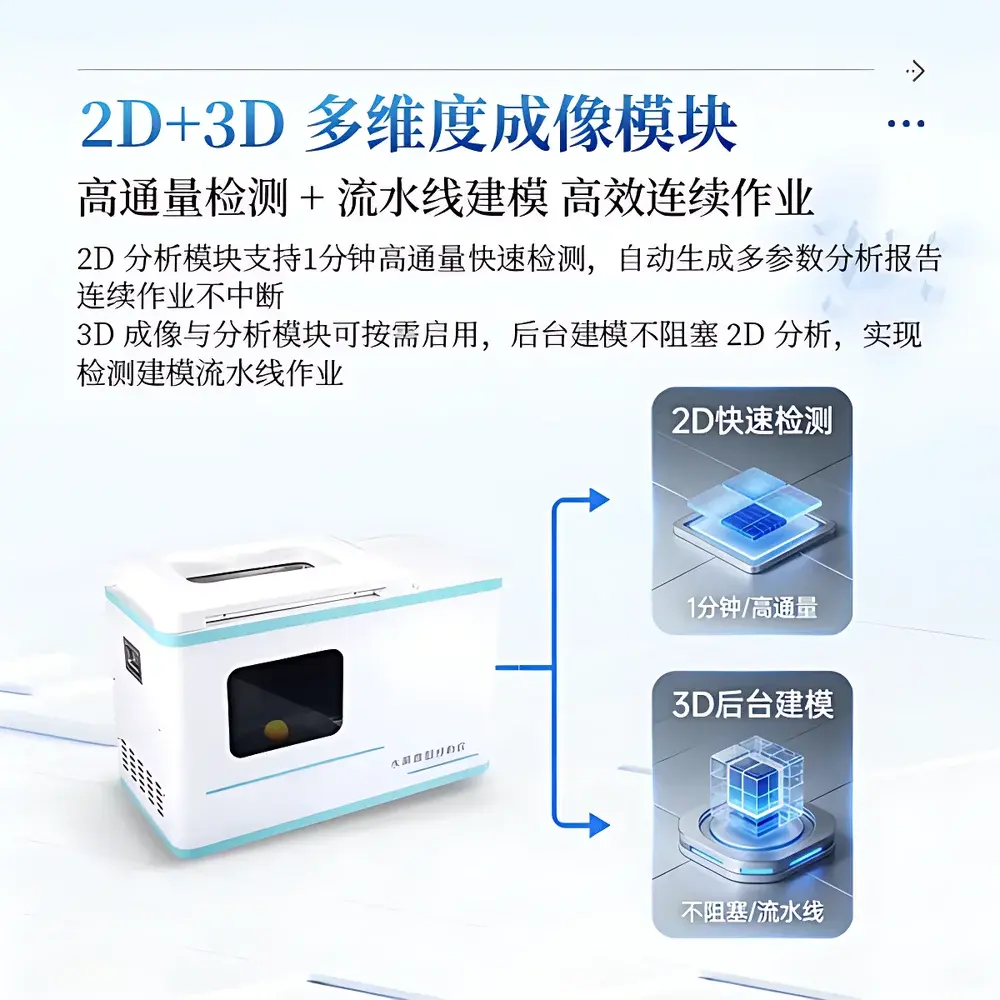
- Dual-mode operation: High-throughput 2D analysis module (<1 min/sample) for rapid screening; on-demand 3D modeling module with background queue processing—enabling concurrent 2D acquisition and 3D reconstruction without workflow interruption.
- Full parametric output suite: 24 morphometric parameters (e.g., volume, density, sphericity, shape factor), 11 colorimetric indices (CIELAB L*a*b*, HSV, grayscale, direct RGB), and 11 texture metrics (GLCM-derived: contrast, homogeneity, entropy, ASM, correlation, dissimilarity, variance, sum variance, sum average, difference variance, SSIM).
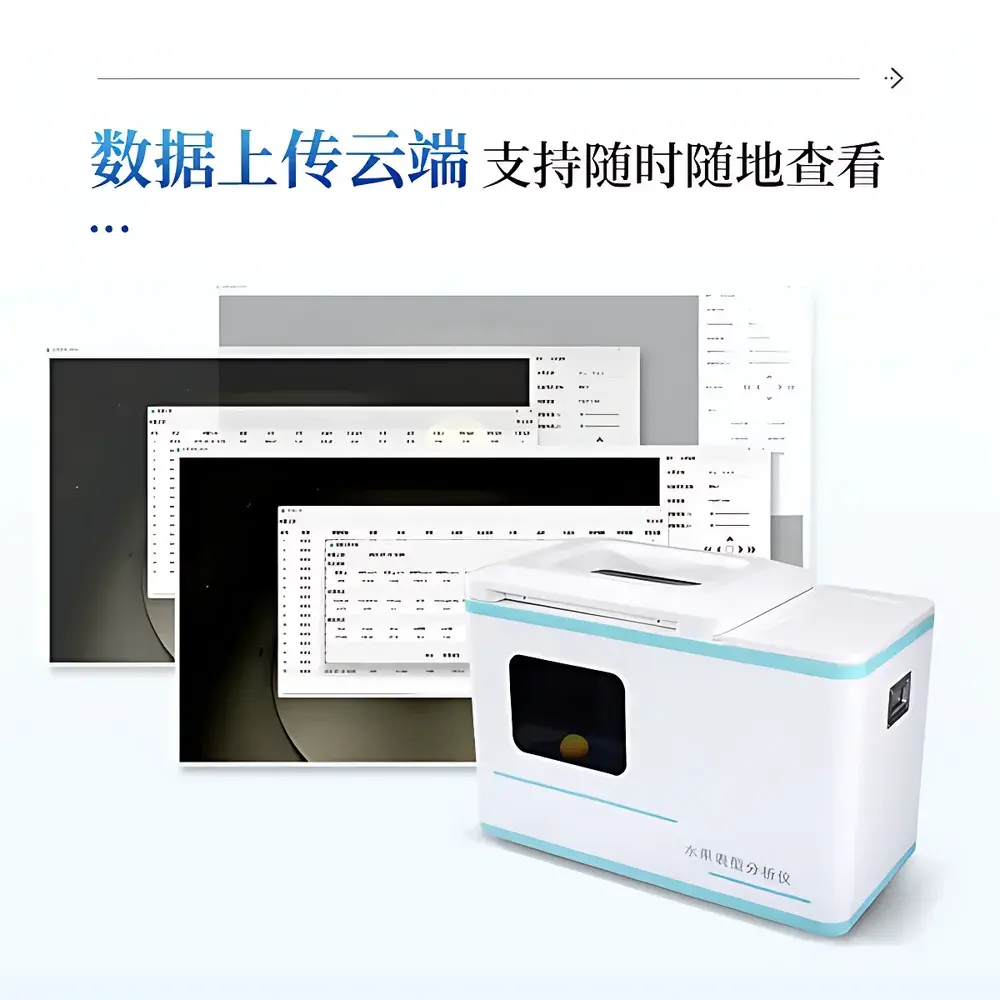
- Cloud-enabled data management with device-locked encryption, time-stamped audit logs, and role-based access control—fully compliant with GLP documentation requirements.
- Software interface supports real-time camera/turntable control, auto/manual focus adjustment, resolution-adaptive rendering, and one-click language toggle (English/Chinese).
Sample Compatibility & Compliance
The IN*VistaFruit system accommodates fruits with diameters from 30 mm to 300 mm and masses between 40 g and 4000 g—covering commercial apple cultivars (e.g., Fuji, Gala, Honeycrisp), pear varieties (Bartlett, Anjou), citrus (navel oranges, grapefruit), and melons (cantaloupe, watermelon). All measurements are performed without physical contact or surface preparation, preserving sample integrity for downstream sensory or biochemical analysis. The system’s calibration protocol conforms to ISO/IEC 17025 guidelines for measurement uncertainty estimation, and its software architecture supports ALCOA+ data integrity principles (Attributable, Legible, Contemporaneous, Original, Accurate, Complete, Consistent, Enduring, Available). Optional 21 CFR Part 11 compliance mode provides electronic signature capability, audit trail export, and user authentication logs—suitable for regulated breeding programs operating under GxP frameworks.
Software & Data Management
The IN*VistaFruit Control & Analysis Suite is built on a modular, client-server architecture with local processing and optional cloud synchronization. Each device is assigned a unique identifier linked to encrypted cloud storage, enabling centralized data aggregation across multiple orchards or breeding stations. Measurement records include full metadata: timestamp, operator ID, instrument firmware version, calibration status, environmental log (ambient lux, temperature), and raw image/point cloud archives. The software generates standardized reports compliant with ASTM E2881-22 (Standard Guide for Digital Image-Based Fruit Quality Assessment) and includes statistical summary dashboards (mean, SD, CV%, outlier detection via Tukey’s fences). Export formats include CSV (for SPSS/R/Matlab), PDF (audit-ready), and DICOM-compatible 3D mesh files (.obj, .ply) for integration with plant modeling platforms such as PlantCV or OpenAlea.
Applications
- Apple Breeding Programs: Enables high-fidelity phenotypic characterization of F1–F3 progeny for QTL mapping of complex traits—e.g., anthocyanin distribution uniformity, calyx depth heritability, or surface wax crystallinity quantified via texture entropy.
- Commercial Orchard Management: Supports varietal benchmarking across growing regions, harvest timing optimization via density/ripeness correlation models, and post-harvest quality loss tracking over cold storage duration.
- Grading & Marketing: Powers automated sorting lines with multi-parameter decision trees (e.g., “Grade A” = sphericity ≥0.88 ∧ red coverage ≥75% ∧ surface defect area <0.5 cm²), ensuring batch consistency for premium branding.
- Academic Research: Facilitates studies in fruit development biology, UV-B response phenotyping, mechanical stress adaptation (via surface curvature gradient analysis), and consumer preference modeling using multivariate regression of texture/color metrics against hedonic scores.
FAQ
What fruit types are supported beyond apples?
The system is validated for apples, pears, citrus (oranges, grapefruit, pomelo), stone fruits (peaches, plums), and melons (watermelon, cantaloupe, honeydew). Custom calibration protocols can be developed for additional species upon request.
Is the 3D reconstruction process destructive or requires sample coating?
No—IN*VistaFruit uses non-contact optical methods only. No sprays, powders, or physical fixtures are applied to the fruit surface.
Can measurement data be integrated with existing LIMS or breeding databases?
Yes—the software provides RESTful API endpoints and ODBC-compliant database connectors for seamless integration with LabVantage, BreedBase, or custom SQL-based repositories.
How is measurement accuracy verified over time?
Each unit ships with NIST-traceable ceramic calibration spheres (10 mm, 50 mm, 100 mm) and certified color charts (BCRA Series II). Quarterly verification protocols are embedded in the software and generate ISO/IEC 17025–compliant validation reports.
Does the system support regulatory submissions for variety protection or certification?
Yes—output reports include instrument identification, calibration certificate references, environmental metadata, and raw data archives—meeting UPOV TG/1/6 and ISTA 5.4 documentation standards for DUS testing.
Related Products