
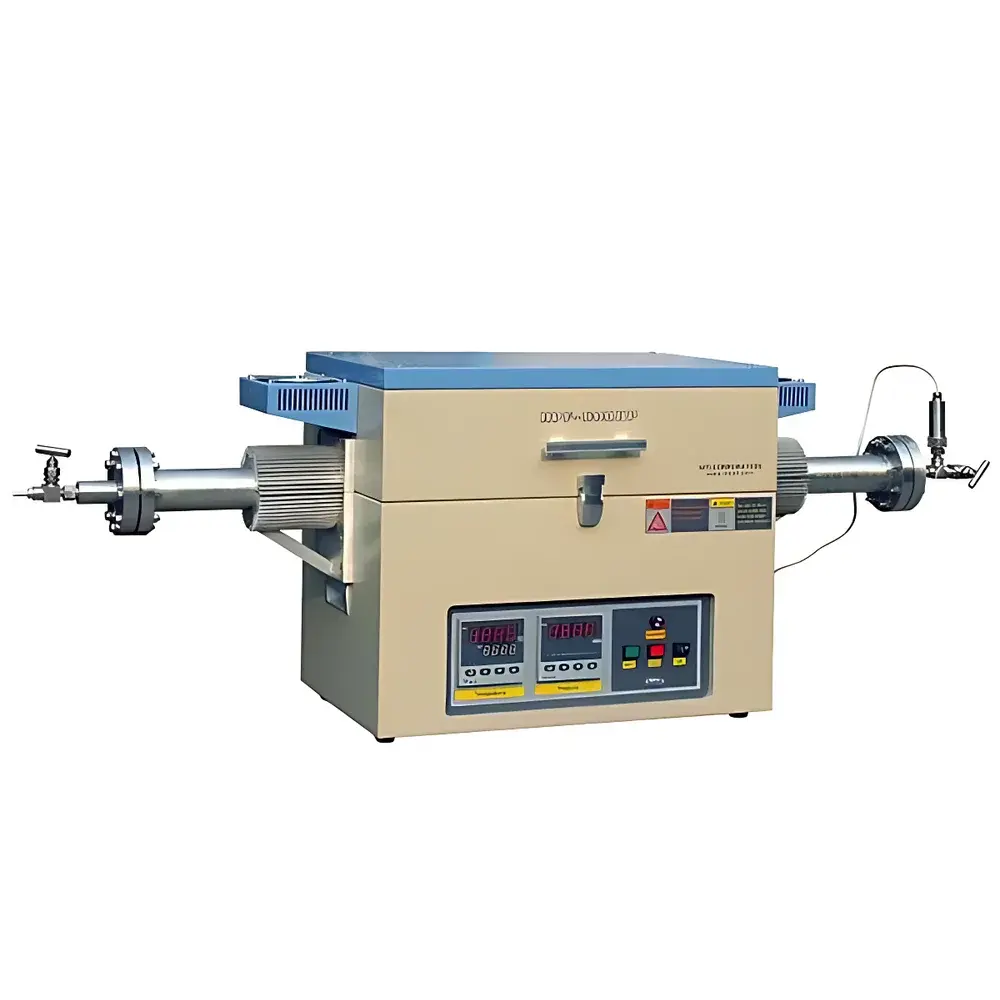
KJ GROUP OTF-1200X-HVHP-80 High-Pressure Tube Furnace (up to 800 °C, 7 bar)
| Brand | KJ GROUP |
|---|---|
| Origin | Liaoning, China |
| Manufacturer Type | Authorized Distributor |
| Country of Origin | China |
| Model | OTF-1200X-HVHP-80 |
| Power Supply | AC 220 V, 50/60 Hz, 2.5 kW |
| Max Operating Temperature | 800 °C |
| Max Pressure Rating | 105 PSI (7 bar) at 800 °C |
| Heating Zone Length | 440 mm |
| Uniform Zone Length | 200 mm |
| Tube Material | Seamless SS310S nickel-based alloy steel |
| Tube Dimensions | OD 80 mm, ID 72 mm, L 1000 mm |
| Heating Element | Mo-doped Fe-Cr-Al resistance wire |
| Max Ramp Rate | ≤30 °C/min |
| Temperature Control Accuracy | ±1 °C |
| Vacuum Performance | 10⁻² torr (mechanical pump), 10⁻⁵ torr (turbo-molecular pump) |
| External Dimensions | 550 × 380 × 520 mm |
| Net Weight | 55 kg |
| Safety Certifications | CE-compliant |
| Cooling | Dual-layer shell with forced-air circulation and aluminum heat sinks |
| Control System | 30-segment PID programmable controller with overheat & thermocouple break protection |
| Pressure Monitoring | Integrated digital pressure sensor with LED display and dual-limit audible/visual alarm with automatic cutoff |
Overview
The KJ GROUP OTF-1200X-HVHP-80 is a precision-engineered high-pressure tube furnace designed for controlled thermal processing under elevated gas pressures—up to 7 bar (105 PSI) at 800 °C. It operates on the principle of resistive heating within a sealed, atmospherically isolated quartz or metallic tube environment, enabling reproducible synthesis, annealing, reduction, oxidation, and sintering of advanced functional materials—including metal-organic frameworks (MOFs), solid-state electrolytes, and pressure-sensitive catalysts. Unlike standard atmospheric tube furnaces, the OTF-1200X-HVHP-80 integrates structural integrity, thermal stability, and real-time pressure regulation into a single compact platform. Its SS310S seamless alloy steel tube provides exceptional resistance to thermal creep, oxidation, and mechanical stress under sustained high-pressure conditions, while the dual-layer cooled housing ensures safe surface temperatures (<55 °C) and low法兰 thermal loading (<100 °C), critical for long-duration experiments involving reactive or pyrophoric gases.
Key Features
- Dual-shell construction with integrated forced-air circulation and aluminum finned heat sinks—maintains external shell temperature below 55 °C and flange temperature below 100 °C during continuous operation.
- High-purity SS310S nickel-based alloy tube (OD 80 mm, ID 72 mm, L 1000 mm) rated for full-cycle operation up to 800 °C and 7 bar; compatible with O₂, N₂, Ar, H₂, NH₃, and mixed process gases.
- PID-based 30-segment programmable temperature controller with independent overheat and thermocouple failure protection circuits—ensuring robust thermal safety and repeatability across multi-step protocols.
- Real-time digital pressure monitoring via calibrated transducer mounted directly on the top flange, featuring LED display, user-configurable upper/lower pressure limits, visual/audible alarms, and fail-safe automatic power cutoff upon threshold breach.
- Internal furnace chamber lined with U.S.-sourced alumina ceramic coating—enhances infrared emissivity, improves thermal uniformity across the 200 mm isothermal zone, and extends refractory life under cyclic thermal loading.
- CE-certified design compliant with EN 61000-6-3 (EMC) and EN 61000-6-2 (immunity); includes grounding continuity verification, insulated wiring harnesses, and IP20-rated electrical enclosure.
Sample Compatibility & Compliance
The OTF-1200X-HVHP-80 supports sample containment in both quartz and metallic crucibles (e.g., alumina, molybdenum, tantalum), with compatibility verified for powder, pellet, thin-film, and fiber specimens up to 70 mm in length. Its pressure-rated CF-63 flange interface accommodates standard vacuum-compatible feedthroughs (electrical, thermocouple, gas lines) and permits integration with mass flow controllers (MFCs), residual gas analyzers (RGAs), and inline pressure regulators. The system meets baseline requirements for GLP-compliant material synthesis workflows and has been validated for use in ASTM E29-23–guided thermal protocol documentation. While not inherently 21 CFR Part 11–compliant, its digital logging interface (via optional RS485/Modbus output) supports traceable data export when paired with validated third-party acquisition software.
Software & Data Management
The furnace operates autonomously via its embedded PID controller, with no proprietary software dependency. All temperature and pressure setpoints, ramp rates, dwell times, and alarm thresholds are configured directly on the front-panel interface. Optional analog/digital outputs (0–5 V, 4–20 mA, Modbus RTU) enable connection to SCADA systems, LabVIEW, or custom Python-based acquisition platforms for time-synchronized logging of T/P/t profiles. Raw data can be exported as CSV files for post-processing in MATLAB or OriginLab. Audit trails—though not natively generated—are achievable through external timestamped recording of controller display values or integration with PLC-based supervisory control architectures meeting ISO/IEC 17025 documentation standards.
Applications
- Synthesis of pressure-stabilized crystalline phases (e.g., high-pressure polymorphs of LiCoO₂, Na₃V₂(PO₄)₃) under inert or reducing atmospheres.
- Thermal decomposition studies of energetic materials and precursors under controlled overpressure to suppress volatilization.
- Gas-solid reaction kinetics (e.g., carburization, nitridation, sulfidation) with in situ pressure feedback for stoichiometric gas consumption modeling.
- High-temperature annealing of ceramic composites under argon overpressure to minimize pore coarsening and intergranular oxidation.
- Calibration and validation of high-temperature pressure sensors and thermocouples in certified test environments.
- Pre-treatment of battery electrode materials prior to electrochemical cell assembly—enabling reproducible SEI formation conditioning.
FAQ
What is the maximum allowable pressure at 750 °C?
At 750 °C, the maximum recommended operating pressure is 180 PSI (12.4 bar), interpolated between the published ratings of 315 PSI at 700 °C and 105 PSI at 800 °C per ASME B31.3 process piping guidelines.
Can this furnace be used under vacuum and high pressure in the same experiment?
No—vacuum and high-pressure operation are mutually exclusive modes. The SS310S tube is rated for either static high-pressure service (≤7 bar) or high-vacuum service (≤10⁻⁵ torr), but not simultaneous application of both extremes due to differential stress limitations.
Is the pressure sensor calibrated and traceable to NIST standards?
The integrated pressure transducer is factory-calibrated with ±0.5% FS accuracy; NIST-traceable calibration certificates are available as an optional add-on service upon request.
What type of thermocouple is recommended for accurate temperature measurement inside the tube?
Type K (Chromel–Alumel) sheathed thermocouples with ceramic insulation are recommended for use up to 800 °C; for extended lifetime under cycling, mineral-insulated (MI) cable variants with Inconel 600 sheathing are advised.
Does the system include gas inlet/outlet fittings suitable for reactive gases like H₂ or NH₃?
Yes—the CF-63 flange accepts standard UHV-compatible fittings; stainless-steel VCR or Swagelok fittings (not included) must be selected based on gas compatibility and leak-rate requirements (typically ≤1×10⁻⁹ mbar·L/s He).



