
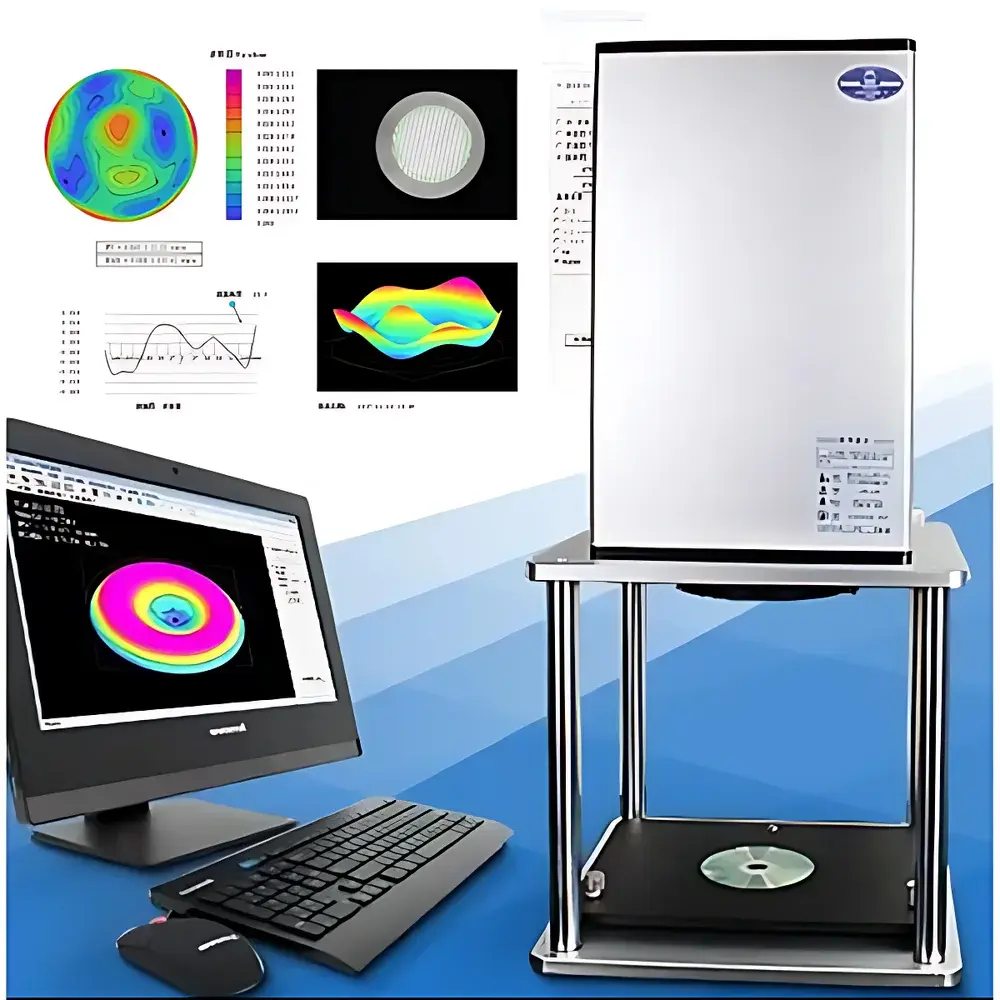
KJ GROUP PG150-PC Fizeau Plane Interferometer
| Brand | KJ GROUP |
|---|---|
| Origin | Liaoning, China |
| Manufacturer Type | Authorized Distributor |
| Country of Origin | China |
| Model | PG150-PC |
| Price | Upon Request |
| Measurement Principle | Fizeau Interferometry |
| Effective Aperture | 150 mm |
| Light Source | Semiconductor Laser, 635 nm |
| Magnification | Fixed |
| Display Interface | PC Software or Dedicated Monitor |
| Reference Flat Accuracy | PV ≤ λ/20 |
| Power Supply | AC 100–240 V, 50/60 Hz |
| Dimensions (W × D × H) | 40 cm × 40 cm × 90 cm |
| Weight | 75 kg |
| Reference Flat Material | Fused Silica (Corning 7980) |
Overview
The KJ GROUP PG150-PC Fizeau Plane Interferometer is a high-precision optical metrology instrument engineered for quantitative surface flatness evaluation of plane optical components. It operates on the well-established Fizeau interferometric principle—where coherent laser light from a 635 nm semiconductor source is split into reference and test beams; interference fringes formed upon recombination encode nanoscale topographic deviations across the measured surface. With an effective aperture of 150 mm, the system supports full-aperture analysis of standard optical flats, calibration plates, precision mirrors, and optomechanical mounting surfaces used in aerospace, lithography optics, and laser cavity alignment. Its rigid mechanical architecture—featuring vibration-damped baseplate integration and thermally stable fused silica reference flats (Corning 7980)—ensures measurement repeatability under controlled laboratory conditions. The instrument is designed to meet foundational requirements for ISO 10110-5 (surface form tolerances) and supports traceable calibration workflows compliant with ISO/IEC 17025-accredited laboratories.
Key Features
- Fizeau-type interferometric configuration optimized for plane surface metrology, delivering high fringe contrast and low coherence noise
- 150 mm clear aperture enabling full-field evaluation of standard optical flats up to Ø150 mm
- Reference flat fabricated from Corning 7980 fused silica with surface figure accuracy better than PV ≤ λ/20 @ 635 nm
- Dual-display capability: real-time fringe visualization via dedicated monitor or integrated PC software interface
- Fixed-magnification optical path ensures consistent pixel-to-length scaling without zoom-induced calibration drift
- Robust mechanical housing (75 kg mass) with minimized thermal expansion coefficient and integrated leveling feet for operational stability
- Universal power input (AC 100–240 V, 50/60 Hz) supporting global deployment without external voltage conversion
Sample Compatibility & Compliance
The PG150-PC accommodates planar samples fabricated from optical glass (e.g., BK7, fused silica), polished metals (stainless steel, aluminum alloys), technical ceramics (Al₂O₃, SiC), and single-crystal substrates (CaF₂, MgF₂). Sample thickness is unconstrained provided the rear surface is non-reflective or anti-reflection coated to suppress spurious etalon fringes. The system complies with fundamental optical testing standards including ISO 10110-5 (specification of surface imperfections), ISO 14999-3 (interferometric measurement of surface irregularity), and ASTM E1379 (standard guide for interferometric measurements of optical surfaces). While not inherently 21 CFR Part 11–compliant, its software architecture supports audit-trail-enabled data export (CSV, TIFF, ZYGO-compatible .dat) suitable for GLP/GMP environments when deployed with validated third-party data management platforms.
Software & Data Management
The PG150-PC interfaces with proprietary Windows-based acquisition and analysis software supporting phase-shifting interferometry (PSI) algorithms. Core functions include automatic fringe centering, Zernike polynomial decomposition (up to 36 terms), PV/RMS error quantification, and ISO-standard surface map rendering (height, slope, curvature). All raw interferograms and processed results are timestamped and stored with metadata (operator ID, environmental temperature/humidity logs if externally sourced, reference flat serial number). Export formats include ASCII text for statistical process control (SPC) integration, PNG/TIFF for documentation, and binary .dat files compatible with industry-standard tools such as MATLAB, Python (OpenCV + NumPy), and ZYGO MetroPro. Software updates are delivered via secure HTTPS portal; no cloud synchronization or remote telemetry is enabled by default.
Applications
- Calibration and certification of optical flats used in national metrology institutes and ISO/IEC 17025-accredited calibration labs
- In-process verification of surface flatness during polishing of laser-grade mirrors and beam splitters
- Incoming inspection of precision mechanical reference plates for coordinate measuring machine (CMM) artifact validation
- Research-grade characterization of thin-film-coated substrates where substrate flatness impacts coating uniformity and adhesion
- Validation of ultra-precision machining processes for silicon wafers, sapphire windows, and EUV mask blanks
- Teaching and demonstration of wavefront analysis principles in university optics and precision engineering laboratories
FAQ
What is the minimum resolvable surface deviation for the PG150-PC?
The theoretical resolution is limited by photon shot noise and camera bit depth; typical RMS repeatability under stabilized lab conditions is ≤0.1 nm (λ/6350), consistent with standard Fizeau interferometers using 12-bit CCD sensors.
Can the system measure wedged or slightly angled surfaces?
No—the PG150-PC is strictly configured for zero-degree incidence on nominally flat surfaces. Wedge angles >5 arcsec introduce significant fringe carrier frequency distortion and require tilt-compensated configurations not supported by this model.
Is the reference flat included with the system calibrated and certified?
Yes—a Corning 7980 fused silica reference flat with documented PV ≤ λ/20 at 635 nm is supplied with NIST-traceable calibration certificate (valid for 12 months post-shipment).
Does the instrument support automated motorized translation stages?
Not natively—the PG150-PC is a manual-alignment platform. However, its mechanical interface conforms to standard M6 threaded mounting holes, permitting third-party integration of motorized X-Y-Z stages with external controller synchronization.
What environmental conditions are required for optimal performance?
Recommended operating range: 20 ± 0.5 °C ambient temperature, <40% RH, air turbulence <0.1 m/s. Active vibration isolation (e.g., pneumatic optical table) is strongly advised for sub-nanometer-level measurements.



