
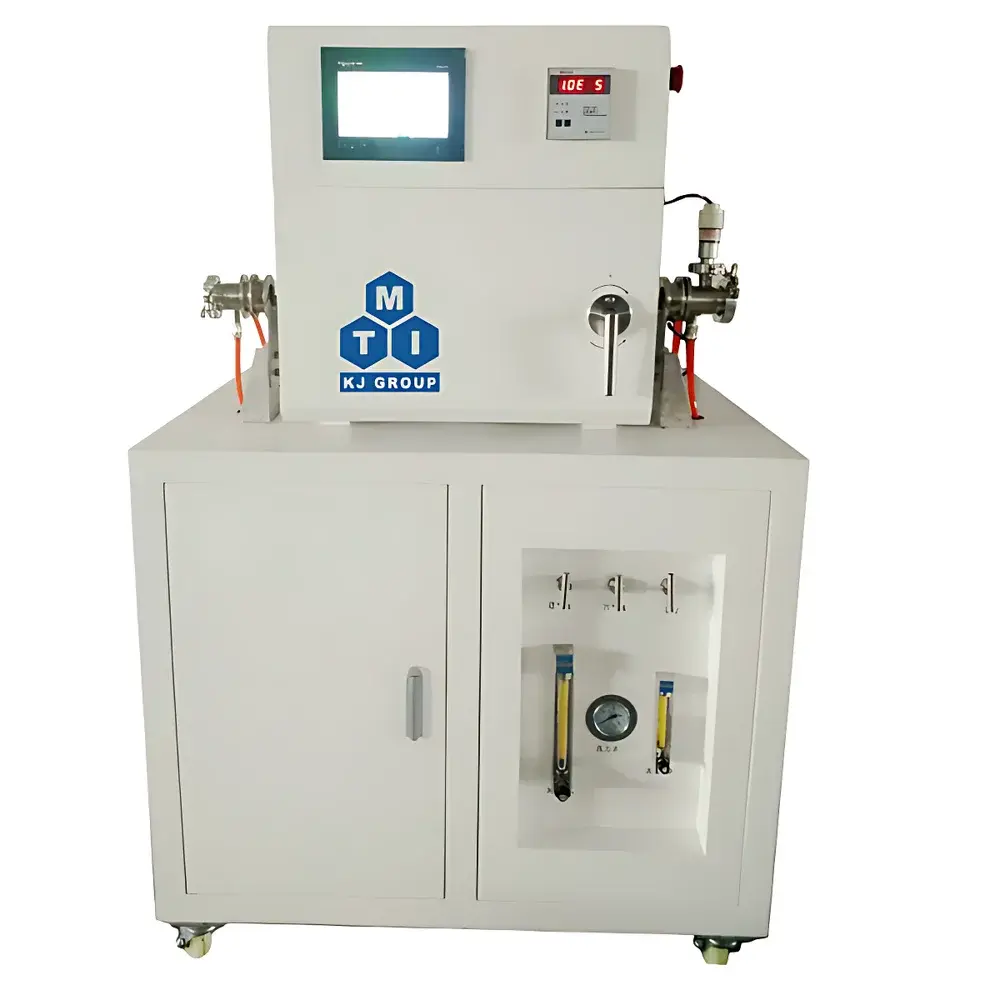
KJ GROUP ZGS Series Microwave Sliding-Rail Tube Furnace
| Brand | KJ GROUP |
|---|---|
| Origin | Liaoning, China |
| Manufacturer Type | Authorized Distributor |
| Product Origin | Domestic (China) |
| Model | ZGS |
| Pricing | Upon Request |
| Voltage | 220±10 V / 380±10 V, 50 Hz |
| Rated Power | 4 kW / 5 kW |
| Microwave Output Power | 0.01–1.40 kW / 0.01–2.80 kW (continuously adjustable) |
| Microwave Frequency | 2.45 GHz |
| Max Operating Temperature | ≤1200 °C |
| Heating Zone Dimensions | Ø40×130 mm / Ø60×130 mm (diameter × length) |
| Temperature Measurement | Type K thermocouple, 0–1300 °C, accuracy ±0.1% of reading |
| Control System | Mitsubishi PLC + Schneider HMI touchscreen |
| Programmable Ramp/Soak Profiles | Up to 40 segments with data logging, export, real-time curve display, and dynamic screen-saver mode |
| Ultimate Static Vacuum | ≤100 Pa |
| Atmosphere Compatibility | Oxidizing, inert, and mildly reducing gases via rapid pre-vacuum gas exchange |
| Microwave Leakage | <0.05 mW/cm² (per IEC 61000-4-3 & GB/T 18317–2001) |
| Safety Interlocks | Door-closed confirmation switch, overtemperature protection, overcurrent protection |
| Main Unit Dimensions (L×W×H) | ~530×1000×1200 mm |
| Support Frame Dimensions (L×W×H) | ~900×1200×1500 mm |
Overview
The KJ GROUP ZGS Series Microwave Sliding-Rail Tube Furnace is an engineered solution for high-efficiency thermal processing under vacuum or controlled atmospheres. Unlike conventional resistance-heated tube furnaces, the ZGS leverages 2.45 GHz industrial microwave energy to directly couple with dielectric and semiconducting materials—enabling volumetric, non-contact heating with exceptional thermal response kinetics. Its sliding-rail configuration allows lateral translation of the quartz or alumina tube relative to the fixed microwave cavity and insulation zone, facilitating rapid thermal ramping (up to 100 °C/s in optimized conditions) and accelerated cooling via forced convection or ambient quenching. This architecture eliminates thermal lag associated with furnace wall conduction and enables precise spatial control over the high-field heating zone. Designed for research-grade reproducibility, the system supports processes requiring strict thermal history control—including SiC thin-film deposition, ceramic capacitor sintering, ZnO nanostructure nucleation, graphene oxide thermal reduction, and conductivity characterization of ceramic substrates.
Key Features
- Integrated vacuum-microwave architecture: Fully enclosed stainless-steel vacuum chamber with direct flange-mounted microwave feedthroughs and waveguide shielding—eliminating external leakage paths and enabling stable operation at ≤100 Pa static vacuum.
- Sliding-rail tube mechanism: Motorized or manual linear displacement of the reaction tube (Ø40 or Ø60 mm ID) within a fixed hot zone, decoupling sample positioning from thermal inertia—reducing thermal soak time by up to 60% compared to static configurations.
- Industrial-grade magnetron source: Water-cooled 2.45 GHz magnetron with analog power modulation (0.01–2.80 kW), delivering stable output across >10,000 hours MTBF; power regulation maintains ±1% stability under load variation.
- Pre-vacuum gas exchange protocol: Automated sequence initiates vacuum pump, monitors pressure decay rate, then introduces process gas at defined flow rates—reducing atmosphere stabilization time by ≥70% versus continuous purge methods.
- Multi-layer low-conductivity insulation: Hybrid ceramic fiber + microporous alumina lining minimizes radial heat loss while maintaining structural integrity at 1200 °C; typical wall surface temperature remains <60 °C during full-power operation.
- Dual-mode thermal control: Combines closed-loop thermocouple feedback with microwave power modulation—supporting ramp-hold, step-soak, and PID-tuned constant-temperature modes with real-time deviation monitoring.
Sample Compatibility & Compliance
The ZGS accommodates standard high-purity quartz, fused silica, and recrystallized alumina tubes (custom lengths available). It is compatible with powder, pellet, thin-film, and fiber samples up to 130 mm in length. The system meets electromagnetic compatibility requirements per IEC 61000-4-3 (radiated immunity) and GB/T 18317–2001 (microwave leakage safety). Vacuum components conform to ISO 2862 (KF quick-connect standards); all seals utilize fluorosilicone O-rings rated for 1200 °C intermittent use. For regulated environments, the PLC-based controller supports audit-trail-enabled data logging (timestamped, user-ID tagged), aligning with GLP documentation practices. While not FDA 21 CFR Part 11 certified out-of-box, the system’s data export (CSV/Excel) and password-protected parameter editing facilitate integration into validated workflows.
Software & Data Management
Operation is managed via a Schneider Electric Magelis GTU touchscreen HMI interfaced with a Mitsubishi FX5U PLC. The interface provides full access to 40-segment programmable profiles—including ramp rate (°C/min), dwell time (min), target temperature, and microwave power setpoint per segment. All thermal and power data are logged at 1 Hz resolution, stored internally (≥10,000 cycles), and exportable via USB to CSV format. Real-time curves overlay temperature, power, and vacuum pressure on a single axis; historical runs can be recalled and superimposed for comparative analysis. Screen-saver mode preserves active trend data without interrupting acquisition. No proprietary software installation is required—data files are natively readable in Excel, MATLAB, or Python (pandas).
Applications
- SiC thin-film synthesis: Rapid carbothermal reduction of SiO₂/C precursors under Ar/H₂ mixtures, achieving stoichiometric control through millisecond-scale thermal transients.
- Ceramic capacitor co-firing: Simultaneous densification and electrode metallization of BaTiO₃-based multilayer devices, minimizing interdiffusion via shortened dwell times at peak temperature.
- ZnO nanowire growth: Vapor-solid growth using Zn powder precursors under low-pressure N₂/O₂—enhanced nucleation uniformity due to axial thermal gradient control along the sliding tube.
- Graphene oxide thermal exfoliation: Controlled deoxygenation at 1050–1150 °C under Ar flow, yielding high-surface-area rGO with preserved sp² network integrity.
- Conductivity mapping of ceramic substrates: In-situ four-point probe integration (optional accessory) during annealing to correlate microstructural evolution (grain size, porosity) with bulk resistivity trends.
FAQ
What vacuum level can the ZGS achieve, and how is it measured?
The system achieves a static ultimate vacuum of ≤100 Pa using a dual-stage rotary vane pump. Vacuum level is monitored via a calibrated Pirani gauge with digital readout integrated into the HMI.
Can the furnace operate under hydrogen-containing atmospheres?
Yes—provided H₂ concentration remains ≤5% in inert carrier gas (e.g., Ar or N₂) and appropriate explosion-proof accessories (e.g., flame arrestors, leak detection) are installed per local safety codes.
Is remote monitoring supported?
The PLC includes Ethernet/IP and RS-485 ports; Modbus TCP integration enables third-party SCADA or LabVIEW-based remote supervision—though no cloud connectivity or vendor-hosted platform is provided.
What maintenance intervals are recommended for the magnetron and waveguide?
Magnetron coolant flow and temperature should be verified daily; waveguide desiccant cartridges require replacement every 6 months in humid environments; annual calibration of thermocouples and vacuum gauge is advised.
Are custom tube materials or diameters supported?
Yes—custom quartz, alumina, or silicon carbide tubes (ID up to Ø80 mm, length up to 300 mm) can be accommodated with mechanical and thermal revalidation support from KJ GROUP Applications Engineering.



