
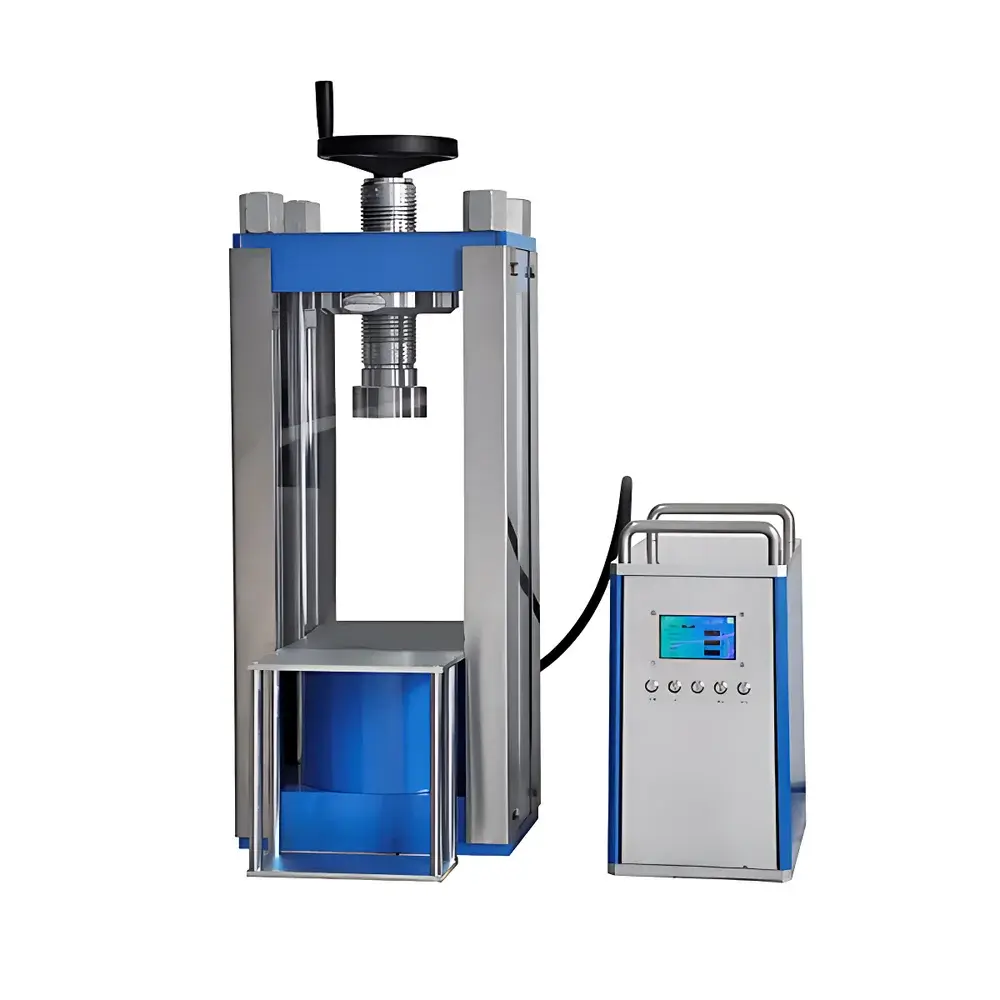
KJ GROUP YLJ-150TA Electric Hydraulic Tablet Press
| Brand | KJ GROUP |
|---|---|
| Origin | Liaoning, China |
| Manufacturer Type | Authorized Distributor |
| Country of Origin | China |
| Model | YLJ-150TA |
| Power Supply | 220 V AC, 50/60 Hz |
| Maximum Pressure Capacity | 0–150 metric tons (1,471 kN) |
| Piston Diameter | φ250 mm (chromium-plated cylinder) |
| Cylinder Stroke | 50 mm |
| Hold Time Range | 0–999 seconds or minutes (user-selectable) |
| Pressure Calculation | Automatic conversion from applied force to sample-specific pressure (MPa or psi) based on entered die cavity diameter |
| Display | 4.3-inch TFT LCD touchscreen interface |
| Safety Enclosure | Reinforced steel frame with transparent polycarbonate safety door |
| Overall Dimensions (W×D×H) | 860 × 600 × 1100 mm |
| Net Weight | 680 kg |
Overview
The KJ GROUP YLJ-150TA Electric Hydraulic Tablet Press is a precision-engineered laboratory-scale hydraulic press designed for reproducible, programmable consolidation of powdered materials into dense, geometrically defined pellets and discs. It operates on a closed-loop electro-hydraulic actuation principle, where motor-driven hydraulic pumps generate controlled pressure through a chromium-plated piston-cylinder assembly. Unlike manual or pneumatic presses, the YLJ-150TA integrates real-time force feedback, digital pressure calibration, and automated pressure profile sequencing—enabling consistent densification across diverse ceramic, metallurgical, pharmaceutical, and battery electrode formulations. Its architecture conforms to ISO 17025-aligned mechanical testing practices and supports GLP-compliant documentation when paired with external data logging systems.
Key Features
- Programmable three-stage compression cycle: ramp-up (programmed pressure gradient), dwell (precise hold time from 0–999 s/min), and controlled depressurization (timed release)
- Automatic pressure-to-stress conversion: users input die cavity diameter; the system calculates and displays compressive stress (MPa or psi) in real time
- 4.3-inch high-contrast TFT LCD touchscreen interface with intuitive menu navigation and parameter recall functionality
- Integrated safety enclosure featuring structural steel framing and impact-resistant polycarbonate viewing door—meets EN 60204-1 electrical safety standards for industrial machinery
- Chromium-plated φ250 mm hydraulic cylinder ensures long-term dimensional stability, minimal friction hysteresis, and resistance to oxidation under repeated load cycling
- 50 mm maximum piston stroke accommodates standard die sets (e.g., 13 mm, 25 mm, and 32 mm diameter punches) and custom tooling up to 45 mm height
Sample Compatibility & Compliance
The YLJ-150TA is compatible with a broad spectrum of powder-based specimens—including oxide ceramics (Al₂O₃, ZrO₂), metal alloys (Ni, Cu, Fe powders), lithium-ion cathode/anode composites (NMC, LFP, graphite), and pharmaceutical excipients (microcrystalline cellulose, lactose). It supports standardized test methods including ASTM C773 (cold compaction of ceramic powders), ISO 3252 (metal powder compression testing), and USP <1062> (tablet hardness qualification). While the unit itself is not FDA 21 CFR Part 11 certified out-of-the-box, its digital control log (timestamped pressure/time profiles) can be exported via USB for audit-ready archiving in validated QA/QC environments.
Software & Data Management
The onboard firmware stores up to 100 user-defined compression protocols, each containing target pressure, ramp rate (%/s), dwell duration, and decompression timing. All operational events—including start/stop timestamps, peak force, actual dwell deviation (±0.5 s), and system fault codes—are recorded in non-volatile memory. Data export is supported via USB 2.0 port in CSV format for post-processing in MATLAB, Excel, or LIMS platforms. Optional RS-485 communication enables integration with centralized lab automation systems for traceable batch processing in GMP-regulated settings.
Applications
- Preparation of sintering-ready green bodies for XRD, SEM, and density analysis
- Electrode pellet fabrication for coin-cell and Swagelok-type battery testing
- Reference standard compaction for hardness calibration (e.g., against NIST-traceable ceramic reference materials)
- Quality control of powder flowability and compressibility (via Heckel analysis)
- Development of cold-isostatic pressing (CIP) preforms prior to encapsulation and high-pressure transfer
- Teaching laboratories for materials science courses covering powder metallurgy and solid-state processing fundamentals
FAQ
What is the maximum theoretical pressure (MPa) achievable with a 13 mm diameter die?
Based on F = P × A, at 150 metric tons (1,471 kN) and A = π × (6.5 mm)² ≈ 132.7 mm², the theoretical maximum pressure is ~11,080 MPa—though practical limits are governed by die material strength (typically ≤ 2,500 MPa for tungsten carbide tooling).
Does the system support external pressure transducer calibration?
Yes—the firmware allows zero-point and span adjustment using NIST-traceable hydraulic pressure calibrators (e.g., Fluke 7050 series) via service mode access.
Can the press operate continuously for extended production runs?
It is rated for intermittent laboratory use (≤ 6 cycles/hour with ≥ 2 min cooling interval between cycles); continuous operation requires optional oil-cooling module (KJ-COOL-150, sold separately).
Is tooling interchangeability standardized?
The press accepts ISO 3327-compliant die sets; KJ GROUP offers a full catalog of hardened steel and WC-Co tooling with metric thread compatibility (M24×1.5 and M33×1.5).
What maintenance intervals are recommended?
Hydraulic oil replacement every 1,000 operating hours or biannually (whichever occurs first); piston seal inspection every 500 cycles; annual verification of pressure sensor linearity per ISO 376 Annex B.



