
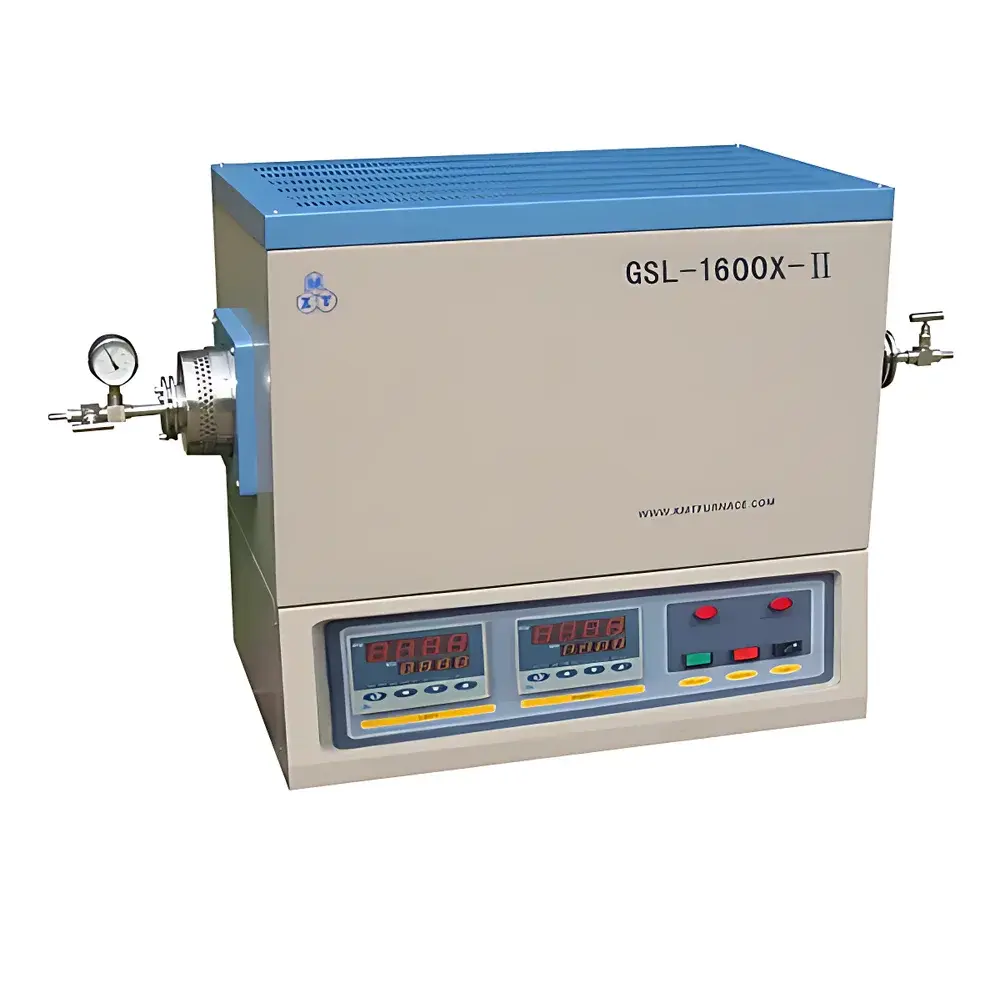
KJ GROUP GSL-1600X-II Dual-Zone High-Temperature Vacuum Tube Furnace
| Brand | KJ GROUP |
|---|---|
| Origin | Liaoning, China |
| Manufacturer Type | Authorized Distributor |
| Country of Origin | China |
| Model | GSL-1600X-II |
| Price | Upon Request |
| Power Supply | AC 220 V, 50/60 Hz, 9 kW |
| Tube Dimensions | Ø60 mm or Ø80 mm × 1000 mm (L) |
| Heating Elements | SiC rods (Zone I, up to 1400 °C), MoSi₂ rods (Zone II, up to 1600 °C) |
| Heating Zone Length | 300 mm per zone |
| Uniform Temperature Zone | 100 mm per zone |
| Operating Temperature Range | 800–1400 °C (Zone I), 800–1600 °C (Zone II) |
| Max. Ramp Rate | 10 °C/min |
| Temperature Control Accuracy | ±1 °C |
| Thermocouple Type | B-type |
| Enclosure Dimensions | 780 × 450 × 720 mm (W×D×H) |
| Net Weight | 150 kg |
| Cooling | Forced-air dual-shell system |
| Insulation | High-purity alumina fiber furnace chamber with imported Al₂O₃ reflective coating |
| Certification | CE-compliant |
Overview
The KJ GROUP GSL-1600X-II is a precision-engineered dual-zone high-temperature vacuum tube furnace designed for controlled thermal processing under inert, reducing, or low-pressure atmospheres. It employs independent resistive heating zones—each equipped with high-stability silicon carbide (SiC) or molybdenum disilicide (MoSi₂) heating elements—to establish programmable axial temperature gradients across a ceramic tube. This architecture enables precise spatial control of thermal profiles, essential for chemical vapor deposition (CVD), physical vapor deposition (PVD), crystal growth, annealing of functional oxides, and synthesis of 1D/2D nanomaterials (e.g., carbon nanotubes, transition metal dichalcogenides). The furnace operates in vacuum (down to 10⁻³ Pa with optional high-vacuum pumping systems) or gas-flow environments (N₂, Ar, H₂, NH₃, etc.), supporting both batch and continuous-feed processes. Its robust double-layer stainless-steel housing incorporates forced-air cooling and high-emissivity alumina fiber insulation, ensuring surface temperatures remain below 60 °C during operation at maximum setpoints.
Key Features
- Dual independent heating zones (300 mm each), each with 30-segment programmable PID temperature control and B-type thermocouple feedback
- High-temperature capability: Zone I up to 1400 °C (SiC rods), Zone II up to 1600 °C (MoSi₂ rods), with ±1 °C thermal stability over 100 mm uniform zones
- Alumina ceramic tube options: Ø60 mm or Ø80 mm × 1000 mm L; compatible with standard flange interfaces (SS304, KF25, VCR, or custom double-ferrule configurations)
- CE-certified electrical architecture with overheat protection, thermocouple break detection, and grounded AC 220 V / 9 kW supply (50/60 Hz)
- Thermally optimized chamber: high-purity alumina fiber insulation + US-sourced Al₂O₃ reflective coating for enhanced radiative efficiency and extended service life
- Integrated air-cooling jacket and thermal shielding maintain external shell temperature <60 °C even at 1600 °C internal operation
Sample Compatibility & Compliance
The GSL-1600X-II accommodates a broad range of sample geometries—including powders, pellets, thin films on substrates, and crucible-loaded precursors—within its 1000 mm-long alumina tube. Its dual-zone gradient capability supports solid-state diffusion studies, zone refining, and controlled nucleation/growth kinetics in materials science research. The system complies with CE safety directives (2014/35/EU Low Voltage Directive and 2014/30/EU EMC Directive). When integrated with optional vacuum gauges, mass flow controllers, and data-logging software, it meets GLP documentation requirements for reproducible thermal process validation. While not inherently FDA 21 CFR Part 11 compliant, audit-trail-capable PC software (optional) enables electronic record generation suitable for regulated QC/QA workflows in academic, industrial R&D, and pre-production settings.
Software & Data Management
The standard 30-segment PID controller includes local setpoint programming, real-time temperature display, and alarm logging (over-temperature, thermocouple failure). Optional PC-based control software provides remote monitoring, automated ramp-soak-hold sequences, time-stamped CSV export, and multi-channel thermal profiling. All digital interfaces adhere to RS485/Modbus RTU protocols for integration into centralized lab automation platforms. Data integrity safeguards include write-protected configuration files, user-access levels, and timestamped event logs—facilitating traceability in ISO/IEC 17025-accredited laboratories.
Applications
- CVD synthesis of graphene, h-BN, MoS₂, and other 2D layered materials via precursor decomposition under controlled thermal gradients
- Thermal annealing of perovskite thin films for photovoltaic device optimization
- Carbothermal reduction of metal oxides to produce ultrafine ceramic powders
- Controlled oxidation/nitridation of SiC, TiC, or ZrC ceramics
- Solid-state reaction studies requiring precise two-point thermal boundary conditions
- Heat treatment of superalloys and refractory metals under vacuum or forming gas
FAQ
What vacuum level can the GSL-1600X-II achieve with standard configuration?
The base system includes a mechanical vacuum port but no pump; with an optional dual-stage rotary vane pump, typical base pressure is 1–5 × 10⁻² Pa. Integration with a turbomolecular pump (optional) enables operation down to 10⁻⁵ Pa.
Can the furnace operate continuously at 1600 °C?
Yes—MoSi₂ heating elements and alumina fiber insulation are rated for continuous operation at 1600 °C. Recommended maximum duty cycle is 8 hours per session to preserve element longevity.
Is the tube orientation horizontal only?
Yes—the design supports horizontal tube placement exclusively, optimized for gas-phase transport and uniform radial heating.
Are custom tube diameters or lengths available?
Standard tubes are Ø60 mm or Ø80 mm × 1000 mm. Custom alumina or quartz tubes (up to Ø100 mm × 1200 mm) may be supplied upon request with lead-time adjustment.
Does the system support inert gas purging without vacuum?
Yes—gas inlet/outlet ports accept standard 6 mm OD tubing; flow rates up to 500 sccm are compatible with optional mass flow controllers and back-pressure regulators.



