
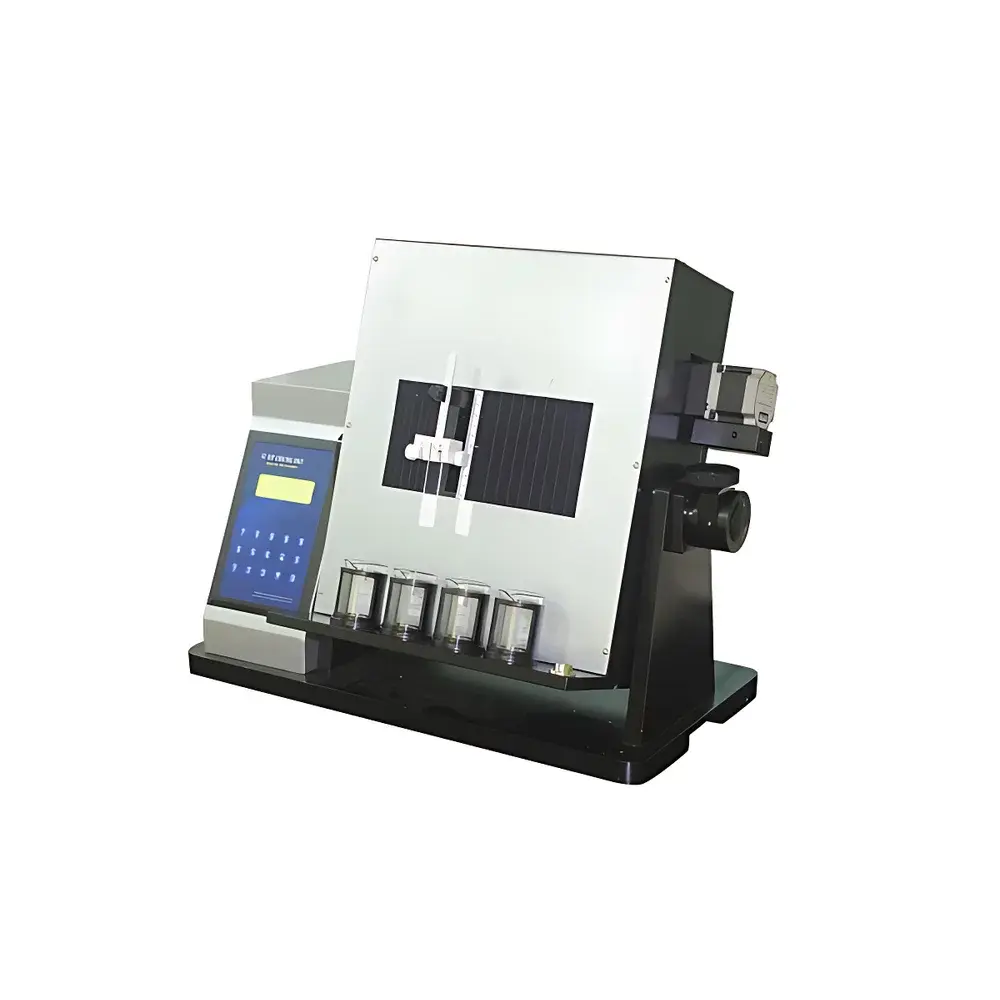
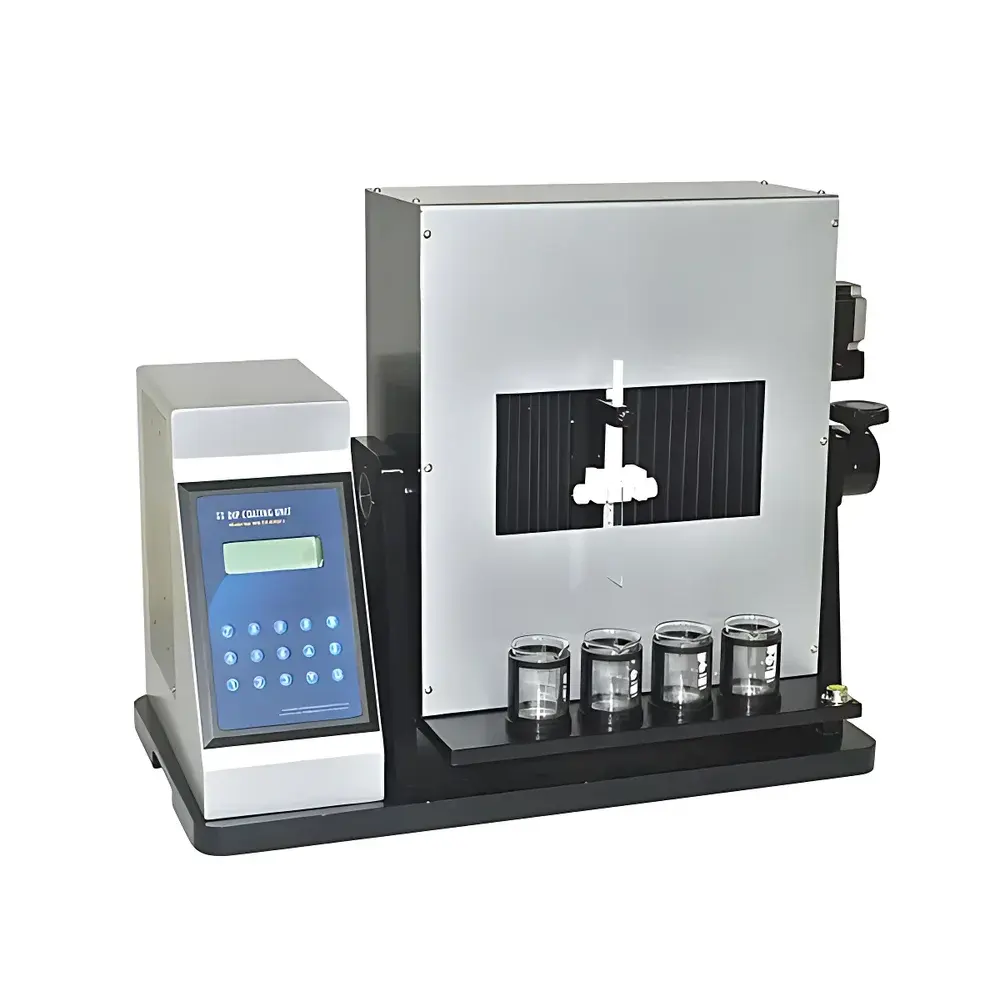
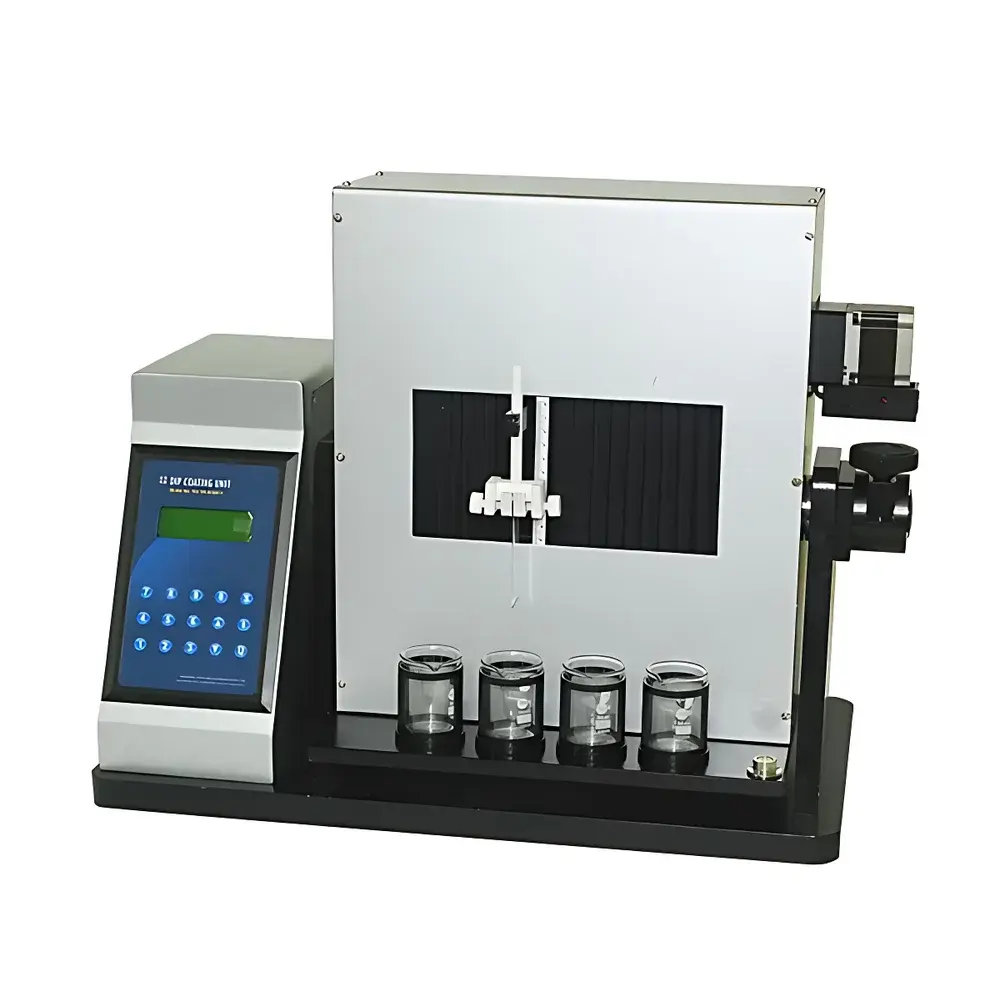
KJ GROUP PTL-AADC 4-Station Tilted Dip-Coating System
| Brand | KJ GROUP |
|---|---|
| Origin | Liaoning, China |
| Manufacturer Type | Authorized Distributor |
| Country of Origin | China |
| Model | PTL-AADC |
| Quotation | Upon Request |
| Drive Motor | Servo motor |
| Drive Mechanism | Precision lead screw |
| Immersion Time | 0–99 s/min/hour (user-selectable) |
| Cycle Count | 1–999 |
| Input Power | 208–240 VAC, 50/60 Hz |
| Power Consumption | ≤800 W |
| Max. Withdrawal Stroke | 75 mm |
| Control Interface | LED touchscreen with 5 programmable coating profiles |
| Communication | RS232 port on control panel |
| Optional Software | Windows 8–compatible PC-based control software |
| Dimensions (W×D×H) | 570 × 300 × 475 mm |
| Net Weight | 23 kg |
| Standard Accessories | Sample holders (4), 150 mL glass beakers (4) |
| Certification | CE compliant |
| Warranty | 12 months parts & labor, lifetime technical support |
Overview
The KJ GROUP PTL-AADC 4-Station Tilted Dip-Coating System is an engineered solution for controlled, reproducible thin-film deposition via vertical dip-coating with adjustable substrate inclination. Unlike conventional vertical dip coaters, the PTL-AADC integrates a precision tilting mechanism that enables angular alignment of substrates between 0° and 45° relative to the liquid meniscus—critical for modulating capillary rise dynamics, gravitational drainage, and solvent evaporation kinetics during withdrawal. This geometric parameter directly influences film thickness uniformity, edge coverage, and interfacial stress distribution in sol-gel, polymer, nanoparticle, and perovskite precursor coatings. The system operates on the principle of controlled meniscus withdrawal: substrates are immersed into coating solutions housed in four independent 150 mL beakers, then withdrawn at user-defined velocities while maintaining a fixed tilt angle. Simultaneous dual-side coating—where asymmetric thickness profiles can be achieved across front and back surfaces—is enabled by the controlled asymmetry introduced through tilt geometry and differential drying kinetics.
Key Features
- Four independent coating stations with dedicated servo-driven lead-screw actuators, enabling parallel processing of up to four distinct coating formulations or substrate batches
- Adjustable substrate tilt angle (0–45°) with mechanical locking and angular calibration scale for repeatable process setup
- Full parametric control per station: immersion speed, dwell time (0–99 s/min/hour), withdrawal speed (0.1–100 mm/min, typical range), post-withdrawal drying delay, and cycle repetition count (1–999)
- LED touchscreen interface with non-volatile memory for storing and recalling up to five complete coating protocols—including tilt angle, timing sequences, and motion profiles
- RS232 serial interface standard; optional Windows 8–compatible software provides remote operation, real-time motion monitoring, data logging (timestamped parameters + status flags), and GLP-compliant audit trail export
- CE-certified electrical architecture with overcurrent protection, emergency stop circuitry, and EMI-filtered power input (208–240 VAC, 50/60 Hz)
Sample Compatibility & Compliance
The PTL-AADC accommodates rigid planar substrates up to 100 mm × 100 mm (e.g., silicon wafers, glass slides, ITO/PET films, ceramic plates) using standardized sample holders with adjustable clamping force. Substrate thickness range: 0.1–5 mm. Compatible with low-to-medium viscosity solutions (<500 mPa·s), including aqueous colloids, alcoholic sol-gels, polymer dispersions, and metal-organic precursors. All wetted components—including beakers and holder fixtures—are chemically inert borosilicate glass or anodized aluminum. The system meets CE safety requirements per EN 61000-6-2 (immunity) and EN 61000-6-4 (emissions). While not intrinsically certified to ISO 14644 (cleanroom) or ASTM D1308 (coating durability), its design supports integration into ISO Class 7–8 environments when used with laminar flow hoods. Process parameters align with common thin-film development workflows referenced in ISO 2137 (viscosity measurement), ASTM C1171 (sol-gel film characterization), and USP (pharmaceutical thin-film coating guidance).
Software & Data Management
The optional PC-based control software provides deterministic command sequencing, synchronized multi-channel parameter logging (time-stamped withdrawal speed, tilt angle, immersion duration, cycle index), and CSV export for statistical process analysis. Each protocol file includes metadata fields for operator ID, sample ID, solution batch number, and environmental notes—supporting traceability under GLP and internal QA frameworks. Audit logs record all parameter modifications, user logins, and system events with tamper-resistant timestamps. Software complies with basic FDA 21 CFR Part 11 principles (electronic signatures not included; requires third-party validation for regulated environments). No cloud connectivity or automatic updates—ensuring data sovereignty and network isolation for sensitive R&D applications.
Applications
- Sol-gel synthesis of TiO₂, SiO₂, and ZnO antireflective or photocatalytic coatings on optical substrates
- Deposition of perovskite precursor layers for photovoltaic device prototyping (e.g., MAPbI₃ on FTO/glass)
- Functionalization of biosensor surfaces with chitosan, collagen, or antibody-conjugated polymer films
- Preparation of calibrated reference films for ellipsometry, profilometry, and UV-Vis spectroscopy calibration
- Rapid screening of formulation viscosity–thickness relationships in QC labs supporting inkjet, spin-coating, and slot-die process development
FAQ
What is the maximum substrate size supported by the PTL-AADC?
Standard sample holders accommodate substrates up to 100 mm × 100 mm and 5 mm thick. Custom fixtures for larger or irregular geometries are available upon engineering review.
Can different tilt angles be set for each of the four stations?
No—the tilt mechanism is shared across all stations; the entire sample stage rotates as a single unit, ensuring identical angular orientation for all four substrates simultaneously.
Is the system compatible with corrosive solvents such as HF-containing etchants or chlorinated organics?
Borosilicate beakers resist mild acids and alcohols but are incompatible with concentrated HF, hot phosphoric acid, or strong oxidizers. For aggressive chemistries, quartz beaker kits and PTFE-coated fixtures are recommended as accessories.
Does the CE marking cover electromagnetic compatibility (EMC) and low voltage directive (LVD) compliance?
Yes—CE certification includes conformity with both EN 61000-6-2/6-4 (EMC) and EN 62368-1 (LVD) for laboratory equipment.
How is calibration verified for withdrawal speed and tilt angle?
Speed calibration is traceable to encoder pulse counts per mm; tilt angle is mechanically indexed with ±0.5° repeatability. Certificate of Conformance (CoC) is supplied with each unit; NIST-traceable calibration services are available separately.



