
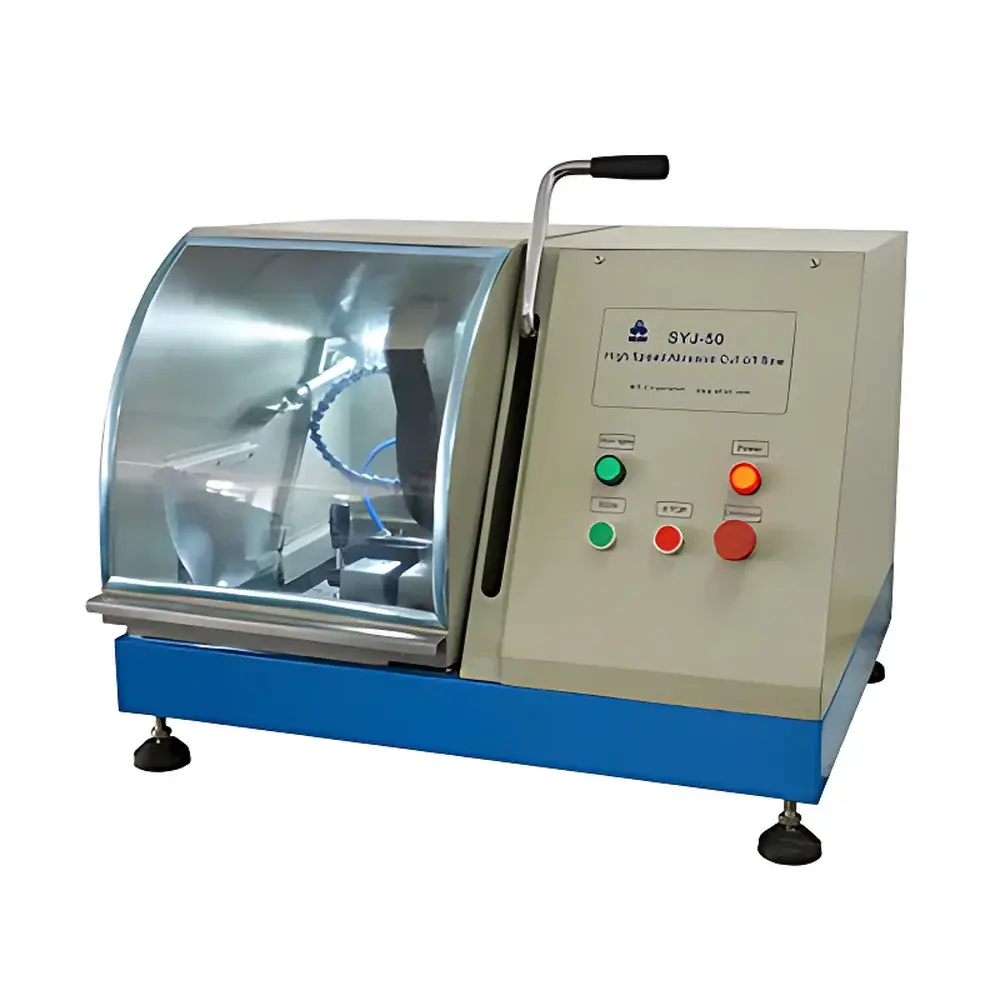
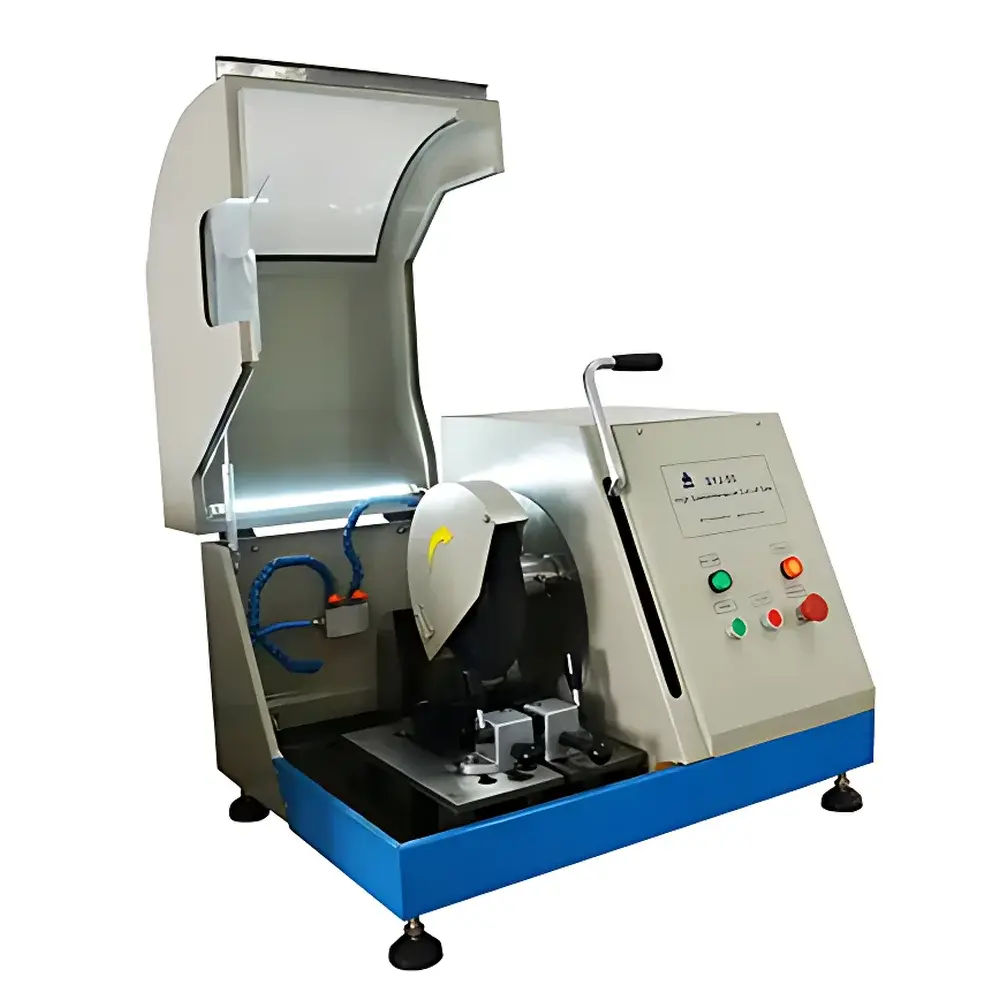
KJ GROUP SYJ-50 Manual Metallographic Specimen Cutting Machine
| Brand | KJ GROUP |
|---|---|
| Origin | Liaoning, China |
| Manufacturer Type | Authorized Distributor |
| Country of Origin | China |
| Model | SYJ-50 |
| Instrument Type | Abrasive Wheel Cutting Machine |
| Power Supply | 3-phase AC 380 V, 50 Hz |
| Total Power | 1.2 kW |
| Spindle Speed | 2800 rpm |
| Motor | 3-phase AC induction motor, 1.1 kW |
| Max. Specimen Size | Ø50 mm × 50 mm |
| Clamp Opening | ≥50 mm |
| Blade Dimensions | Ø250 mm × Ø25.4 mm or Ø32 mm × 2 mm |
| Machine Dimensions (L×W×H) | 750 × 620 × 650 mm (980 mm with cover open) |
| Weight | ≈85 kg |
| Operating Environment | 0–45 °C, 10–85% RH (non-condensing) |
| Cooling | Integrated dual-nozzle water cooling system |
| Safety Features | Polycarbonate observation window, full enclosure guard, internal LED illumination, stainless steel worktable |
Overview
The KJ GROUP SYJ-50 Manual Metallographic Specimen Cutting Machine is a CE-certified, benchtop abrasive wheel cutter engineered for precision sectioning of metallurgical specimens under controlled thermal conditions. It operates on the principle of high-speed abrasive cutting—utilizing rotating silicon carbide or alumina wheels to achieve clean, low-distortion cross-sections without significant heat-affected zones. Designed for laboratories requiring rapid, repeatable sample preparation prior to mounting, grinding, and polishing, the SYJ-50 serves as a foundational tool in metallographic workflow compliance with ASTM E3, ISO 643, and GB/T 13298 standards. Its compact footprint (0.47 m² floor space), integrated water-cooling architecture, and fully enclosed cutting chamber ensure operational safety and specimen integrity—particularly critical when preparing samples for microstructural analysis, hardness testing, or failure investigation.
Key Features
- Dual-Quick-Clamp Fixturing System: Patented side-actuated clamps accommodate irregular geometries—including crankshafts, valve bodies, and threaded components—with consistent holding force across variable cross-sections.
- Optimized Thermal Management: Multi-point water delivery nozzles direct coolant directly onto the blade–specimen interface, minimizing localized heating that could alter phase distribution, induce martensitic transformation in steels, or compromise grain boundary contrast.
- Enhanced Operator Visibility & Safety: A shatter-resistant polycarbonate observation window and built-in LED lighting enable real-time monitoring of cut progression while maintaining full OSHA-compliant physical separation between operator and rotating blade.
- Corrosion-Resistant Construction: 304 stainless steel worktable and sealed bearing housings prevent degradation from aqueous coolants or aggressive cutting fluids, extending service life in high-utilization QC environments.
- Ergonomic Manual Feed Mechanism: Lever-actuated vertical feed allows precise control over cutting rate—critical for brittle ceramics, hardened alloys, or layered composites where excessive feed force induces chipping or delamination.
Sample Compatibility & Compliance
The SYJ-50 accommodates metallic specimens up to Ø50 mm × 50 mm—including ferrous and non-ferrous alloys (e.g., AISI 4140, Al 6061, Ti-6Al-4V), sintered carbides, technical ceramics (Al₂O₃, Si₃N₄), and polymer-bonded composites. Blade interchangeability supports application-specific optimization: silicon carbide wheels for cast iron and aluminum; alumina for stainless steels and nickel-based superalloys; and edge-brazed diamond blades (optional) for refractory metals or graphite. The system complies with EN 61000-6-2 (EMC immunity) and EN 61000-6-4 (EMC emission), and its mechanical guarding meets ISO 13857 requirements for safe distances. While not classified as GLP/GMP-grade equipment per se, its reproducible manual feed protocol and documented maintenance schedule support audit-ready sample prep SOPs aligned with ISO/IEC 17025 clause 7.2.2.
Software & Data Management
As a manually operated cutting instrument, the SYJ-50 does not incorporate embedded firmware, touchscreen interfaces, or digital data logging. All operational parameters—including feed rate, blade selection, coolant flow duration, and specimen orientation—are recorded manually in laboratory notebooks or LIMS-integrated electronic batch records. This analog design ensures electromagnetic compatibility in sensitive metrology labs and eliminates validation overhead associated with FDA 21 CFR Part 11-compliant software systems. For users requiring traceability, optional accessories—including the YJXZ-12 recirculating pump and JXZ-25Y filtration water tank—can be integrated into closed-loop cooling circuits with external flow meters and temperature sensors compatible with third-party SCADA platforms.
Applications
- Routine sectioning of tensile bars, fatigue coupons, and weld cross-sections for ASTM E8/E8M mechanical testing.
- Preparation of representative subsamples from large castings or forgings for spectrochemical analysis (OES, XRF) or inclusion rating per ASTM E45.
- Cutting of heat-treated components to verify case depth (e.g., carburized or nitrided layers) prior to microhardness profiling.
- Sectioning of electronic packaging substrates (e.g., DBC ceramics, metal matrix composites) for SEM/EDS cross-sectional imaging.
- Emergency failure analysis where rapid access to fracture surfaces is required—without introducing artifacts from EDM or laser cutting.
FAQ
Is the SYJ-50 suitable for cutting hardened tool steels (e.g., H13, M2)?
Yes—when equipped with alumina or diamond-impregnated blades and operated with consistent coolant flow, it achieves clean cuts in materials up to 62 HRC without observable tempering or white-layer formation.
Can the machine be adapted for automated feed or programmable cycle control?
No—the SYJ-50 is strictly manual-feed. For automated sectioning, KJ GROUP offers the SYJ-200 series with CNC-controlled Z-axis and integrated PLC logic.
What maintenance intervals are recommended for long-term reliability?
Lubricate linear guide rails every 100 operating hours; inspect blade flanges and spindle bearings annually; replace coolant hoses and seals biannually if using corrosive inhibitors.
Does the unit meet UL or CSA safety certification for North American installation?
It carries CE marking per Machinery Directive 2006/42/EC. UL/CSA listing is not available; users must validate local electrical code compliance via qualified facility engineers.
Is distilled water required for the cooling system?
No—tap water is acceptable, but use of corrosion-inhibited glycol-free coolant (e.g., KJ-COOL-10) is strongly advised to protect stainless components and prevent scale buildup in nozzles.



