
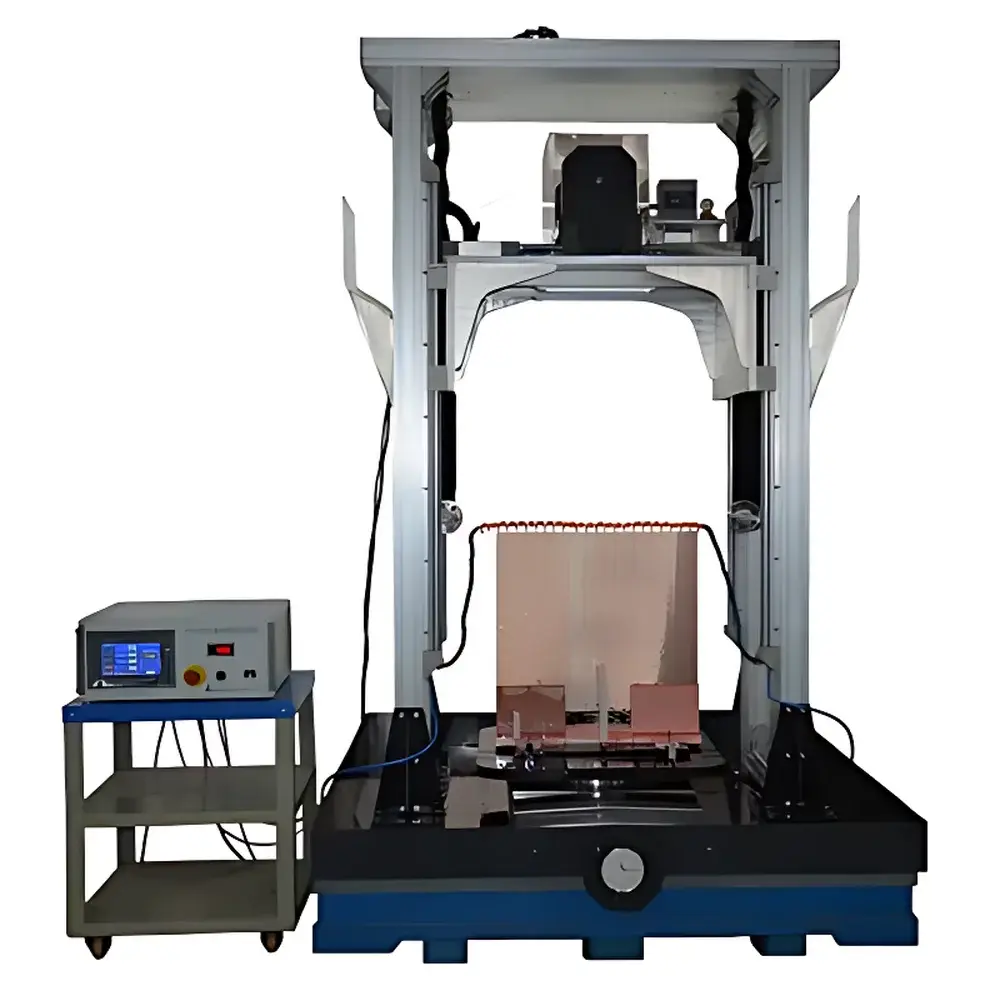
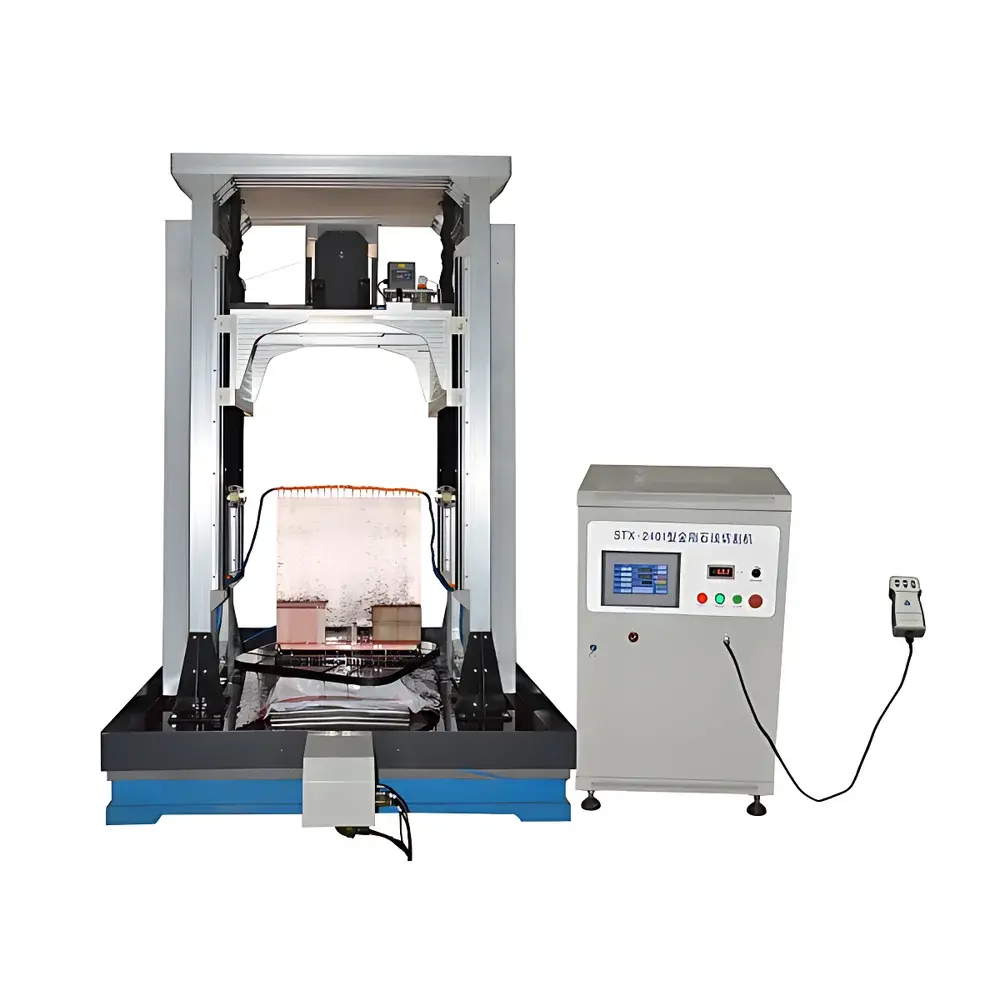
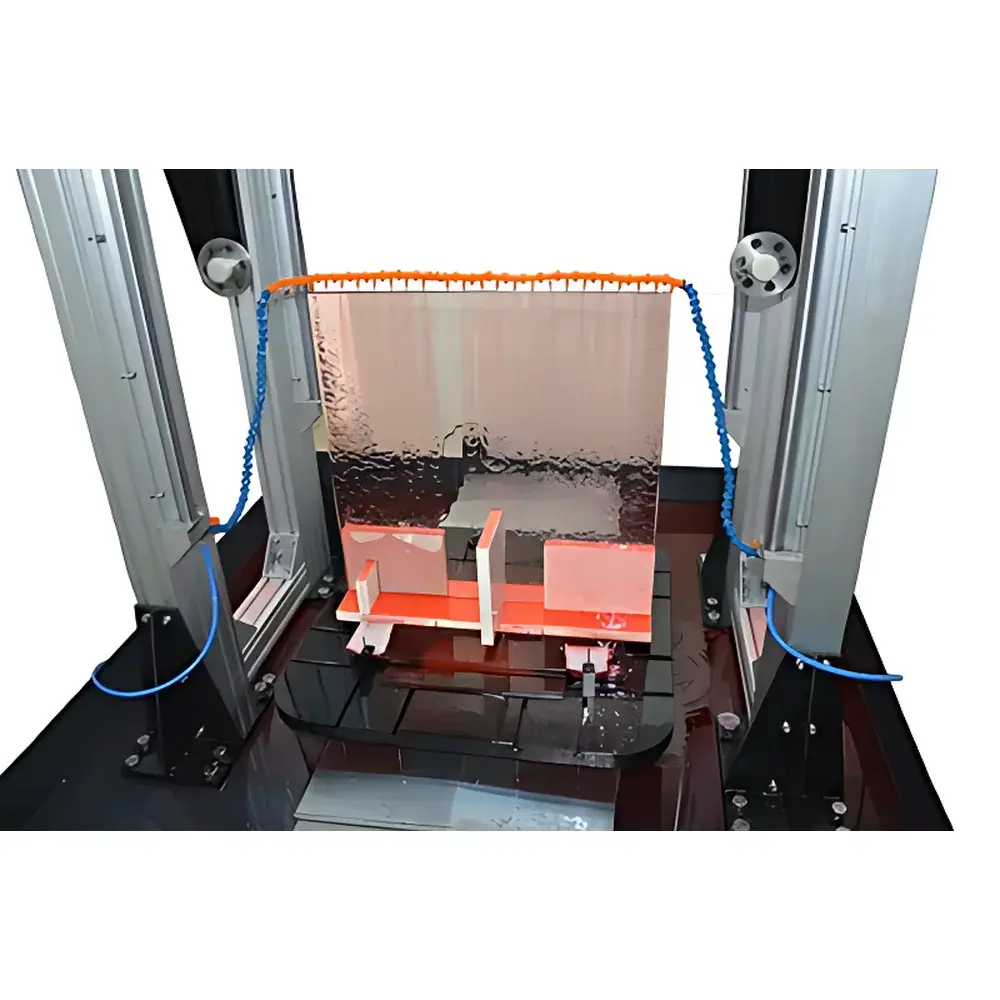
KJ GROUP STX-2401 Fully Automated Diamond Wire Saw
| Brand | KJ GROUP |
|---|---|
| Origin | Liaoning, China |
| Model | STX-2401 |
| Instrument Type | Precision Diamond Wire Cutting System |
| Max Sample Diameter | Ø600 mm (24") |
| Max Sample Height | 650 mm |
| Wire Length | ≤270 m |
| Wire Diameter | ≤0.45 mm |
| Wire Speed | 0–8 m/s (adjustable) |
| Z-Axis Stroke | ≤680 mm |
| Y-Axis Stroke | ≤650 mm |
| Y-Axis Positioning Accuracy | 0.01 mm |
| Worktable Size | 700 mm × 700 mm |
| Worktable Load Capacity | 600 kg |
| Worktable Rotation Range | 0–360° |
| Rotation Positioning Accuracy | ±0.1° |
| Cutting Speed | 0.05–30 mm/min |
| Tension Control | Pneumatic (0.1–0.4 MPa adjustable) |
| Guiding Pulley Center Distance Adjustment Range | 900–530 mm |
| Spool Torque Range | 0–2.4 N·m |
| Power Supply | AC 220 V, 50 Hz |
| Total Power Consumption | <4100 W |
| Main Drive Motor | 2 kW servo |
| Motion Axes Motors | Panasonic servo (Y/Z/R) |
| Control System | PLC + 10.1" HMI touchscreen |
| Safety Features | Wire-break auto-stop, emergency stop |
| Operating Environment | Altitude <1000 m, 10–40°C, 45–65% RH |
| Footprint | 2200 mm × 1700 mm × 2600 mm (w/d/h) |
| Net Weight | ~1600 kg |
Overview
The KJ GROUP STX-2401 Fully Automated Diamond Wire Saw is an industrial-grade precision cutting system engineered for high-accuracy sectioning of brittle, hard, and heterogeneous materials in research laboratories, materials science centers, and advanced manufacturing QA/QC facilities. It operates on the principle of abrasive wire cutting—utilizing a continuously reciprocating diamond-impregnated wire under controlled tension to achieve kerf widths as low as 0.15 mm, minimizing material loss while preserving structural integrity and surface finish. Unlike rotary or abrasive wheel saws, the STX-2401 eliminates mechanical vibration-induced microcracking and thermal damage, making it especially suitable for fragile crystals (e.g., Si, sapphire, Ge), optically transparent media (e.g., ZnS, CaF₂), and biologically preserved specimens where subsurface deformation must be avoided. Its large-format capability—supporting samples up to Ø600 mm × 650 mm—addresses a critical gap in the market for automated, metrology-grade slicing of oversized ingots, geological cores, and biomedical cadaveric blocks.
Key Features
- Automated continuous-feed cutting with programmable multi-pass sequences (1–99 cycles), enabling unattended operation for extended-duration slicing protocols.
- Pneumatically actuated tensioning system with fine-pressure regulation (0.1–0.4 MPa), dynamically optimized for wire diameters from 0.125 mm to 0.45 mm—preventing breakage during fine-wire operation while ensuring consistent cutting force.
- Three-axis precision motion control: Y-axis (horizontal feed, 1–500 mm/min), Z-axis (vertical descent, 1–150 mm/min), and R-axis (worktable rotation, 1–200°/min), all driven by Panasonic servo motors and calibrated to ±0.01 mm linear and ±0.1° angular resolution.
- Large-diameter worktable (700 mm × 700 mm) with 600 kg load capacity and motorized 360° indexing—enabling orientation-specific cuts (e.g., crystallographic plane alignment, anisotropic material sectioning) without manual re-fixturing.
- PLC-based control architecture with 10.1-inch resistive touchscreen HMI, supporting both manual jog mode and fully parameterized automatic routines—including variable-speed ramping, dwell timing, and return-stroke acceleration profiles.
- Integrated safety interlocks: real-time wire-break detection triggering immediate motor halt and pneumatic tension release; dual-channel emergency stop circuit compliant with IEC 60204-1.
Sample Compatibility & Compliance
The STX-2401 accommodates a broad spectrum of materials whose Mohs hardness is below that of diamond (≥10), including but not limited to single-crystal semiconductors (Si, GaAs, InP), optical ceramics (Al₂O₃, YAG), IR-transmissive substrates (ZnSe, Ge, Si), geological specimens (granite, basalt, meteorites), and hydrated biological tissues (plastinated human organs, osteointegrated dental implants, vascular stent-embedded arterial segments). All cutting parameters—including feed rate, wire speed, and tension—are independently configurable to meet ASTM E3–22 (Standard Guide for Preparation of Metallographic Specimens) and ISO 14577–1:2022 (Metallic materials — Instrumented indentation test) pre-sectioning requirements. The system supports GLP-compliant documentation when integrated with external LIMS via Modbus TCP or RS-485, and its non-contact cutting methodology avoids cross-contamination—critical for ISO/IEC 17025-accredited testing labs handling certified reference materials.
Software & Data Management
While the STX-2401 does not embed proprietary PC software, its PLC controller logs all operational events—including start/stop timestamps, axis position trajectories, tension pressure readings, and fault codes—in non-volatile memory with UTC-synchronized timestamps. These logs are exportable via USB flash drive in CSV format for traceability audits. Optional integration with third-party SCADA platforms (e.g., Ignition, Siemens WinCC) is supported through standard OPC UA or Modbus RTU protocols. For regulated environments, users may deploy validated electronic lab notebook (ELN) systems to capture metadata such as operator ID, sample ID, cutting protocol version, and environmental monitoring data (temperature/humidity logged externally), satisfying FDA 21 CFR Part 11 requirements for audit trails and electronic signatures when paired with appropriate access controls.
Applications
- Materials Science: Orientation-controlled slicing of Czochralski-grown silicon ingots for photovoltaic wafering R&D; kerf-loss minimization studies on sapphire boules for LED substrate development.
- Geosciences: Preparation of petrographic thin sections (30 µm) from unconsolidated sediments and metamorphic rock cores, preserving delicate mineral assemblages without polishing artifacts.
- Medical Device Testing: Cross-sectional analysis of coated cardiovascular stents embedded in calcified arterial tissue, enabling SEM-EDS mapping of coating delamination and corrosion interfaces.
- Infrared Optics Manufacturing: Low-damage slicing of bulk ZnS and CdTe crystals for CO₂ laser window blanks, where subsurface damage layer depth must remain <5 µm per MIL-PRF-13830B.
- Thermoelectrics Research: Sectioning of Bi₂Te₃-based p/n-leg modules for interface characterization via XRD and Hall effect measurements—avoiding thermally induced carrier redistribution common in blade-sawn samples.
FAQ
What is the minimum kerf width achievable with the STX-2401?
Using a 0.125 mm diamond wire at optimal tension and feed rate, typical kerf widths range from 0.15 mm to 0.18 mm—subject to material hardness and cooling efficiency.
Can the STX-2401 perform angled or bevel cuts?
No—the machine performs orthogonal vertical slicing only; angular cuts require post-mounting sample tilting fixtures (custom-engineered upon request).
Is coolant circulation mandatory during operation?
Yes—continuous coolant flow (typically deionized water or specialized cutting oil) is required to dissipate frictional heat, suppress diamond grit wear, and evacuate swarf; the included recirculating chiller meets ISO 8502-3 particulate cleanliness standards.
Does the system comply with CE or UL safety directives?
The STX-2401 conforms to IEC 61000-6-2 (EMC immunity) and IEC 61000-6-4 (EMC emissions); CE marking requires end-user responsibility for site-specific risk assessment and local regulatory validation.
What maintenance intervals are recommended for pneumatic components?
Air filter regulators should be drained weekly; pneumatic actuators and solenoid valves require inspection every 500 operational hours per ISO 8573-1 Class 4 compressed air quality guidelines.



