
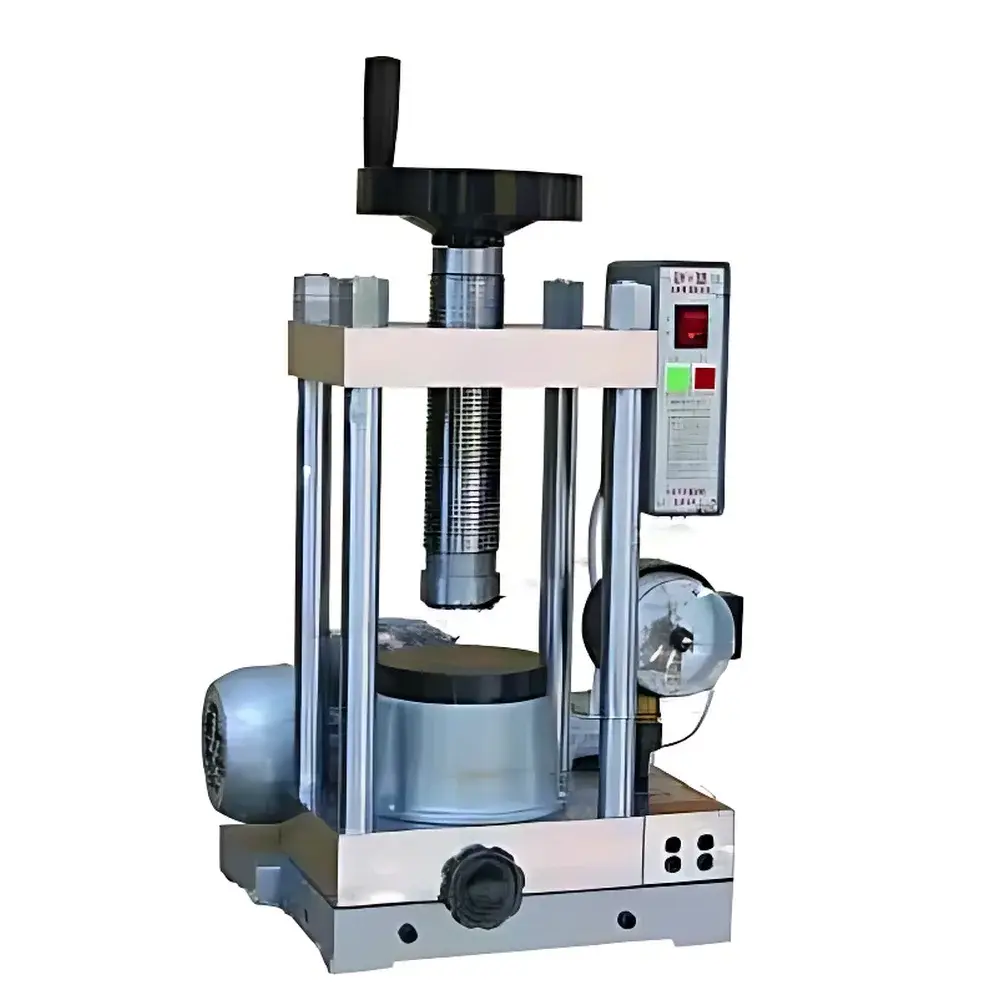
KJ GROUP YLJ-30TA Semi-Automatic Electric Pellet Press
| Brand | KJ GROUP |
|---|---|
| Origin | Liaoning, China |
| Manufacturer Type | Authorized Distributor |
| Country of Origin | China |
| Model | YLJ-30TA |
| Instrument Type | Semi-Automatic Pellet Press |
| Power Supply | AC 220 V, 50 Hz |
| Rated Power | 180 W |
| Piston Stroke | 0–20 mm |
| Working Chamber Dimensions | 165 mm × 110 mm × 200 mm |
| Platen Diameter | Ø125 mm |
| Maximum Pressure | 30 T (0–35 MPa) |
| Overall Dimensions | 560 mm × 360 mm × 340 mm |
| Net Weight | 68 kg |
| Hydraulic Fluid | ISO VG 32 mineral oil (equivalent to SAE 30 engine oil) |
Overview
The KJ GROUP YLJ-30TA Semi-Automatic Electric Pellet Press is an engineered laboratory press designed for reproducible, controlled consolidation of fine powders into mechanically stable pellets under uniaxial compression. It operates on a hydraulic–mechanical hybrid principle: electric motor-driven gear reduction actuates a high-ratio hydraulic pump, generating pressure in a closed-loop oil circuit that transmits force to a vertically oriented piston. This architecture ensures consistent force application without manual lever operation, while maintaining precise control over stroke displacement and dwell time—critical parameters for achieving uniform green density in ceramic, battery electrode, catalyst, and geochemical reference material preparation. The system is calibrated to deliver up to 30 metric tons (300 kN) of compressive load, corresponding to a maximum nominal pressure of 35 MPa when applied across the standard Ø125 mm platen. Its compact footprint and integrated safety interlocks make it suitable for benchtop deployment in QC labs, materials R&D facilities, and university teaching laboratories where space, repeatability, and operator safety are prioritized.
Key Features
- High-efficiency electromechanical drive: 180 W AC motor coupled with precision gear reduction enables rapid pressurization (typical ramp-up to full load in <12 s) and equally fast demolding—reducing cycle time without compromising force stability.
- Zero-pressure drift design: Sealed hydraulic circuit with dual-stage check valves and reinforced O-ring seals prevents pressure decay during dwell, ensuring constant load maintenance for durations up to 60 seconds—essential for sintering precursor densification studies.
- Low-noise operation (<65 dB(A) at 1 m): Optimized gear meshing, vibration-damped mounting, and laminar oil flow path minimize acoustic emissions, supporting compliance with ISO 14001 lab environmental requirements.
- Integrated mechanical safety: Hard-limit stop at 20 mm piston stroke prevents over-travel; pressure relief valve set at 35 MPa activates automatically if system exceeds rated capacity; grounding terminal meets IEC 61000-6-3 EMC immunity standards.
- Ergonomic interface: Front-mounted analog pressure gauge with 0–40 MPa range (Class 1.6 accuracy per EN 837-1), tactile emergency stop button, and clearly labeled oil fill/maintenance ports simplify daily operation and preventive servicing.
Sample Compatibility & Compliance
The YLJ-30TA accommodates powder samples requiring cold compaction prior to sintering, XRF/XRD analysis, or electrochemical testing—including oxide ceramics (Al2O3, ZrO2), Li-ion cathode/anode composites (NMC, LFP, graphite), metallurgical preforms (Fe, Cu, Ti alloys), cementitious binders, and geological powders (e.g., USGS rock standards). Its Ø125 mm platen supports standard die sets conforming to ASTM E1359 (for pressed pellet geometry) and ISO 17892-6 (for geotechnical specimen preparation). All structural components meet GB/T 150.1–2011 (China’s pressure vessel safety code), and electrical assembly complies with GB 4793.1–2019 (IEC 61010-1 equivalent) for laboratory equipment safety. While not certified for GMP production environments, its repeatable force delivery and traceable pressure readout support GLP-aligned documentation workflows.
Software & Data Management
The YLJ-30TA is a standalone electromechanical instrument without embedded digital control or data logging. However, its analog pressure gauge output (0–10 V optional signal via external transducer kit) is compatible with third-party DAQ systems (e.g., National Instruments USB-6009, Keysight 34972A) for time-stamped force–displacement profiling. Users may integrate it into LIMS or ELN platforms using RS-232 or Modbus RTU adapters (sold separately). For audit readiness, manual logbooks documenting batch ID, powder mass, die ID, applied pressure, dwell time, and operator signature satisfy basic 21 CFR Part 11 record-keeping requirements when supplemented with dated, signed hardcopy entries.
Applications
- Preparation of homogeneous XRF calibration standards from certified reference materials (CRMs), minimizing heterogeneity-induced matrix effects.
- Densification of solid-state battery electrode slurries (e.g., NCM811 + PVDF binder) into free-standing pellets for four-point probe conductivity measurement per ASTM F3097.
- Consolidation of ceramic green bodies for thermal expansion coefficient (CTE) determination via dilatometry (ASTM E228).
- Compression of soil/cement blends to specified dry densities for unconfined compressive strength (UCS) testing (ASTM D1633).
- Routine quality verification of metal injection molding (MIM) feedstock rheology via green strength evaluation post-compaction.
FAQ
What hydraulic fluid is recommended for long-term reliability?
ISO VG 32 mineral-based hydraulic oil (e.g., Shell Tellus S2 MX 32 or equivalent) is specified. Avoid synthetic or multi-grade engine oils, as viscosity shear-thinning may compromise pressure stability.
Can the press be used with custom dies larger than Ø125 mm?
No. The platen diameter defines the maximum supported die size. Larger dies risk uneven load distribution, platen deformation, and non-compliance with stated pressure accuracy.
Is periodic recalibration required for the pressure gauge?
Yes. Annual verification against a certified deadweight tester (e.g., Fluke PPCH series) is recommended per ISO/IEC 17025 guidelines to maintain traceability to NIST standards.
What maintenance intervals apply to the gearbox and hydraulic system?
Gearbox lubricant should be replaced every 1,000 operating hours or biannually; hydraulic oil and filter must be changed every 2,000 hours or annually—whichever occurs first—to prevent valve stiction and seal degradation.
Does the unit include overload protection beyond the 35 MPa relief valve?
Yes. A thermally protected motor starter interrupts power if winding temperature exceeds 110 °C, and a mechanical cam limiter physically arrests piston motion at 20 mm stroke—providing redundant safeguards against catastrophic failure.



